KVIC and the fund of funds: why most Korean VC money is partly public
한국벤처투자(KVIC)와 모태펀드
Korea Venture Investment Corporation manages the Korea Fund of Funds, a government-capitalised pool established in 2005 that invests in venture capital funds rather than companies directly. Its own page states the fund size, its 13 government partners and that it groups its sub-funds into several categories.

On this page
"KVIC" and "모태펀드" name one structure. Understanding it explains something odd: a private-sounding VC term sheet in Korea often carries public money.
KVIC is a fund of funds, not a VC firm
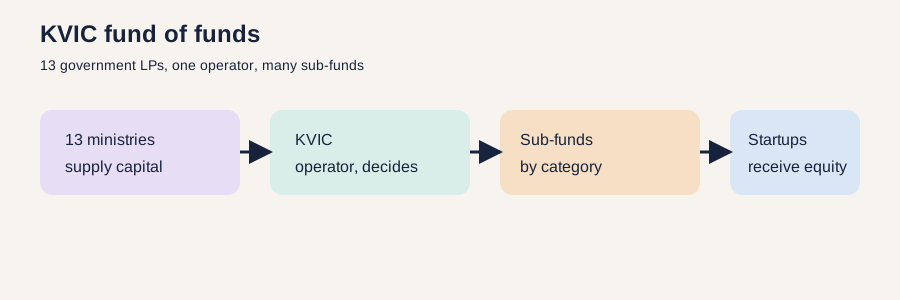
KVIC's page on the Korea Fund of Funds splits the role in two. The government supplies capital. KVIC, "the specialized operator," decides where it goes.
KVIC does not write cheques to startups directly.
The page states the Fund of Funds began on 15 July 2005. It cites South Korea's Special Measures Law for Venture Business Development. The stated aim was to move from supply-driven policy toward one that answers market demand.
The fund's scale, as KVIC states it
KVIC's page gives concrete figures for the Korea Fund of Funds:
| Figure | KVIC's published number |
|---|---|
| Established | 15 July 2005 |
| Fund size | 8.896 trillion won, as of 31 December 2023 |
| Operating period | 30 years, 2005 to 2035 |
| Government LP partners | 13 government bodies, including the SME, Science, Culture and Labor ministries |
The page calls this structure "market-demand-responsive capital recycling." Each of the 13 partner ministries funds it for its own policy reason. KVIC pools that capital into one operating structure.
What this means for a founder raising in Korea
Some Korean VC funds name KVIC, 모태펀드, or a specific ministry as an LP in their own materials. That fund is likely operating inside a categorised KVIC sub-fund. It is not a fully private vehicle.
That can mean reporting duties to the fund manager. It can also mean the fund's mandate only covers certain sectors or stages. Ask directly whether a fund carries KVIC capital, and which category, before assuming the terms are purely commercial.
The right question is not "does KVIC fund startups?" It is "which KVIC sub-fund capitalises the VC I am talking to, and does my company fit that category?"
See the ecosystem guide for where KVIC sits among Korea's other national funding bodies.
Frequently asked questions
- What does KVIC stand for?
- Korea Venture Investment Corporation, published in Korean as 한국벤처투자, the specialized operator of the Korea Fund of Funds.
- Does KVIC invest directly in startups?
- No. KVIC's own page describes it as investing government capital into venture capital funds, which then invest in companies.
- When was the Korea Fund of Funds established?
- 15 July 2005, under South Korea's Special Measures Law for Venture Business Development, per KVIC's own page.
- How large is the Korea Fund of Funds?
- KVIC's page states 8.896 trillion won as of 31 December 2023, operating over a 30-year period from 2005 to 2035.
- Why does a Korean VC fund's category matter to a founder?
- KVIC's page groups its sub-funds into several categories. A fund raised under one category may not invest outside it.
Sources
- KVIC - Korea Fund of Funds (about-business overview) — read 2026-09-24
- KVIC - Korea Fund of Funds page — read 2026-09-24
Everything above is the rule as published. See how it applies to your case.
Read next
- InstitutionsSeoul Bio Hub: the city's life-science and health startup centre
- InstitutionsUlsan Technopark: heavy-industry centres and one unexplained Singapore line
- InstitutionsJeju Technopark: the island's foundation for bio, energy and digital sectors
- InstitutionsBusan Technopark: its complexes, tenancy and support lines