Pangyo Startup Campus: 60 seats, and a "Global" track that still wants a Pangyo address
판교 스타트업캠퍼스: 60개 좌석과 판교 주소를 요구하는 '글로벌' 트랙
The Pangyo Startup Campus, run through Gyeonggi's startup platform, incubates 60 companies across three tracks including a Growth/Global category. Its separate Global Startup programme, aimed at overseas expansion, requires the applicant to already be based in Pangyo or Gyeonggi Province.
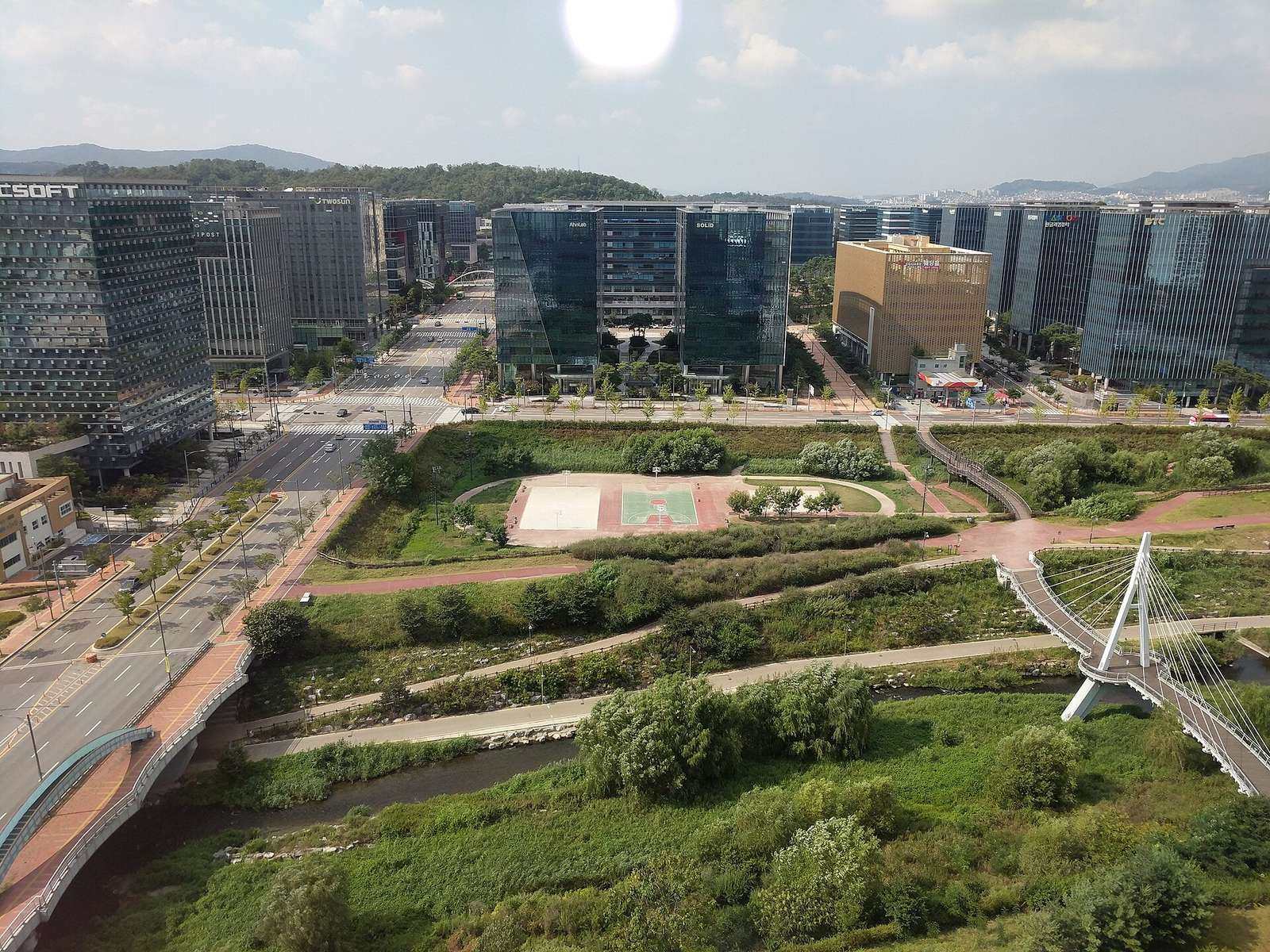
Pangyo Startup Campus runs incubation for 60 companies at a time, through the Gyeonggi Startup Platform. Its own page splits the seats into three named tracks, one labelled Growth/Global. That track is different from the separate Global Startup programme on the same site.
Sixty seats, three tracks
The campus's own incubation page states eligibility as a prospective entrepreneur or a startup under seven years old. The company must also register its head office at the campus. Total capacity is 60 companies, split evenly: Preliminary/Initial, Private investment-linked, and Growth/Global, 20 seats each.
The published sequence is recruitment announcement, application, evaluation and selection, move-in, then incubation operation. Beyond office space, the page lists business consultation spanning startup through operations and crisis management. It also lists networking with other resident companies, mentors and investors.
| Incubation track | Seats |
|---|---|
| Preliminary / Initial stage | 20 |
| Private investment-linked | 20 |
| Growth / Global | 20 |
| Total | 60 |
A separate Global Startup programme, domestic-first
The same site runs a distinct Global Startup programme aimed at strengthening overseas-expansion competitiveness. Its 2026 round opened for applications February 26 to March 20, 2026, for 20 companies. Those companies came from fourth-industrial-revolution fields: IT, BT, CT, AI and autonomous vehicles.
Eligibility for that round required the applicant to be based in Pangyo Techno Valley. It could also be headquartered in Gyeonggi, with a research or overseas-focused division inside the valley. The page does not extend eligibility to a company without a Pangyo or Gyeonggi presence.
The 2026 round ran contracts through November 30, 2026, with applications submitted online through the Gyeonggi Business Secretariat. Neither programme page states a separate rule for foreign ownership. That is true once a company already has the required local base.
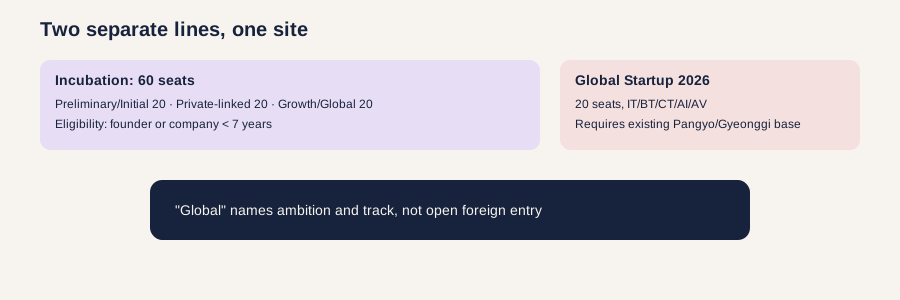
A foreign founder should treat "Global" here as a label for company stage and expansion ambition, confirmed against the current notice, not as a statement that the campus accepts applicants without a Korean base.
Use the ecosystem guide to place the campus inside Gyeonggi's wider startup-support network.
Frequently asked questions
- How many companies does Pangyo Startup Campus incubate?
- Its own incubation page sets total capacity at 60 companies, split evenly across three tracks of 20 seats each: Preliminary/Initial, Private investment-linked, and Growth/Global.
- What is the eligibility for incubation?
- A prospective entrepreneur or a startup under seven years old, on condition the company registers its head office at the campus, per the page fetched for this post.
- Is the Global Startup programme the same as the Growth/Global incubation track?
- No. Growth/Global is one of the three 20-seat incubation tracks. Global Startup is a separate overseas-expansion programme on the same site, with its own eligibility and dates.
- Can a foreign-founded company with no Korean base apply to Global Startup?
- The 2026 round's own eligibility line, as fetched for this post, required the applicant to already be based in Pangyo Techno Valley or headquartered in Gyeonggi Province with a division inside the valley.
- When did the 2026 Global Startup round run?
- Applications ran February 26 to March 20, 2026, for 20 companies in IT, BT, CT, AI and autonomous-vehicle fields, with contracts running through November 30, 2026.
Sources
- Pangyo Techno Valley - Startup Campus incubation programme (스타트업 캠퍼스 보육) — read 2026-09-24
- Pangyo Techno Valley - Global Startup programme (글로벌 스타트업) — read 2026-09-24
Everything above is the rule as published. See how it applies to your case.
Read next
- InstitutionsTIPS Town in Seoul, Pohang and Daejeon: what tenancy actually requires
- InstitutionsTIPS operators by type, region and sector: what the 145-operator list shows a foreign founder
- InstitutionsSeoul Global Center: business consultation for foreign residents
- InstitutionsGangwon Technopark: two specialist platforms behind a script-loaded homepage