D.CAMP and Front1: the bank-funded foundation's Seoul startup spaces
은행권청년창업재단의 디캄프와 프론트원
D.CAMP runs two Seoul office locations for startups: Seolleung, open since 2013, and Mapo, open since 2020 and marketed as FRONT1. Its own site publishes the entry route, the fee and the eligibility profile it targets. The front1.kr address itself now redirects to dcamp.kr rather than serving its own site.
On this page
A founder who has read about "FRONT1" and "D.CAMP" as if they were two separate stops should check the current site first. One now folds into the other.
Front1 no longer resolves on its own
Fetching front1.kr, and front1.kr/en, both return a 301 redirect straight to dcamp.kr. Neither serves independent content of its own any more.
D.CAMP's own space page still names Mapo, opened in 2020, as the larger of its two locations. That page is the current source for what "FRONT1" now means in practice: D.CAMP's Mapo campus.
Two locations, one published fee
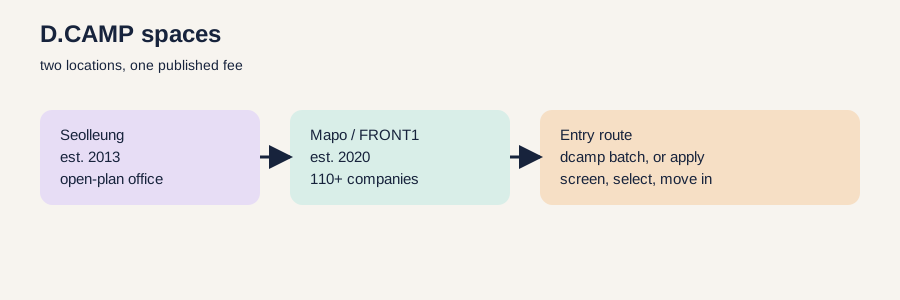
D.CAMP's site names two office locations. Seolleung, open since 2013, is the original hub, with open-plan desks, meeting rooms and a library. Mapo, open since 2020, is larger, with 110-plus companies of capacity and both open and private office types.
Both locations share the same published terms. D.CAMP's page prints an 18-month term with no renewal review, a fee of 50,000 won per seat per month plus VAT, and unlimited team size per desk.
| Location | Opened | Capacity note |
|---|---|---|
| Seolleung | 2013 | Open-plan office, meeting rooms, library |
| Mapo (FRONT1) | 2020 | 110-plus companies, open and private office types |
How a startup actually gets a desk
D.CAMP's page names two routes into a desk. The main one runs through the quarterly dcamp batch accelerator, which pre-screens the startups that then move into space.
An independent application is the second route. D.CAMP's page lists the sequence as application, screening, selection, move-in and graduation.
D.CAMP's own page names its target profile for space: IT and deep-tech startups, generally valued between 10 and 30 billion won, plus companies already in D.CAMP's own portfolio.
Who actually funds and runs it
D.CAMP's own pages carry the "은행권청년창업재단" name as their operator. Its homepage also lists a family-site section naming more than twenty Korean banks and financial institutions, including Hana Bank, KB Bank, Shinhan Bank, Woori Bank and Industrial Bank of Korea.
That list is the clearest signal of how broad the funding base is. D.CAMP's own pages, though, do not print the foundation's founding date or the exact capital committed, so this article does not state either.
Place D.CAMP inside Korea's wider support system with the ecosystem guide before deciding whether its space programme fits your stage.
Frequently asked questions
- What is D.CAMP?
- A startup growth partner run by the 은행권청년창업재단 (the bank-funded foundation named on D.CAMP's own pages), connecting investment, office space and network programmes for early-stage founders.
- What is FRONT1?
- The name D.CAMP now uses for its Mapo campus, opened in 2020. The separate front1.kr address redirects to dcamp.kr rather than hosting its own site.
- Who operates D.CAMP?
- D.CAMP's own pages carry the 은행권청년창업재단 name as operator, with a family-site list naming more than twenty Korean banks and financial institutions.
- How much does a desk cost?
- D.CAMP's own space page prints 50,000 won per seat per month, plus VAT, on an 18-month term with no renewal review.
- How does a startup get space?
- Through the quarterly dcamp batch accelerator, which pre-screens entrants, or through an independent application that D.CAMP's page describes as application, screening, selection, move-in and graduation.
Sources
- D.CAMP official homepage — read 2026-09-24
- D.CAMP - space programme (fees, terms, entry route) — read 2026-09-24
- front1.kr - redirects to dcamp.kr (301, observed directly) — read 2026-09-24
Everything above is the rule as published. See how it applies to your case.
Read next
- InstitutionsTIPS Town in Seoul, Pohang and Daejeon: what tenancy actually requires
- InstitutionsTIPS operators by type, region and sector: what the 145-operator list shows a foreign founder
- InstitutionsSeoul Global Center: business consultation for foreign residents
- InstitutionsPangyo Startup Campus: 60 seats, and a "Global" track that still wants a Pangyo address