E-7 visa from the employer's side: what a Korean startup must show to sponsor its first foreign hire
특정활동(E-7) 사증: 창업 초기 기업이 첫 외국인 전문인력을 초청하는 요건
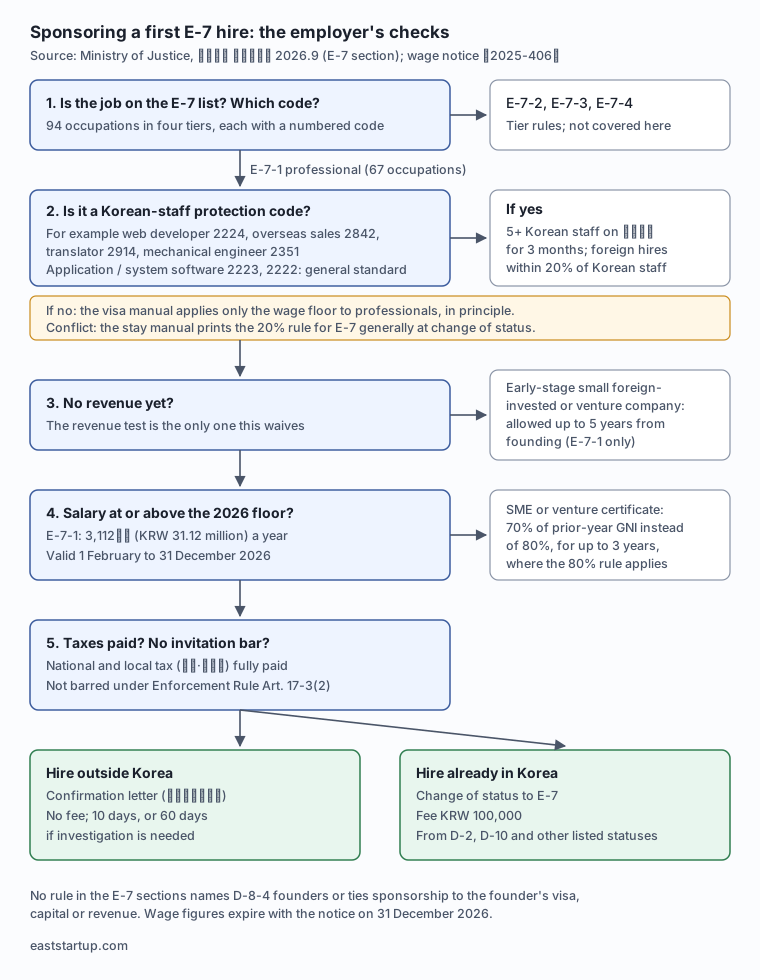
What a Korean startup must show to sponsor an E-7 hire, from the Ministry of Justice's 2026.9 manuals: the no-revenue provision for early-stage foreign-invested or venture companies, the job-code rule that decides whether 5 Korean staff and a 20% ratio apply, the KRW 31.12 million wage floor valid to 31 December 2026, and the filing steps and fees.

On this page
- E-7 is a list of occupations, each with a code
- What the Ministry checks about you, the employer
- The Korean-staff rule depends on the job code
- Which code carries the rule
- The two manuals disagree
- Two provisions written for startups
- No revenue for up to five years
- A lower wage floor for certified SMEs and ventures
- What your hire must bring
- The 2026 wage floor
- Filing the application
- The confirmation letter
- Change of status inside Korea
- After approval
- What no rule says about D-8-4 founders
Search for the E-7 visa and the results speak to the job-seeker: which degree, which salary, which documents. This post speaks to the other side of the contract, the founder who signs the invitation.
Everything here comes from the Ministry of Justice's own documents. The main one is the 사증발급 안내매뉴얼, 2026.9 edition, E-7 section. The others are the matching stay manual (외국인체류 안내매뉴얼), the Ministry's 2026 wage notice and the Enforcement Rule of the Immigration Act.
The manuals are extracted HWP files with no page numbers, so this post cites them by section. HiKorea's own notice warns that revised manuals can take time to upload. The change log records an E-7 revision on 7 August 2026, so check the current edition before you file.
If you already hold the D-8-4 startup visa, the OASIS matrix post covers your own status. This one covers the person you want to hire.
E-7 is a list of occupations, each with a code
The manual defines 특정활동 as work in occupations the Minister of Justice has designated. These are fields where Korea particularly needs foreign workers with professional knowledge, skills or techniques, to strengthen national competitiveness among other aims. The manual calls them 도입직종.
The manual's list header counts 94 of them, in four tiers. Some English guides print lower totals. The Ministry's own count is the one to use.
| Code | Tier, in the manual's words | Occupations |
|---|---|---|
| E-7-1 | 전문인력: managers and professionals | 67 |
| E-7-2 | 준전문인력: office and service workers | 10 |
| E-7-3 | 일반기능인력: craft and related workers | 14 |
| E-7-4 | 숙련기능인력: skilled workers under a points system | 3 |
Every occupation carries a number based on the Korean Standard Classification of Occupations (한국표준직업분류). The 2026.9 list is mid-renumbering and prints the old code beside the new one. Web developer is now 2224, formerly 2228, while data specialist is now 2231, formerly 2224.
The same document still uses some old codes in its per-occupation headings. Read any code with its former number beside it, the way the list prints it.
What the Ministry checks about you, the employer
The inviter must be the representative of a company or body in a permitted occupation. The manual then lists three things that disqualify the inviter.
- Falling under the invitation bars in Article 17-3(2), items 1 to 7, of the Enforcement Rule of the Immigration Act.
- Failing the employer requirements for the occupation, the cap on foreign hires per company, or the minimum wage requirement.
- Unpaid national or local tax.
Two of the Article 17-3 bars concern employers directly. One covers certain Labour Standards Act violations within the last three years. The other covers anyone who neglected the reporting duty under Article 19 or 19-4 of the Act twice or more in the month before applying.
Beyond the bars, the officer weighs the file as a whole. The manual names the questions: whether a bar applies, whether the company meets the requirements and operates normally, and whether it relies on low wages.
The employer's file for a confirmation letter, per the manual's common list:
- The application form, a passport copy and one standard photo.
- Company establishment papers, such as the business registration certificate or foreign-investment company registration.
- A copy of the employment contract.
- National and local tax payment certificates.
- Proof that the company needs a foreign hire, such as an invitation-reason letter and a plan for the role, or a ministry recommendation.
- A guarantee of identity (신원보증서).
- Proof of the hire's qualifications: degrees, experience certificates, a CV, valid licences.
The invitation-reason letter (초청사유서) must set out the need for a foreign hire, the plan for the role and the expected effect, in specific terms. The immigration office may add or drop documents to test whether the invitation is genuine.
The guarantee of identity applies to listed occupations, such as mechanical engineers, drafters and designers. None of the software developer codes appears on that list.
The Korean-staff rule depends on the job code
The visa manual protects Korean jobs through a set of tests: employer requirements, a cap on foreign hires per company, and a minimum wage.
For professionals, the manual's principle is that only the wage floor applies. Its reasoning is that professionals are hard to replace with Korean workers and add to national wealth and job creation.
The exceptions carry names. The manual applies the Korean-staff tests to professional occupations where it sees a risk of excessive invitations: mechanical engineers, drafters, travel product developers, overseas sales staff and translators or interpreters, among others.
Where the tests apply, the manual restricts in principle any company with fewer than 5 Korean employees that sells mainly in the domestic market. A Korean employee counts only after 3 months on the employment insurance (고용보험) roster at minimum wage or above.
The manual draws the consequence itself. You must submit 3 months of roster records, so you can in principle apply only 3 months after opening. For a new company, it counts the 3 months from the business registration date.
Foreign hires must then stay within 20% of your Korean employees. E-7-1 to E-7-3 holders count as foreign staff for the ratio. Residents on F-2, F-4, F-5 or F-6, among other statuses, do not.
The manual gives a rounding rule for the 20% figure but no worked example. Ask the immigration office how it applies to your headcount rather than doing the sum yourself.
The manual refuses, in principle, new and replacement invitations, changes of status and workplace changes for a company already over 20%.
Which code carries the rule
The manual's per-occupation section is where this becomes an employer's decision. "Software developer" is not one bucket.
| Occupation (code) | What the manual prints |
|---|---|
| Web developer (2224, formerly 2228) | General standard, but the 20% Korean-employment rule applies |
| Application software developer (2223) | General standard |
| System software developer (2222) | General standard |
| Computer systems designer and analyst (2221) | General standard |
| Data specialist (2231) | General standard |
| Information security specialist (2233) | General standard |
| Overseas sales (2842) | Subject to the Korean-staff protection test |
| Translator or interpreter (2914) | Korean-staff protection test applied by analogy (준용) |
| Designer (295) | At most 1 foreign hire at 5-49 insured Korean staff, 2 at 50-99, 3 at 100 or more |
For the five codes marked general standard, the manual prints no 20% line.
The two manuals disagree
The visa manual says the Korean-staff tests do not apply to professionals in principle, apart from the named exceptions. The stay manual, in its general standard for a change of status, prints the 20% rule and the 5-employee restriction for E-7 hires without that split.
The stay manual also reprints the visa manual's professional exemption in its own reference section, so it contradicts itself.
It also carries one line the visa manual's matching section lacks. With a recommendation from a body such as KOTRA or 한국무역협회, the office may allow advanced-industry firms foreign hires up to 50% of Korean staff.
We print both because neither document settles it. Even on a general-standard code, expect the ratio question at a change-of-status filing, and have your employment insurance roster ready.
Two provisions written for startups
No revenue for up to five years
The visa manual's screening standard carries one line written for young companies. Quoted in full:
(창업 초기 소규모 외국인투자기업 또는 벤처기업) 제조 ․ 무역 ․ 컨설팅 ․ R&D 등 소규모 업체가 전문인력을 고용하고자 할 경우 창업일로부터 최대 5년간은 매출실적이 없어도 허용(67개 전문인력 직종만 해당)
In English: an early-stage small foreign-invested company or venture company, in fields such as manufacturing, trade, consulting or R&D, may hire professionals with no sales record for up to 5 years from founding. It covers the 67 professional (E-7-1) occupations only.
Read the scope narrowly. The line waives the revenue record. It says nothing about the Korean-staff tests, the wage floor or tax clearance.
It also does not define an early-stage foreign-invested or venture company. Whether a D-8-4 founder's corporation qualifies is a question the E-7 section does not answer.
A lower wage floor for certified SMEs and ventures
The second provision concerns pay. For occupations where the wage requirement is 80% of the prior year's per-capita GNI, the manual allows 70% instead, for up to 3 years.
Three kinds of company qualify: an SME holding a 중소기업(소상공인)확인서, a venture holding a 벤처기업 확인서, and a certified mid-sized company outside the capital region. The hire must have no E-7 work history at Korean companies, or 3 years or less of it.
After 3 years the 80% standard returns. Where the relief figure and the year's announced amount differ, the manual applies whichever favours the applicant.
The manual gives no won value for 70% or 80% of GNI. It takes GNI from the figure the Bank of Korea publishes each year. It does not say that the 2026 floor below equals 80%.
What your hire must bring
The general rule asks for one of three things, each in a field related to the occupation: a master's degree or higher, a bachelor's degree plus 1 year of experience, or 5 years of experience.
Experience counts only after the degree or licence. The exception is high-tech fields such as IT, bio and nano, where internships before graduation count as experience.
Several routes relax that rule where the need to hire is recognised:
- Graduates of a Korean university with a bachelor's or higher: any major, and no 1-year experience requirement.
- Bachelor's graduates of a university in the 타임誌 top 200 or the QS top 500: the 1-year experience requirement can go.
- One year or more in a professional role at a world top-500 company: the education and experience requirements can go.
- Annual pay of 3 times the prior year's per-capita GNI or more: education and experience both waivable in any occupation, with no ministry recommendation needed.
- D-10-3 high-tech interns with a year or more of internship, hired in the same field at 1 times GNI or more: education and experience waived at change of status.
The 2026 wage floor
The Ministry sets the floors by public notice. Notice 제2025-406호, dated 29 December 2025, applies from 1 February to 31 December 2026.
| Tier | 2026 annual floor |
|---|---|
| E-7-1 professionals | 3,112만원 (KRW 31.12 million) |
| E-7-2 semi-professionals | 2,589만원 (KRW 25.89 million) |
| E-7-3 general skilled | 2,589만원 (KRW 25.89 million) |
| E-7-4 skilled, points system | 2,600만원 (KRW 26 million) |
Occupations with their own wage standard follow that standard instead. The amount that counts is the one in force on the application date.
The employment contract must state total monthly pay or annual salary against working hours, with daily and monthly hours spelled out. Below the standard, the manual restricts issuance in principle.
The notice covers 2026 only. After 31 December 2026, check the Ministry's next wage notice before you rely on any figure in this table.
Filing the application
The Ministry expects the company to act first. It finds the foreign professional, checks their qualifications and hires them, then applies. The Ministry reviews the file for disqualifications and decides.
There are two routes. A hire outside Korea needs a confirmation of visa issuance, the 사증발급인정서, which the inviting company files. A hire already in Korea on an eligible status changes status to E-7 instead.
The confirmation letter
The visa manual sends the application to the immigration office covering the company's location. It allows online filing through the visa portal only where the company holds a ministry talent recommendation (우수인재 고용추천).
정부24 lists both online and in-person filing, links to visa.go.kr, and prints no such restriction. The two sources disagree, so ask the office which route your file can take.
정부24 lists no fee. The processing period is 10 days, or 60 days for a file that needs investigation. It counts periods of 6 days or more from the day of receipt, excluding Saturdays and public holidays.
The Enforcement Rule sets the base consular fee for a single-entry visa with a stay of 91 days or more at the equivalent of US$60. Consulates can vary it on reciprocity grounds.
Change of status inside Korea
Registered foreigners staying lawfully on D-1, D-2, D-4, D-5, D-6, D-7, D-8, D-9, D-10 or E-1 to E-6 can change to E-7, as can their F-3 spouses. The manual marks E-6 with a footnote. That list includes students on D-2 and job-seekers on D-10.
Short-term B and C statuses, D-3, E-8, E-9, E-10 and G-1 cannot switch to E-7.
| Fee under the Enforcement Rule | Amount |
|---|---|
| Change of status | KRW 100,000 |
| Change or addition of workplace | KRW 120,000 |
| Extension of stay | KRW 60,000 |
| Registration card, issue or reissue | KRW 35,000 |
The employer's side of a change-of-status file mirrors the confirmation letter. It needs the employment contract and company papers, such as the business registration certificate or corporate register. It also needs a ministry recommendation or proof of need, and national and local tax certificates.
For the software codes, the manual names who may issue an employment recommendation (고용추천서). It is the trade ministry through KOTRA, or the SME ministry through 중소벤처기업진흥공단, with the note 중소기업에 한함, SMEs only.
Those codes do not appear on the manual's list of occupations where a recommendation is mandatory.
After approval
The first grant of stay is capped at 3 years. Five years applies to a few listed cases, such as talent a ministry recommends.
The stay manual also provides a reporting route for a change of workplace: the holder reports within 15 days. The report route excludes anyone dismissed or who quit through their own fault without the original employer's transfer consent.
One shortcut does not work. The stay manual says a D-8 company that registers a non-investing foreigner as an officer is hiring that person domestically. The case falls under E-7, not D-8.
So a co-founder without an investment stake does not join on the company's D-8 by taking a director's title. They need a status of their own, and E-7 is the one the manual names.
What no rule says about D-8-4 founders
We searched the E-7 sections of both manuals for D-8-4, 기술창업, 창업 and 스타트업. No rule there names D-8-4 founders, and none ties sponsorship to the founder's visa, capital or revenue.
The startup-specific provisions are the two above: the revenue waiver and the SME and venture wage relief. A claim that D-8-4 companies face extra E-7 conditions does not come from these manuals.
Korean hires do matter to your own long-term status. The stay manual's permanent residence section lists D-8-4 holders who attracted investment of 3억원 or more and employ 2 or more Koreans. The routes to permanence post covers that path.
For your own status as a founder, the visa simulator scores the D-8-4 matrix.
Frequently asked questions
- Can my startup sponsor an E-7 hire if it has no revenue yet?
- Yes, within limits. The Ministry of Justice's 사증발급 안내매뉴얼 (2026.9 edition, E-7 section) allows early-stage small foreign-invested or venture companies to hire professionals with no sales record for up to 5 years from founding. It covers the 67 professional (E-7-1) occupations only, and it waives the revenue record, not the other requirements.
- Do I need five Korean employees to sponsor an E-7?
- It depends on the job code. The visa manual applies the 5-employee and 20% tests to Korean-staff-protection occupations such as web developer (2224), overseas sales and translators, and says professionals are otherwise exempt in principle. The stay manual prints the 20% rule generally at change of status, so the two manuals disagree.
- What is the minimum E-7 salary in 2026?
- For E-7-1 professionals, 3,112만원 (KRW 31.12 million) a year, under Ministry of Justice notice 제2025-406호, valid from 1 February to 31 December 2026. E-7-2 and E-7-3 are 2,589만원 and E-7-4 is 2,600만원. Occupations with their own standard follow it instead.
- Is there a lower salary floor for startups?
- Companies with a 중소기업(소상공인)확인서 or a 벤처기업 확인서, and certified mid-sized companies outside the capital region, can apply 70% instead of 80% of prior-year per-capita GNI for up to 3 years. The hire must have no more than 3 years of E-7 work in Korea. The manual prints no won value for either percentage.
- How long does the confirmation letter take, and what does it cost?
- 정부24 lists no fee and a processing period of 10 days, or 60 days for a file that needs investigation. The base consular fee for a single-entry visa with a stay of 91 days or more is the equivalent of US$60 under the Enforcement Rule of the Immigration Act.
- Can I make my co-founder a director of my D-8 company instead?
- Not as a way around E-7. The stay manual says a non-investing foreigner registered as an officer of a D-8 company counts as a domestic hire and falls under E-7, not D-8.
- Can my hire switch to E-7 from D-2 or D-10 without leaving Korea?
- Yes. Both appear on the stay manual's list of statuses that can change to E-7. The change of status fee is KRW 100,000.
Sources
- Ministry of Justice, 사증발급 안내매뉴얼 (체류자격별 대상 첨부서류 등), 2026.9 edition, 25. 특정활동(E-7) section, with the manual change log (수정 이력); HiKorea notice attachments — read 2026-09-18
- Ministry of Justice, 외국인체류 안내매뉴얼, 2026.9 edition, 특정활동(E-7), 기업투자(D-8) and 영주(F-5) sections; same HiKorea notice — read 2026-09-18
- 법무부 공고 제2025-406호, 2026년 특정활동(E-7) 체류자격 임금요건 기준 공고 (dated 2025-12-29, applies 2026-02-01 to 2026-12-31) — read 2026-09-18
- 출입국관리법 시행규칙 (in force 2026-09-15), Articles 17-3, 71 and 72: invitation bars and fees; law.go.kr — read 2026-09-18
- 정부24, 사증발급인정서발급신청: filing method, fee and processing period (content changed 2026-06-29) — read 2026-09-18
- Hero photograph: Incheon International Airport Terminal 1 by Arne Müseler, Wikimedia Commons, CC BY-SA 3.0 DE — read 2026-09-18
Everything above is the rule as published. See how it applies to your case.
Read next
- VisasOASIS-9, Support Start-Up Items Commercialization: the other 30 prerequisite points on the D-8-4 matrix
- VisasOASIS-6, Invention Start-Up Exhibition: the 30 prerequisite points on the D-8-4 matrix
- VisasOASIS-7, Graduation from Start-Up Incubation: 15 points and the six-month rule on the D-8-4 matrix
- VisasOASIS-8, Support for corporation establishment: the 15-point item on the D-8-4 matrix