LINC 3.0: the industry-academia programme funding 76 Korean campuses
LINC 3.0 사업과 대학 내 창업 지원
LINC 3.0 is the Ministry of Education's third-phase industry-academia cooperation programme, funding 76 universities across three categories. The Ministry's own release states the university count and the 2022 budget figure; it does not itemise a startup-centre budget line, and this article does not invent one.
On this page
A founder who hears "LINC 3.0" as a single startup programme is missing the structure. It funds universities, and each university then decides what it builds with that funding.
One national programme, three university categories
The Ministry of Education's own press release names LINC 3.0 as the successor to LINC and LINC+. It selected 76 universities for this phase.
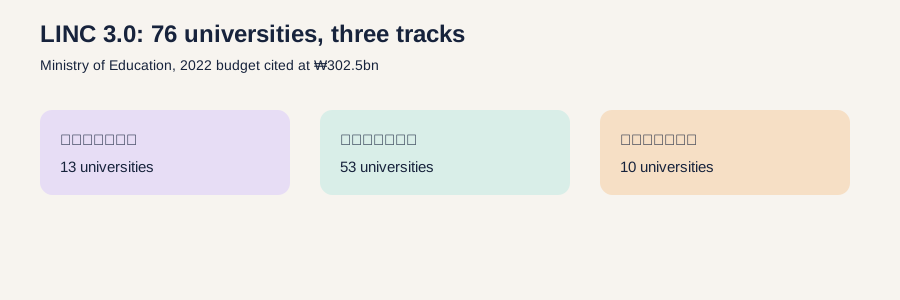
The release splits those 76 into three categories. It names 13 universities under a technology-innovation-leading track, 53 under a demand-customised-growth track, and 10 under a collaboration-foundation-building track.
| Category (Ministry's term) | Universities |
|---|---|
| 기술혁신선도형 | 13 |
| 수요맞춤성장형 | 53 |
| 협업기반구축형 | 10 |
What the Ministry's own numbers cover
The Ministry's release cites a 2022 budget of about 302.5 billion won across the 76 universities. It states support can run up to six years per university, split three years plus a further three.
The release states these figures at the national programme level. It does not break the budget down by category, by university, or by activity such as a startup centre.
What one university's own page says
A university-level LINC 3.0 page, fetched for this post at Hanyang University ERICA, states its own project goals: building what it calls an entrepreneurial university, and activating business support for industry. It does not list specific startup programmes on that page.
That gap matters. The specifics live at the individual university's own LINC 3.0 site, not on the Ministry's national page. That can mean a startup education centre, a startup club, seed funding or an incubation office.
The foreign-founder question neither page answers
Neither the Ministry's release nor the Hanyang ERICA page fetched for this post states whether a foreign-founded company, or a foreign student founder, can use a LINC 3.0-funded startup service. Confirm this directly with the specific university before relying on it.
See where a university's LINC 3.0 unit sits inside Korea's wider support system with the ecosystem guide.
Frequently asked questions
- What is LINC 3.0?
- The Ministry of Education's third-phase industry-academia cooperation programme, following LINC and LINC+, funding 76 selected universities.
- How many universities are in LINC 3.0?
- 76, per the Ministry's own release, split into three categories: 13 technology-innovation-leading, 53 demand-customised-growth, and 10 collaboration-foundation-building.
- How much funding does LINC 3.0 provide?
- The Ministry cites about 302.5 billion won for the 2022 budget across all 76 universities, with support running up to six years per university.
- Does LINC 3.0 fund startup centres directly?
- The Ministry's release does not itemise a startup-centre budget line. What a university builds with its LINC 3.0 funding, including any startup support, is set at that university.
- Can a foreign-founded company use LINC 3.0 startup support?
- Neither the Ministry's release nor the university page checked for this post addresses foreign eligibility. Confirm directly with the specific university's LINC 3.0 office.
Sources
- Ministry of Education - LINC 3.0 selection press release — read 2026-09-24
- Hanyang University ERICA - LINC 3.0 project page — read 2026-09-24
Everything above is the rule as published. See how it applies to your case.
Read next
- InstitutionsTIPS Town in Seoul, Pohang and Daejeon: what tenancy actually requires
- InstitutionsTIPS operators by type, region and sector: what the 145-operator list shows a foreign founder
- InstitutionsSeoul Global Center: business consultation for foreign residents
- InstitutionsPangyo Startup Campus: 60 seats, and a "Global" track that still wants a Pangyo address