모두의 창업 is a competition, not an information portal — and round one takes 10,000
모두의 창업 reads like an information corner on the K-Startup landing page. It is a four-round national idea competition run by KISED that selects 10,000 entrants in round one and puts 10억원 or more behind the winner — and for a founder already registered four to seven years, it is close to the only national track still open.

On this page
The door label is not the programme
The page at k-startup.go.kr is not the portal. It is a hallway in front of three doors, and each door carries a one-line label.
The label on the 모두의 창업 door reads 더 나은 창업을 위한 정보를 만나보세요 — come find better information for startup work. Its tagline adds 누구에게나 있는 시작, 창업 스토리를 공유합니다. Read the label alone and you conclude the site is a magazine.
Open the site and you find a competition. Rounds, selection quotas, tracks, a deadline, a prize.
Name this failure mode, because it will recur on other Korean government properties. A landing page describes how a door feels to a browsing visitor. Only the programme's own pages describe the programme.
Skip the second page and you do not know what the programme is. We skipped it, and we published the label.
What the four rounds actually are
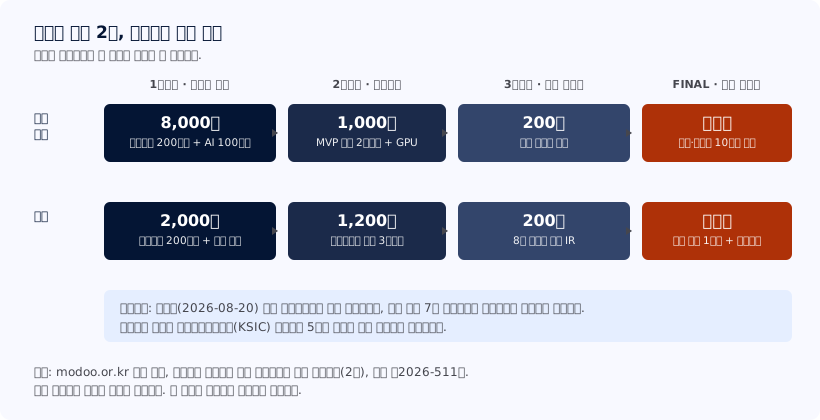
| Round | What happens | Who survives |
|---|---|---|
| 1 — 신청·심사 | Written application and screening | 8,000 general and tech, 2,000 local |
| 2 — 지역예선 | Regional preliminary | Narrowing toward the audition field |
| 3 — 지역 오디션 | Regional audition, in person | About 200 per track |
| FINAL — 전국 오디션 | Public national audition, open IR | One winner per track |
The operator posted the 2차 통합 모집공고, announcement 제2026-511호, on 2026-08-19. KISED's own site ran the recruitment popup from 2026-08-20 to 2026-09-17.
The screening institutions are not a black box either. The operator publishes the full list, and you choose which one screens you.
The eligibility clause is where the real news is
Two groups can enter, and the second one is the interesting one.
No business registration as of the announcement date. You enter as a 예비창업자, on the clause KISED's overview page also prints for 예비창업패키지. That programme's 2026 공고 used a fixed cutoff date instead, 22 January 2026.
Already registered. You must be within 7 years of the registration date, and the new venture must be 이종창업 — a different industry from the existing one. Whether it is different is decided at screening on the 5-digit subclass of the Korean Standard Industrial Classification, not on your description of it.
That second clause opens a window nothing else covers well. 초기창업패키지 stops at 3 years of 업력. A founder in year five with a genuinely new line of business has passed that gate.
Most national programmes then have nothing for them. This one does.
One detail trips people. The new business registration certificate falls due only on advancing — round three for the general and tech tracks, round two for the local track. You apply without it.
Where K-Startup and the 원스톱 센터 still fit
The three doors are real; only the description of the first one was wrong.
| Door | What it carries | When you use it |
|---|---|---|
| 모두의 창업 (modoo.or.kr) | A four-round national idea competition | Entering, this cycle |
| K-Startup 창업지원포털 | 창업지원사업 공고 — announcements — and applications | Applying to the national packages, tracking deadlines |
| 스타트업 원스톱 지원센터 | Expert consultation at one counter | Stuck, and needing a professional |
The landing names three consultation fields — 법률, 경영, 회계. Law, management, accounting. Its blurb promises an online version soon.
Frequently asked questions
- Is 모두의 창업 an information site?
- No. It is a four-round national idea competition. Round one selects 8,000 entrants in the general and tech tracks and 2,000 in the local track; round two is a regional preliminary, round three a regional audition, and the final is a public national audition. The door label on the K-Startup landing reads like an information corner, which is where that description comes from — but the operator's own pages describe a competition.
- Can I enter if my business is already registered?
- Conditionally. With no business registration as of the announcement date you enter as a 예비창업자, on the same opening clause KISED's overview page prints for 예비창업패키지 (whose 2026 공고 used a fixed cutoff date, 22 January 2026). With a registration you must be within 7 years of it and starting in a different industry — 이종창업 — judged at screening on the 5-digit KSIC subclass code.
- Why does that matter if I have been trading for five years?
- Because 초기창업패키지's clock stops at 3 years of 업력. Between years four and seven, a founder starting in a new industry has very few national tracks left, and this is one of them.
- When do I have to produce the new business registration?
- Only on advancing: at round three for the general and tech tracks, at round two for the local track. You do not need it to apply.
- What is actually at stake?
- Prize money and investment of 10억원 or more for the final winner in the general and tech tracks; up to 1억원 plus investment linkage in the local track.
- So what is K-Startup for?
- The K-Startup 창업지원포털 carries 창업지원사업 공고 — the announcements themselves — and the application loop for the national packages. It is the same operator, doing a different job. The 스타트업 원스톱 지원센터 is the third door on that landing, a single counter for consultation in 법률, 경영 and 회계.
- Can I enter more than one track?
- No. You choose one track, and you choose the mentoring institution that will screen you.
Sources
- 모두의 창업, programme introduction — tracks, eligibility, per-round selection numbers, support and the application procedure — read 2026-09-02
- 모두의 창업 notices — 「모두의 창업 프로젝트」 통합 모집공고(2차), announcement 제2026-511호, posted 2026-08-19 — read 2026-09-02
- 모두의 창업, participating institutions — CCEI centres, university startup offices, accelerators — read 2026-09-02
- K-Startup landing page — the three doors and their own labels — read 2026-09-01
- KISED main site — 모두의 창업 recruitment popup, posted as 2026-08-20 to 2026-09-17 — read 2026-09-01
- KISED, 예비창업패키지 programme page — eligibility and ceiling, for comparison — read 2026-09-01
- KISED, 초기창업패키지 programme page — the 3-year 업력 requirement, for comparison — read 2026-09-01
- Hero photograph: Busy people at a coffee shop (Unsplash) by Tim Gouw, Wikimedia Commons, CC0 — read 2026-09-01
- 2026년도 예비창업패키지 예비창업자 모집 수정 공고, 중소벤처기업부 공고 제2026-207호 (revised 2026-03-24), with its Q&A attachment (별첨 4) — eligibility cutoff, funding, schedule, foreigner identity check — read 2026-09-18
Everything above is the rule as published. See how it applies to your case.
Read next
- InstitutionsTIPS Town in Seoul, Pohang and Daejeon: what tenancy actually requires
- InstitutionsTIPS operators by type, region and sector: what the 145-operator list shows a foreign founder
- InstitutionsSeoul Global Center: business consultation for foreign residents
- InstitutionsPangyo Startup Campus: 60 seats, and a "Global" track that still wants a Pangyo address