OASIS-1 Basic Intellectual Property course: 10 elective points on the D-8-4 start-up visa matrix
OASIS-1 지식재산권 기초 과정 — D-8-4 매트릭스에서 10점
OASIS-1 is the entry-level intellectual property course on Korea's D-8-4 start-up visa points matrix: 10 elective points, an 80% attendance floor, and two different durations on the operator's own page — 2 weeks in the course listing, 2 days in its worked example. What it covers, and the one thing its points cannot do.

On this page
Korea lets foreigners found companies on a start-up visa. The application rides on a points matrix.
Most founders meet that matrix as a wall. 60 points, and no single item scores enough to clear it.
OASIS-1 is a course item on the elective side of the matrix. This post covers what the operator publishes about it — format, curriculum, and where the 10 points fit.
What OASIS-1 is, and who actually runs it
OASIS-1 is the Basic Intellectual Property Course. It is one module of the Overall Assistance for Startup Immigration System, the programme that scores the D-8-4 startup visa.
The Global Start-up Immigration Center operates the system. The Minister of Justice and the Minister of SMEs and Startups designated it. That makes this centre the operator — not a ministry.
The operator's job description for OASIS-1 is one sentence: a basic course, required to acquire or apply for intellectual property rights, and to stay in Korea. The "apply for" half matters. The course is the on-ramp for founders who hold no IP yet and need to file.
The format: the page gives two durations
The operator's course listing sizes OASIS-1 as a total of 12+@ hours, scheduled 2 to 8 hours a day across 2 weeks.
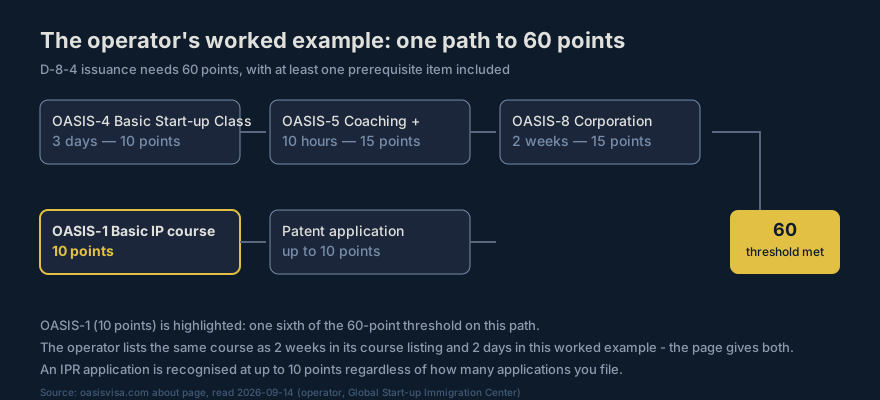
The same operator prices OASIS-1 as "2 days, 10 points" in its 60-point worked example. Two weeks, two days: the page names both, and states no reconciliation between them.
Two more numbers from the course listing:
- Completion requires a minimum attendance of 80%.
- The operator provides classes in a proper language for participants.
Attendance is the one enforcement lever on the page. The operator publishes no fees and no schedule for this course in this section.
The six published modules and their hours:
| Module | Hours |
|---|---|
| Understanding Korean society | 1.0 |
| Understanding immigration control law and OASIS | 2.0 |
| Introduction to intellectual property systems | 3.0 |
| Finding invention ideas | 2.0 |
| Sharing the ideas and presenting them | 2.0 |
| Upgrading the ideas | 1.0 |
Six of the 11 published hours name the IP side: three on an introduction to the systems, two on finding invention ideas, one on upgrading them. The remaining five cover Korean society, immigration law and OASIS, and a block on sharing and presenting ideas.
Where 10 points sits on the matrix
The D-8-4 matrix has two pools. Prerequisite items carry 180 points. Electives carry 120.
Issuance adds a gate: at least one prerequisite item must appear on the sheet. The threshold sits at 60 points, and the operator's requirements also list a corporation step.
OASIS-1 is an elective with 10 points:
| Elective item | Points |
|---|---|
| OASIS-1, OASIS-2 or OASIS-4 course, each | 10 |
| OASIS-5, OASIS-7 or OASIS-8 item, each | 15 |
| TOPIK 5 or higher, or KIIP 5 or higher | 20 |
| TOPIK 3 or higher, or KIIP 3 or higher | 10 |
| Master's degree or higher, domestic or overseas | 10 |
Read the example twice. It buys one of every kind of action the operator accepts: two courses, a coaching block, the incorporation step, and an IP filing.
The one thing 10 points cannot do
The prerequisite pool pays more because it marks less common achievements. Here is the IP half:
| IPR status | Points |
|---|---|
| Patent, held (registrant) | 60 |
| Utility model or design, held | 30 |
| Co-inventor on a registered patent | 30 |
| Co-inventor on a utility model or design | 10 |
| Patent application, filed | Up to 10 |
| Utility model or design application | 5 |
The matrix caps overlapping IPR points at 60. A registered patent plus a registered design scores 60, not 90.
Jointly owned IPR divides its points equally across the participants. And an IPR application is recognised at up to 10 points regardless of how many you file. One filed patent scores the same as four.
How OASIS-1 relates to OASIS-2 and OASIS-3
OASIS-2 is the advanced course on the same theme. Prior-art searches, litigation systems, invention declarations and mock trials, over 20+@ hours. Also worth 10.
The two electives score identically. Choose by depth, not by points.
OASIS-3 is not a course. It funds application fees, written-opinion fees and agent commissions for the IP applications of selected ideas, once per person.
The scope is narrow: patent, utility model and design. Trademarks are excluded.
The sequence for a founder with no IP reads: OASIS-1 to learn the system, OASIS-3 support to file, and the filed application then scores as a prerequisite item, at up to 10 points.
Rounds open on the operator's published schedule. The live calendar tracks each round as it opens, including the centre running it and the application window for each round.
When it runs, and how to apply
The operator keeps one schedule page for the whole programme. It prints an application window, an announcement date and class days, round by round.
It prints no round for OASIS-1. Treat that page as where a round would appear, and ask the centre directly in the meantime.
The page also prints a group route. Courses for institutions and schools run at about twenty people, on a schedule agreed with the centre.
Related on KBridge: the D-8-4 points matrix and OASIS-2, the advanced course.
Frequently asked questions
- How many points is OASIS-1 worth on the D-8-4 matrix?
- 10 points, as an elective item. The prerequisite pool offers 180 points and the elective pool 120, and a D-8-4 award needs 60 points with at least one prerequisite item included.
- How long is the OASIS-1 course?
- The page gives two durations. The course listing says a total of 12+@ hours over two weeks, at 2 to 8 hours a day, with a minimum of 80% attendance for completion. The operator's 60-point worked example lists the same course as "2 days, 10 points".
- Who runs OASIS-1?
- The Global Start-up Immigration Center, the operating body designated by the Minister of Justice and the Minister of SMEs and Startups. It is the operator of the system, not a ministry.
- Can the OASIS-1 course get me a D-8-4 visa on its own?
- No. The visa requires 60 points plus at least one prerequisite item, and OASIS-1 is an elective. The operator's own 60-point worked example combines OASIS-4, OASIS-5, OASIS-8 and a patent application alongside OASIS-1.
- How much does OASIS-1 cost?
- The operator does not publish a fee for the course on the fetched page, so nothing is claimed here. Contact details for the operator are on the same page if you want to ask directly.
- How is OASIS-1 different from OASIS-2?
- OASIS-2 is the advanced course: prior-art searching, infringement and litigation systems, and writing invention declarations, over 20+@ hours. Both score 10 points. The operator exempts OECD-registered IPR holders from OASIS-2 education and credits the points directly.
- Does OASIS-3 pay for my patent application?
- OASIS-3 funds the application process of selected ideas — application fees, written opinions and agent commissions, once per person, for patent, utility model and design applications. Trademarks are excluded. It is support, not a scored points item.
- Where do I find the current OASIS-1 round schedule?
- The Global Start-up Immigration Center publishes its own schedule. Our OASIS page tracks the live rounds as they are published, including the centre running each round.
Sources
- Global Start-up Immigration Center (oasisvisa.com) - D-8-4 points matrix, OASIS course list including OASIS-1 hours, attendance and curriculum, and the 60-point worked example — read 2026-09-14
- Global Start-up Immigration Center (oasisvisa.com) - Program Schedule page: application windows, announcement dates, class days and venues per round, plus the selection and eligibility notes per programme — read 2026-09-16
Everything above is the rule as published. See how it applies to your case.
Read next
- VisasOASIS-4 Basic Start-up Class: the syllabus behind 10 elective points on the D-8-4 matrix
- VisasOASIS-2 Advanced Intellectual Property course: the deeper 10 points on the D-8-4 matrix
- VisasOASIS-3, Intellectual Property Application Support and Prototype Production Support: no printed points
- VisasD-9-1, Korea's trade visa: TOPIK 3, 60 of 160 points, and a visa that only extends if you actually trade