OASIS-3, Intellectual Property Application Support and Prototype Production Support: no printed points
OASIS-3 지식재산권 출원 지원 및 프로토타입 제작 지원 — 점수표에 없는 항목
OASIS-3 does what scored items do not: it pays for the IP application of a selected idea and supports prototype production, once per person, for patent, utility model and design only. The operator prints no points value for it. What the operator page actually says.

On this page
Korea scores the D-8-4 start-up visa on a points matrix. Every course on the operator's list carries a printed score.
OASIS-3 breaks that pattern. The operator gave it a support job, and no number.
This post covers what the operator publishes about the support — who picks the ideas, what gets paid, and what stays out.
What OASIS-3 is
OASIS-3 is one item of the Overall Assistance for Startup Immigration System, the programme that scores the D-8-4 start-up visa. The Global Start-up Immigration Center operates the system. The Minister of Justice and the Minister of SMEs and Startups designated that centre.
The operator's printed name is long and literal: Intellectual Property Application Support and Prototype Production Support. The first half of the name matches the first half of the job description. The prototype half comes in its own printed sentence.
The first half: paying for the filing
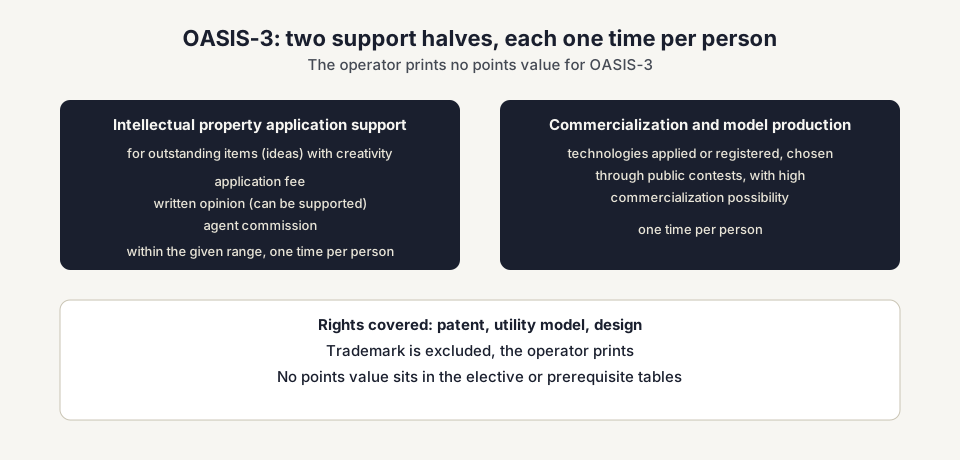
For items the operator calls outstanding with creativity, it provides support in the intellectual property application process. The printed expense list has three lines: the application fee, the written opinion, and the agent commission.
The printed limit follows. The expenses run "within the given range", and the page defines the range no further.
The written opinion appears in brackets — the operator prints that it can receive support. The page prints no amount for that line.
The second half: prototypes
The second half selects technologies, ideas already applied for or registered, with high commercialization possibility. Selection goes through public contests.
What follows selection: support for commercialization and for model production. It also runs once per person.
The operator prints no amounts here either, and no number of winners per contest.
Where OASIS-3 sits on the matrix
The operator's two points tables skip it entirely:
| Prerequisite row | Points |
|---|---|
| IPR holder (patent / utility model or design) | 60 / 30 |
| Co-inventor on a registered right | 30 / 10 |
| Applicant of IPR | Up to 10 / 5 |
| Government startup support, OASIS 6 or OASIS 9 recipient | 30 |
| E-1 or E-3 stay over 3 years | 30 |
| Secured investment of 100+ million KRW | 60 |
The secured-investment row scores 60. The operator prints its items and its points in separate blocks, so the row reads by position, nine values against nine cells.
The pool total confirms it. Capped IP points at 60, plus 30, plus 30, plus 60, make the 180 the operator prints.
The elective table lists OASIS-1, OASIS-2 and OASIS-4 at 10 points each, and OASIS-5, OASIS-7 and OASIS-8 at 15. OASIS-3 appears in neither pool.
That is the whole arithmetic story: a filed application scores points. The support item that helps you file scores none.
Rounds open on the operator's published schedule. The live calendar tracks each round as it opens, including the centre running it and the application window for each round.
When it runs, and how to apply
The operator keeps one schedule page for the whole programme. It prints an application window, an announcement date and class days, round by round.
It prints no round for OASIS-3. Treat that page as where a round would appear, and ask the centre directly in the meantime.
The item is awarded through the operator's public contests rather than an open intake. The announcement is the thing to watch.
Related on KBridge: the D-8-4 points matrix and what moves an OASIS score.
Frequently asked questions
- How many points is OASIS-3 worth on the D-8-4 matrix?
- None, as printed. The operator's elective table lists OASIS-1, OASIS-2 and OASIS-4 at 10 points each and OASIS-5, OASIS-7 and OASIS-8 at 15 each, and the prerequisite table carries other items. OASIS-3 appears in neither.
- What does OASIS-3 pay for?
- The operator provides expenses for acquiring the rights of selected ideas: the application fee, the written opinion, and the agent commission, within a given range. The page defines the range no further and prints no amounts.
- Does OASIS-3 cover trademark applications?
- No. The printed scope covers patent, utility model and design only, and the operator prints that trademark is excluded.
- How often can OASIS-3 support be received?
- The page prints the limit of one time per person on both halves — the IP application support and the commercialization and model production support.
- How do ideas get selected for the prototype support?
- The operator selects technologies or ideas that are applied for or registered, with high commercialization possibility, through public contests. No other selection route appears on the page, and the page prints no number of winners.
- Is OASIS-3 a course like OASIS-1?
- No. OASIS-1 and OASIS-2 are courses with syllabi, hours and an 80% attendance floor. OASIS-3 is support — a printed expense list and a contest-selected prototype track, with no printed hours or syllabus.
- If OASIS-3 pays for my application, do I still score points for it?
- Yes, on the filed application itself. The operator's prerequisite table recognizes an IP application at up to 10 points for a patent and 5 for a utility model or design. The aim of the support item ends at the application process; the points belong to the filing row of the table.
Sources
- Global Start-up Immigration Center (oasisvisa.com) - OASIS-3 item description including its two support halves, expense lines, one-time-per-person limits, rights scope, and its absence from both points tables — read 2026-09-15
- Global Start-up Immigration Center (oasisvisa.com) - Program Schedule page: application windows, announcement dates, class days and venues per round, plus the selection and eligibility notes per programme — read 2026-09-16
Everything above is the rule as published. See how it applies to your case.
Read next
- VisasOASIS-2 Advanced Intellectual Property course: the deeper 10 points on the D-8-4 matrix
- VisasD-9-1, Korea's trade visa: TOPIK 3, 60 of 160 points, and a visa that only extends if you actually trade
- VisasD-8-4, Korea's startup visa: the OASIS matrix, and the 60-point threshold the operator publishes
- VisasThe route into Korea's startup visa runs through D-10-2 — preparation only, and a clock you should plan around