MSS, KISED and K-Startup: who sits above a Korean startup notice?
중소벤처기업부와 창업진흥원, 공고의 국가 단위 구조
MSS, KISED and K-Startup are related parts of the national startup-support layer, but they do different jobs. Use the ministry for policy context, KISED for its own programme and operator material, and the current notice for the rules of a specific call.
On this page
Korean startup support can look like one system because several official sites point to each other. That is useful for discovery, but it can blur responsibility. A foreign founder needs to know which page supplies background and which document controls the application.
MSS supplies the ministry context
The Ministry of SMEs and Startups, or MSS, is the national ministry whose official site groups startups with policy areas such as venture businesses, technology innovation, human resources and export. Those categories explain the policy setting. They are not a single application form or a promise that every startup can enter every programme.
Use the ministry site when you need to understand the policy owner, a national announcement or a ministry newsroom item. Then move to the named programme notice for the practical question: who may apply, what must be submitted and what the selected applicant receives.
KISED operates its own startup programmes
KISED describes its role as supporting startup businesses, job opportunities and technology-based startups. Its programme pages cover lines such as commercialization, startup infrastructure, events and networking, and overseas expansion. The individual page can explain the programme’s purpose, support categories and contact point.
That does not make KISED the administrator of every notice displayed on K-Startup. A notice may be issued by a different national body, a local government, a university or a specialized centre. Read the organizer and contact fields in the notice itself.
The distinction is practical. If a KISED page says a programme includes commercialization funds, that is useful context for that programme. It does not transfer the same support to an unrelated local or private call.
K-Startup is the discovery and application portal
K-Startup organizes startup-support information into lines including commercialization, R&D, facilities and incubation, mentoring and education, events and networking, loans, personnel and global support. It also separates ongoing and closed notices and maintains a reference library.
The portal therefore acts as a map across institutions. The map can help a founder find a relevant call, but the call’s issuing body remains important. The attached form, eligibility text, deadline and contact details belong to the current notice.
| Layer | Best use | What it cannot prove by itself |
|---|---|---|
| MSS | Ministry policy and national context | That a founder qualifies for a specific call |
| KISED | KISED programme descriptions and operator guidance | That KISED runs every portal listing |
| K-Startup | Finding notices, categories and application routes | That every listing has the same rules |
| Named operator | Round-specific eligibility, forms and support | That another programme uses identical terms |
This model also explains why two official pages can use different language. A general programme introduction can be a stable overview, while a year-specific notice changes the applicant test, dates or documents. The notice is the document to resolve the current round.
Read the notice from the bottom up
Start with the title and issuing body. Then check the application period, applicant definition, exclusions, required files, selection process and contact. Only after those checks should you compare the support with your business need.
For a foreign founder, identify the applicant entity first. Is the application made by a Korean company, an overseas company, an individual or a proposed founder? A programme’s global label does not answer that question unless the notice does.
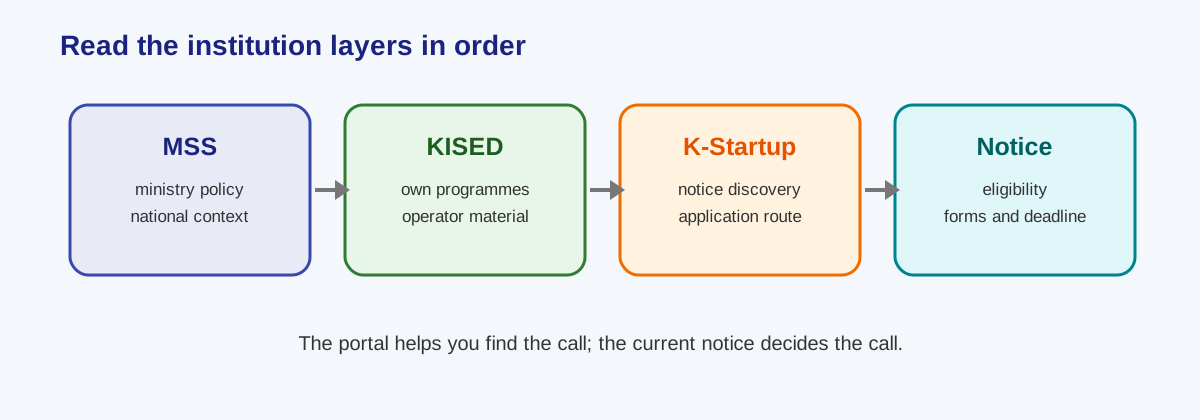
Use the ecosystem directory to understand the institutions, then confirm each opportunity in the current programmes directory.
Frequently asked questions
- What is MSS?
- MSS is the Ministry of SMEs and Startups. Its official site provides ministry-level policy context for startups, venture businesses, technology innovation, human resources and export.
- What is KISED?
- KISED is the Korea Institute of Startup & Entrepreneurship Development. Its official programme pages describe startup support lines and its own programme material.
- What is K-Startup used for?
- K-Startup collects startup-support information, notices, programme categories, reference material and application routes from multiple bodies.
- Does a K-Startup listing mean KISED administers the programme?
- No. K-Startup is a portal. Read the notice’s issuing body, operator, contact and attachments to identify who controls the round.
- Which page decides whether a foreign founder can apply?
- The current notice and its attachments. Check the applicant definition and the applying entity rather than relying on a general ministry or programme overview.
Sources
- MSS official English site - ministry mission, startup policy areas and newsroom — read 2026-09-21
- KISED official Korean site - programme and notice navigation — read 2026-09-21
- K-Startup official portal - ongoing notices and support lines — read 2026-09-21
Everything above is the rule as published. See how it applies to your case.
Read next
- InstitutionsMost Korean startup funding is administered by 창업진흥원 (KISED). Here is what it runs and who it answers to.
- InstitutionsKorea's regional startup centres — the 창조경제혁신센터, where support stops being one-size-fits-all
- Institutions모두의 창업 is a competition, not an information portal — and round one takes 10,000
- InstitutionsAll 19 창조경제혁신센터: Partner, Launch Date and Published Field, from the KISED Dataset