TIPS and the private-public matching route: the investor decides first, the government funds follow
TIPS — 민간 투자사가 먼저, 정부 자금이 뒤따르는 매칭 경로
TIPS selects startups through private investment firms: a TIPS-operating firm invests, incubates and recommends first, and government R&D and commercialisation funds are matched to that decision. KISED prints a ₩123.7 billion budget across some 860 companies — but a recommendation is not an award, and the two official pages even print different application windows.

On this page
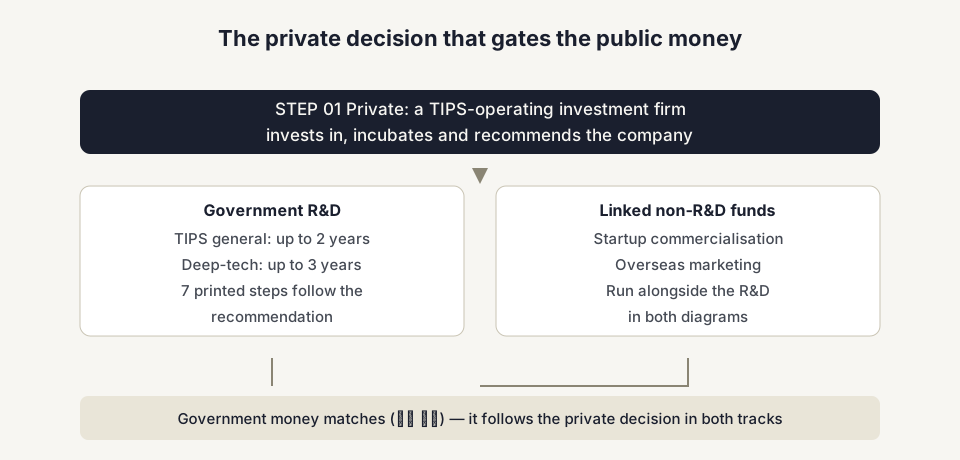
There is a shelf of Korean startup programmes, and there is TIPS. On KISED's own commercialisation menu, TIPS sits beside the pre-startup and early-startup grant packages. TIPS inverts the entry point: inside TIPS, a private investment firm reads the company first.
That inversion is the whole mechanic. KISED prints it in one line on the programme page. Private investment firms select strong startup companies, and government funds then match the private money with R&D and commercialisation support.
Two official pages carry two different names
KISED prints the programme name under the commercialisation menu. The name sits beside the pre-startup and early-startup grant packages.
The portal names the programme in English as "Tech Startup Incubator Program" on its homepage. The same page prints one cumulative stat: 4,588 TIPS teams to date. The portal dates the figure nowhere, so read it as the portal's own count and nothing larger.
The portal also carries the marks of five institutions in its footer. The lineup matches the programme's design. The state sits on one side, and investment-industry bodies on the other.
| Portal footer institutions |
|---|
| Ministry of SMEs and Startups |
| TIPA |
| KISED |
| Korean Business Angels Association |
| Korean Venture Capital Association |
What the pages state as eligibility
KISED states the eligible target in one block. The company sits within 7 years of founding. A domestic or overseas investment firm has invested in it or recommended it.
The same block adds a 10-year limit for new-industry fields.
The portal adds the team-level conditions. The team holds 2 or more members and plans high-tech development.
The team does not need a legal entity on file to apply. The portal accepts applications from teams while still affiliated with a university or research institute.
The two tracks, and what rides alongside them
The procedure page draws two R&D tracks under the same recommendation gate: TIPS general, and TIPS deep-tech. The same chart shows a linked non-R&D programme alongside them. Its two parts are startup commercialisation and overseas marketing.
| Step | General | Deep-tech |
|---|---|---|
| Operator recommendation | At 1.2 to 1.5 times | Simply recommended, no multiple |
| R&D project length | Up to 2 years | Up to 3 years |
| Linked non-R&D funds | Startup commercialisation, overseas marketing | Same |
The recommendation notation is the page's own. The general track reads 1.2 배수 through 1.5 배수 — 1.2 to 1.5 times. Deep-tech gets a simple recommendation, with no multiplier stated.
The seven printed steps after a recommendation
After the recommendation, the procedure page prints seven steps in order. Each step moves the company one gate closer to the funds.
First, IRIS system registration. The page marks this step as deadline-strict.
Second, the pre-review. The reviewer checks the investment contract and the applicant's qualification.
Third, the selection evaluation. The page lists three criteria together: technical quality, business quality, and execution capacity.
Fourth, the selection notice. The ministry approves the selection first. A professional body then notifies the company.
Fifth, the contract, and the dedicated account for project funds. Sixth, execution: the operator keeps investing, incubating and mentoring through the R&D project.
The seventh printed item is the non-R&D side of the chart: the startup commercialisation fund and the overseas-marketing support, diagrammed alongside the awarded R&D project.
Applying: the two official descriptions
The portal's application instructions run through the operators themselves. A founder registers on the portal and designates an operator in their investment field. The business plan goes to that operator, in its own format or template.
Operators also recruit through their own networks, forums, competitions and postings.
KISED's page routes the same programme through the K-Startup portal, k-startup.go.kr. The document set there: the business plan, the investment agreement, and supporting documents. The agency page dates the 2026 public call at March, and prints the office contact for a direct question.
Both routes describe the same 2026 programme. The agency names the central portal; the operator names the firms and their document intake. A real application path touches both.
The 2026 calendar as KISED prints it
KISED's page prints four dated steps for 2026, ending with support payments inside the calendar year.
| KISED's 2026 steps | Months |
|---|---|
| Public call (사업공고) | March |
| Application and intake | March to October |
| Selection evaluation and contracting | April to November |
| Support payments | May to December |
The operator recommendation step sits above these in the portal's own procedure chart. It carries no printed dates in KISED's calendar. A concrete round date is a question for the operator that would recommend the company.
The two pages print disjoint halves of one sequence. Neither prints the other half's clock.
The programme index builds this matching route into the wider shelf. It carries the grants, the reimbursements, and each line's staging.
Related on KBridge: grant, matching and voucher money compared and how a programme notice is structured.
Frequently asked questions
- What does TIPS stand for?
- Two official expansions are in print. KISED files the programme as 민관공동창업자발굴육성 (TIPS); the operator portal's pages print 민간투자주도형 기술창업지원 and headline it "Tech Startup Incubator Program". Use whichever expansion the 공고 you are filing against carries.
- Who is eligible for TIPS?
- KISED's page: a startup within 7 years of founding that a domestic or overseas investment firm has invested in or recommended — 10 years for new-industry fields. The operator portal adds a 2-or-more-member team planning high-tech development.
- Do I need to incorporate my company before applying?
- No. The operator portal states a team can apply while still affiliated with a university or research institute and before registering a legal entity.
- How big is the TIPS programme?
- KISED's page prints a ₩123.7 billion budget (지원예산 1,237억원) and a support scale of 860 companies for 2026.
- What is the difference between general TIPS and deep-tech TIPS?
- Per the operator portal's procedure page: the general track's operator recommendation runs at 1.2 to 1.5 times and the R&D project runs up to 2 years; the deep-tech track is recommended simply, with no multiplier stated, and runs up to 3 years. A linked non-R&D programme — startup commercialisation and overseas marketing — is diagrammed alongside both.
- What happens after an operator recommends a company?
- Seven printed steps: recommendation, IRIS system registration, a documentary pre-review of the investment contract and applicant eligibility, a selection evaluation of technical quality, business quality and execution capacity, MSS approval and notification, contract signing with the project account, then execution of the R&D project.
- When can I apply for TIPS in 2026?
- The two official pages differ. KISED's programme steps print application and intake from March to October 2026; the operator portal says applications run continuously through the operators. Both pages were live on 2026-09-15. Confirm the window with the specific operator you approach before preparing a filing.
- Where do I apply for TIPS?
- Two official routes describe one programme: KISED names the K-Startup portal, k-startup.go.kr, with a business plan, the investment agreement and supporting documents; the operator portal describes registering on jointips.or.kr, designating an operator by investment field, and submitting a plan to that firm.
Sources
- KISED TIPS programme page (민관공동창업자발굴육성) — eligibility, budget 1,237억원 and 860 companies, investor-first matching line, 2026 four-step calendar, k-startup application route and document list — read 2026-09-15
- TIPS operator portal (jointips.or.kr) homepage — the English programme name Tech Startup Incubator Program, the expansion 민간투자주도형 기술창업지원, and the cumulative 4,588 TIPS Teams figure — read 2026-09-16
- TIPS operator portal (jointips.or.kr), 지원내용 및 절차 — general and deep-tech tracks, 1.2–1.5배수 recommendation notation, 7-step procedure via IRIS, ongoing intake through operators, unincorporated team eligibility — read 2026-09-15
Everything above is the rule as published. See how it applies to your case.
Read next
- ProgramsCOMEUP 2026 lands at COEX on 9 December — and the K-Startup Grand Challenge window is still unannounced
- ProgramsTry Everything 2026 at DDP, and the investor meetup door that shut on 19 July
- ProgramsKorea's 예비창업패키지 pays up to KRW 80 million — to founders who have not yet registered a business
- Programs초기창업패키지 starts where 예비창업패키지 stops: registered, three years in, up to KRW 150 million