AI solo founder camp (1인 창업가 캠프): who runs it and what a cohort covers
AI 기반 서비스 개발·사업화 1인 창업가 캠프
The AI solo founder camp is a private, state-subsidised online course, not a grant. NextRunners ran the 7th cohort for 120 weekdays, with a training account card paying up to 96% of the 9,113,280 won tuition. The notice says nothing about nationality, but the card decides who can enrol.

On this page
The AI solo founder camp (AI 기반 서비스 개발·사업화 1인 창업가 캠프) turns up in search beside government startup calls. It is not one. The notice says so itself, and that changes how a foreign founder should read it.
Who runs the AI solo founder camp?
NextRunners (넥스트러너스 주식회사) is the operator. The 7th-cohort notice on K-Startup lists it under the education institution category, with a marketing team as the contact department. Its contact link points to an OZ Coding School channel.
K-Startup carries a warning on the notice.
The call is a private programme. It does not belong to the Ministry of SMEs and Startups (MSS) or to the Korea Institute of Startup and Entrepreneurship Development (KISED). The operator handles every step.
The notice's application window closed on 25 September 2026, and our catalogue page links it.
What does a cohort cover?
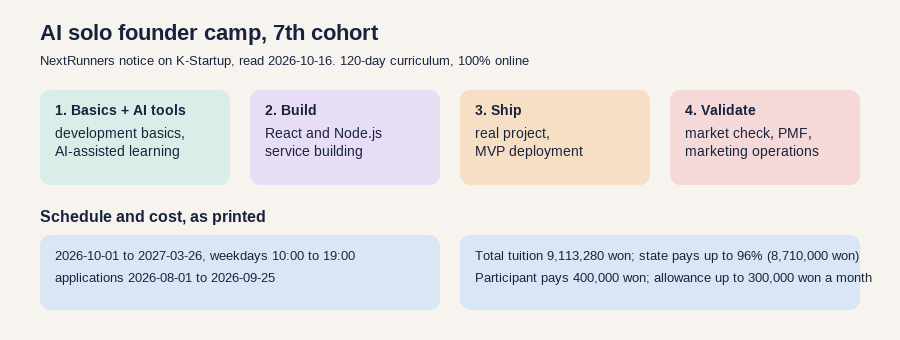
The 7th-cohort notice (2026) prints a four-block curriculum. For example, block three is a real project that ends in an MVP deployment. The course aims at a working service.
- Development basics, taught with AI tools
- Service building with React and Node.js
- A practical project and MVP deployment
- Market validation, PMF and marketing operations
Classes run on weekdays from 10:00 to 19:00, fully online, as a mix of recorded video and live sessions. The 7th cohort took 120 curriculum days, from 1 October 2026 to 26 March 2027. Weekends and public holidays did not count.
What does the camp cost, and who pays?
According to the 7th-cohort notice (2026), the cost sits in the card, not in a grant. The state pays through the training account card, so the participant pays a small share.
| Item | 7th cohort, as printed |
|---|---|
| Total tuition | 9,113,280 won |
| State subsidy | up to 96%, 8,710,000 won |
| Participant self-pay | 400,000 won |
| Training allowance | up to 300,000 won a month, paid for 6 months |
The notice confirmed that the allowance can offset the 400,000 won. It also lists a free MacBook Pro loan and a paid AI-tool subscription as cohort benefits.
How does selection work?
The selection process runs in five steps. An online form comes first, then a document review, then a phone interview of about five minutes if needed.
Pass notices go out one by one. You then register on HRD-Net with the card.
The form asks for basic details and a motivation statement. It is the only document. The notice welcomes pre-founders who have an idea but no developer.
The notice lists eight kinds of applicant. They range from pre-founders to people who want to build a one-person SaaS or automation service with AI tools.
Can a foreign founder join the AI solo founder camp?
What does the camp notice say?
The notice is silent on nationality. It sets one gate that touches foreigners: applicants must hold a 국민내일배움카드 or be able to get one. The age field starts at 20.
In practice, that card gate decides who can enrol.
What do the card rules say?
The card rules sit with the Ministry of Employment and Labor, not with the operator. According to one Ministry counselling answer, foreigners' eligibility depends on their residence status.
That answer lists F-2, F-5, F-6, D-7, D-8 and D-9 as eligible classes. It lists E-1 to E-7, F-4, C-4, E-9, E-10 and H-2 as not eligible. F-2, F-5 and F-6 holders also need current or past employment insurance.
However, the page carries no date, and it does not say how the D-8-4 startup visa sub-code counts. Treat it as a pointer. Confirm your own status with HRD-Net or an employment centre first.
When has the camp opened in past years?
The operator reopens the camp with a new cohort number. According to its 2025 first-cohort notice (2025), the call took applications from 15 May to 20 June. Classes ran from 26 June to 18 December 2025.
The 7th cohort took applications from 1 August to 25 September 2026. Both calls closed well before class day, and the notice warns that dates can change for the operator's internal reasons.
For the next cohort, watch the K-Startup education category. Our programme pages show closed calls too, so you can compare timing.
Does the camp lead to funding?
No grant comes with it. The notice prints no funding amount and lists benefits instead: a training allowance, a hardware loan, mentoring, and VC and VA feedback after completion.
The notice also offers a chance of investment review. It prints no amount or condition. Treat that line as the operator's offer, not a funding commitment.
If you want grants after the course, read our guide to programme lines by sector and stage. The government lines there ask for a registered business or a pre-founder plan.
For more calls that suit foreign founders, browse the EastStartup programme catalogue.
Frequently asked questions
- Who runs the AI solo founder camp?
- NextRunners (넥스트러너스 주식회사), a private company. K-Startup lists the notice under the education institution category and warns that it is not an MSS or KISED programme.
- How long is a cohort and when did the 7th run?
- The 7th cohort was a 120-day curriculum from 1 October 2026 to 26 March 2027, on weekdays, fully online, excluding weekends and public holidays.
- What did the 7th cohort cost?
- Total tuition was 9,113,280 won. The state subsidy covered up to 96%, 8,710,000 won, and the participant paid 400,000 won, which a training allowance of up to 300,000 won a month could offset.
- Can a foreigner apply?
- The notice sets no nationality rule. It requires a 국민내일배움카드 or the ability to obtain one, and the Ministry of Employment and Labor decides card eligibility by residence status.
- Does the camp give a grant or equity funding?
- No funding amount is printed. The notice lists a training allowance, a MacBook Pro loan, mentoring and a chance of VC feedback and investment review, with no stated amount.
- Is it the same as a K-Startup government programme?
- No. The notice itself says the call is privately run, and the operator handles every step from application to management.
Sources
- K-Startup notice: [Government-funded] AI-based service development and commercialisation 1인 창업가 캠프, 7th cohort (NextRunners) — read 2026-10-16
- K-Startup notice: 1인 창업가 개발부트캠프 1st cohort, 2025 (NextRunners) — read 2026-10-16
- Ministry of Employment and Labor online counselling answer on 국민내일배움카드 eligibility by foreign residence status (undated) — read 2026-10-16
Everything above is the rule as published. See how it applies to your case.
Read next
- ProgramsD-Testbed (D-테스트베드): the fintech data sandbox where you test an idea first
- ProgramsMedia'X' Challenge 2026 by SBS Foundation and Korea Investment Accelerator
- ProgramsWomen founder programmes in Korea (여성창업): the commercialisation lines and who is eligible
- ProgramsPatent application cost voucher (특허출원·등록 비용 바우처): who runs the rounds and what it pays