D-Testbed (D-테스트베드): the fintech data sandbox where you test an idea first
D-테스트베드 안내
D-Testbed is a Financial Services Commission programme, run with the Korea Fintech Center, that lets fintech teams test ideas on combined financial and non-financial data in a closed remote environment. It reported 170 teams in five years, and its 2026 notice set no nationality rule.

On this page
D-Testbed (D-테스트베드) is not a pilot with a government buyer, despite what its name suggests to a product founder. It is a data sandbox for fintech ideas.
In practice, a team files a plan, gets access to protected data, and tests the idea before building a product. The 2026 second-half call, listed in our catalogue, shows how it works.
What is D-Testbed, and who runs it?
The Financial Services Commission (금융위원회) and the Korea Fintech Center (한국핀테크지원센터) run it together. The FSC's April 2026 press release says fintech firms and pre-founders can use the Center's combined financial and non-financial data in a safe analysis environment to prove an idea.
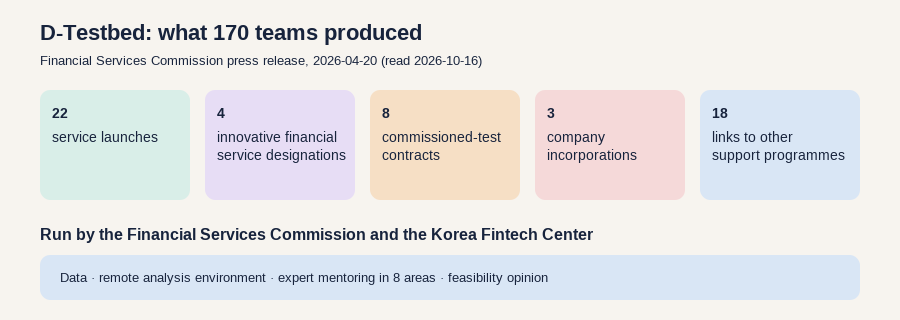
The FSC lists four things the programme gives. They are data, a remote data-analysis environment, expert mentoring and a feasibility opinion. The opinion comes from a private expert group and covers the test process, the validity of the result and how realistic the idea is.
Mentoring spans eight areas. Four are business areas: law and regulation, business strategy, fundraising and patents. Four are technical: statistical analysis, CSS development, security and infrastructure.
What has it produced so far?
The FSC reports 170 teams over five years, since the 2021 pilot. It counts 22 service launches and 4 designations as an innovation-grade financial service (혁신금융서비스). It also counts 8 commissioned-test contracts, 3 company incorporations and 18 links to other support programmes.
| Outcome since the 2021 pilot | Count |
|---|---|
| Teams that took part | 170 |
| Service launches | 22 |
| Designations as an innovation-grade financial service (혁신금융서비스) | 4 |
| Commissioned-test contracts | 8 |
| Company incorporations | 3 |
| Links to other support programmes | 18 |
Since 2024, the FSC says, it has tied the testbed to two follow-on lines. Fintech Cube gives office space and tailored growth programmes. The Digital Financial Technology Internalization programme gives funds to fintech startups founded within three years.
How did the 2026 rounds work?
The first-half round took 4 weeks, from 20 April to 15 May 2026, and aimed at about 25 companies. It had two tracks. A test track ran in a closed remote environment, and a new GPU track gave high-performance computing for teams that bring their own data.
In 2026 the FSC also lengthened data provision from at most 3 years to at most 5 years. It allowed external data to be imported and introduced a hybrid environment.
In the hybrid environment, the network opens briefly before pseudonymised data is brought in. That lets generative AI train on outside data.
For example, the GPU track gives each company up to 24 weeks of GPU use, which the programme may adjust by usage. The second-half call ran from 12 August to 8 September 2026 at 17:00. Both rounds are closed now.
What does an applicant submit?
The second-half notice asks for one document, a D-Testbed execution plan. It covers general company details, the idea and the plan for carrying out the test. The reviewers read only the paper, so the selection process rests on the plan alone.
Evaluation is document-based. It scores how sound the plan is and how novel the idea is. The notice does not print a point scale, so we give none.
The data specification sits on the programme's own website, in its notice board. Read it before you write the plan, because it tells you which fields you will actually have.
Who can apply, and what about foreigners?
The second-half notice confirmed that the target is any company or individual, including teams, that wants to check its own idea against the data provided. The K-Startup listing marks company age as open to all stages, so a pre-founder is not ruled out.
The notice is silent on nationality, residence and visa status. However, it does not say foreigners may apply, and it does not exclude them. It does not say how an individual without a Korean company is vetted either.
The programme supports the testing stage, not a launch. If your idea is a financial service, you still need a business entity for the next step. Our guide to registering a business in Korea as a foreigner covers that.
When do rounds open?
The two 2026 rounds give the rhythm. A first-half call ran from late April to mid-May, and a second-half call ran from mid-August to early September.
Treat that as a pattern, not a promise. Each 2026 window lasted about four weeks.
Watch the programme's site and the K-Startup portal. Our guide to K-Startup portal accounts for foreigners explains how to see notices early.
For other tests with public bodies, read about GovTech and public-sector competitions.
To place it among other support lines, browse the programme catalogue.
Frequently asked questions
- What is D-Testbed?
- It is a fintech data sandbox run by the Financial Services Commission and the Korea Fintech Center. Teams test ideas on combined financial and non-financial data in a closed remote analysis environment.
- Is it a pilot with a government customer?
- No. The sources describe data, a remote analysis environment, expert mentoring and a feasibility opinion. They do not describe a public buyer or a procurement contract.
- How many teams has it supported?
- The FSC reported 170 teams over five years since the 2021 pilot, with 22 service launches, 4 designations as an innovation-grade financial service (혁신금융서비스) and 3 incorporations.
- Who can apply to the second-half 2026 round?
- Any company or individual, including teams, that wants to check its own idea using the data provided. The notice sets no company-age limit.
- Does the notice say anything about foreigners?
- No. It mentions neither nationality nor residence nor visa status, so confirm identity and agreement requirements with the Korea Fintech Center.
- What do I submit?
- A D-Testbed execution plan covering general company details, the idea and the test plan. Evaluation is document-based and scores the plan's soundness and the idea's novelty.
- When did the 2026 rounds open?
- The first-half round ran from 20 April to 15 May 2026, and the second-half round ran from 12 August to 8 September 2026 at 17:00.
Sources
Everything above is the rule as published. See how it applies to your case.
Read next
- ProgramsAI solo founder camp (1인 창업가 캠프): who runs it and what a cohort covers
- ProgramsMedia'X' Challenge 2026 by SBS Foundation and Korea Investment Accelerator
- ProgramsWomen founder programmes in Korea (여성창업): the commercialisation lines and who is eligible
- ProgramsPatent application cost voucher (특허출원·등록 비용 바우처): who runs the rounds and what it pays