Register a business in Korea as a foreigner: sole proprietor or corporation, and what your visa needs
외국인 사업자등록: 개인사업자와 법인, 비자에 맞는 형태
A sole proprietor registers at the tax office within 20 days of starting; a corporation registers at the court registry first. D-8-4 needs a corporation, D-9-1 needs an individual registration as a trade business, and the date you register decides whether 예비창업패키지 or 초기창업패키지 is still open to you.

On this page
- Two structures, two different offices
- Registering as a sole proprietor
- The 10-digit 사업자등록번호, decoded
- The 13-digit 법인등록번호 is a separate number
- Checking someone else's number
- Setting up a 주식회사
- KRW 100 million is the foreign-investment threshold
- Which structure your visa needs
- When you register decides which package you can apply for
A foreign founder in Korea can register a business in two ways, at two different offices. Each way produces a different set of numbers.
Which one you need depends on two outside things. One is the visa you hold or want. The other is the government package you still hope to apply for.
Every rule below comes from the statute or from the issuing body's own text. Where two official sources disagree on a rule stated here, the guide prints both.
Two structures, two different offices
A sole proprietor, 개인사업자, deals with the tax office alone. Article 8 of the VAT Act (부가가치세법) gives a business 20 days from the day it starts to apply for registration. A new business may also apply before it starts.
You do not have to use the office for your own district. The same article lets you file with any tax office, and treats that filing as made to the office for your premises.
A corporation, 법인, starts somewhere else. Under the Commercial Act (상법), a company comes into existence when it registers its incorporation where its head office sits. The registry office there assigns its registration number.
Only then does the corporation register for tax. The Corporate Tax Act (법인세법) requires a new corporation to register with its tax office. Filing the incorporation report, 법인설립신고, counts as filing that registration.
| Sole proprietor (개인사업자) | Corporation (법인) | |
|---|---|---|
| First office | Tax office (세무서) or Hometax | Court registry (등기소) |
| Then | Nothing further | Tax office: 법인설립신고, which counts as 사업자등록 |
| Numbers you hold | 10-digit 사업자등록번호 | 13-digit 법인등록번호 and 10-digit 사업자등록번호 |
| Deadline in the law | 20 days from starting business | 2 weeks for the incorporation registration, counted from the end of the incorporation checks |
Registering as a sole proprietor
The National Tax Service (NTS) publishes the document list. For an individual it starts with the application form and a copy of the lease, if you rent the premises. A business that needs a licence adds a copy of it, and a partnership adds its partnership agreement.
Foreigners add one item: a copy of the alien registration card (외국인등록증) or passport. NTS also asks for a form appointing a tax administrator (납세관리인) in two cases. One is when you do not usually stay at the premises; the other is 6 months or more abroad.
NTS's procedure page says the business owner must sign the application form in their own hand. It also covers the online route.
With a Hometax account and a certificate (공인인증서), NTS says you can apply and submit documents without visiting a tax office. You can also receive the certificate online once registration completes.
The paper follows quickly. The VAT Act's enforcement decree gives the tax office 2 days from the application to issue the certificate, and some days do not count. It may extend that by up to 5 days when it needs to check the premises or the business.
Registering early has a limit. The same decree lets the tax office refuse a registration filed before the start date when it judges that you will not actually start the business.
NTS's procedure page defines one more term you will meet. A 간이과세자, a simplified taxpayer, is an individual business expecting annual supply below 10,400만원, which is KRW 104 million.
The tax office registers a business; it does not decide what your visa lets you do.
The Immigration Act (출입국관리법) lets a foreigner stay within the scope of their status. Activity that belongs to another status needs the Minister of Justice's permission in advance.
The 10-digit 사업자등록번호, decoded
Both structures end with a 10-digit business registration number, written xxx-xx-xxxxx. NTS's scheme, republished on the government's 110 call-centre site, gives each block a job.
| Digits | NTS name | What it holds |
|---|---|---|
| 1-3 | 일련번호코드 | A serial, 101 to 999, issued in order to new businesses |
| 4-5 | 개인 법인 구분코드 | The type of business, in the table below |
| 6-9 | 일련번호코드 | A serial, 0001 to 9999 |
| 10 | 검증번호 | A check digit the system uses to catch errors |
| Middle two digits | Meaning |
|---|---|
| 01 to 79 | Individual, taxable (개인과세사업자) |
| 90 to 99 | Individual, VAT-exempt (개인면세사업자) |
| 81, 86, 87, 88 | For-profit corporation, head office |
| 82 | Non-profit corporation, head office and branches |
| 83 | The state, a local government, or a local government association |
| 84 | Foreign corporation: head office, branch or liaison office |
| 85 | For-profit corporation, branch |
Read the first three digits as a serial, not as a tax-office or region code. NTS labels them 일련번호코드 and issues 101 to 999 in order.
Code 84 covers a foreign corporation's head office, branch or liaison office. Invest KOREA describes a foreign-invested company as a domestic corporation established under the Commercial Code.
The 13-digit 법인등록번호 is a separate number
A corporation holds a second number. The Supreme Court rule builds the 법인등록번호 from 13 digits. Four identify the registry office, two the type of corporation, and seven are a serial.
The registry assigns it at the incorporation registration. For a foreign corporation, that means its first registration of an office in Korea. A sole proprietor holds only the 10-digit number, while a corporation holds both.
Checking someone else's number
NTS runs two checks, published as an open API on data.go.kr. The status check takes the number alone. It returns whether the business is operating, suspended or closed, its tax type, and any closure date.
The authenticity check matches the number against the open date and the representative's name. NTS updates the data every 30 minutes, and a new business takes 1 to 2 days to appear.
Setting up a 주식회사
The government's plain-language law guide lists the steps in order. Form a group of promoters, choose the company name and business purpose, and have the promoters write the articles of incorporation (정관).
Then decide the share issue and complete the incorporation, either by the promoters alone or by subscription. The last step is the incorporation registration, the incorporation report and the business registration.
The Commercial Act puts a clock on that last stage. Where the promoters take all the shares, article 317 allows 2 weeks for the incorporation registration. The count starts when the checks under articles 299 and 300 finish.
Capital no longer blocks the door. The current Commercial Act sets no minimum capital. Article 329 only requires each par-value share to be KRW 100 or more.
The old KRW 50 million minimum went with the 2009 amendment (법률 제9746호). That amendment also eased small incorporations.
A company with under KRW 1 billion in capital, set up by its promoters alone, can use a bank balance certificate (잔고증명서) in place of a payment custody certificate.
KISED runs startbiz.go.kr for the Ministry of SMEs and Startups. It is an online incorporation system covering five company types, from 주식회사 to 합자회사.
Whether it serves foreign promoters is not stated anywhere this guide could find. Its preparation checklist assumes a 주민등록등본 address and a personal bank certificate.
The same checklist sets a floor on people. A 주식회사 needs at least two, the representative and an auditor with no shares. A 유한회사 or 유한책임회사 can be set up by one person.
KRW 100 million is the foreign-investment threshold
The figure comes from investment law, not company law. The Foreign Investment Promotion Act's enforcement decree counts KRW 100 million or more as foreign direct investment (FDI) in two cases.
One is where the foreigner holds 10% or more of the voting shares. The other is where the foreigner holds shares and sends or appoints an officer to the company.
Invest KOREA adds the other half. A foreigner may set up a corporation with less than KRW 100 million. That company does not count as FDI, and falls under the stock-acquisition notice in the Foreign Exchange Transaction Act instead.
Invest KOREA's sequence has five steps. Notify the FDI, remit the funds, register the corporation, register the business, and register as a foreign-invested company.
It puts the whole run at about two weeks. It also says the residence visa comes after company registration.
Which structure your visa needs
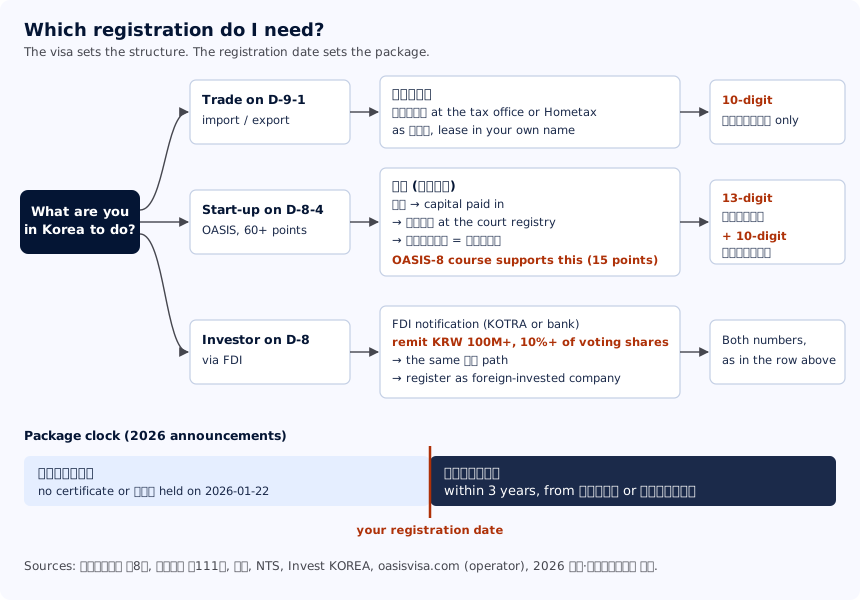
| Visa | Structure | What the source prints |
|---|---|---|
| D-8-4 start-up visa (OASIS) | Corporation | Operator: degree or the center's letter, 60 points or more, and corporation establishment |
| D-8 corporate investor | Corporation with FDI | KRW 100 million or more brought in from abroad, to set up and run a corporation; FDI status also needs 10% of voting shares or an officer |
| D-9-1 trade visa | Sole proprietor, as 무역업 | Individual registration certificate as a trade business, and a lease in your own name |
For the D-8-4 start-up visa, the Global Start-up Immigration Center is the operator of OASIS. It lists three requirements: a degree or the center's letter of recommendation, 60 points or more, and corporation establishment.
The degree is a bachelor's degree, or an associate degree from Korea. The center's Korean page heads the section 법인사업자, a corporate business.
OASIS-8, the operator's course supporting corporation establishment, carries 15 points. The operator's 60-point example lists it as 2 weeks, which is the course, not the time incorporation takes.
For the investment D-8, Invest KOREA sets out the corporate investor route. A foreigner who brings in KRW 100 million or more from abroad, and sets up and runs a corporation under the Foreign Investment Promotion Act, may apply.
KOTRA's 2025 visa guide lists a copy of the business registration certificate and the certificate of incorporation registration among the D-8 documents. So a D-8 file includes both documents.
The D-9-1 trade visa points the other way. The operator's D-9-1 page, headed private business, asks for a business (individual) registration certificate.
That registration must be a "trade business", 무역업. The applicant also needs a lease for an independent premises in their own name.
The points test sits beside it: 60 or more of 160, with at least 10 from required items. The D-9-1 points guide walks through it.
When you register decides which package you can apply for
KISED's two entry packages sit on either side of the registration date. The rules below come from the 2026 announcements, and each year's 공고 sets its own dates.
KISED's 예비창업패키지 page words the test as no business registration, individual or corporate, and no incorporation registration. It anchors both to the announcement date.
The 2026 announcement words it differently. You must not hold a business registration certificate in your own name, or legal power to represent a corporation. Its reference date is '26.1.22, which is 22 January 2026.
It then adds that a business or corporate registration completed on or after '26.1.23 does not bar you. A representative director, an each-representative director, a joint representative director, or an inside director with representative power cannot apply.
The two texts disagree. The page ties the test to the announcement date and to any registration.
The announcement ties it to 22 January and to holding a certificate or representative power. Read the current year's announcement, not the programme page.
Selection does not end the matter. Selectees must found a business, registered in the industry of their selected item, by 2 months before the agreement ends. The announcement allows either a sole proprietorship or a corporation.
The same announcement mentions foreigners in its identity step. Applicants pass a real-name check through Seoul Credit Rating & Information (SCI). Foreigners with no real-name data on file must register it first.
KISED's 초기창업패키지 page opens that package to companies up to 3 years old. The 2026 announcement counted those years as 23 January 2023 to 22 January 2026.
An individual counts from the 개업연월일, the open date on the certificate. A corporation counts from the 법인설립등기일, the incorporation registration date. Both must have started business and completed registration.
That announcement also allows for a foreign representative. The representative may present with an interpreter's help, or a listed officer may present instead with a letter of delegation.
In 2026 the two packages met at the same date. 초기창업패키지 took businesses dated up to 22 January 2026. 예비창업패키지 tested who held a certificate on 22 January, and let in anyone who registered from 23 January.
| Your position, registration test only | 2026 예비창업패키지 | 2026 초기창업패키지 |
|---|---|---|
| Not registered, no representative power | Could apply | Could not: registration required |
| Held a certificate or representative power on 22 January 2026 | Could not, apart from narrow exceptions in the 공고 | Inside the window if dated from 23 January 2023 |
| Registered on or after 23 January 2026 | Could apply | Outside the window, which ended 22 January 2026 |
Current announcements are in the programme catalogue.
Frequently asked questions
- How long do I have to register a business in Korea?
- Twenty days from the day the business starts, under article 8(1) of the VAT Act (부가가치세법). A new business may also register before it starts, but the tax office can refuse an early registration if it judges that the business will not actually start.
- What is a 사업자등록번호, and what do the digits mean?
- The 10-digit business registration number NTS issues, written xxx-xx-xxxxx. The first three digits are a serial from 101 to 999. The middle two mark the type: 01-79 taxable individual, 90-99 VAT-exempt individual, 81, 86, 87 or 88 for-profit corporation head office, 84 foreign corporation. The next four are a serial and the last is a check digit.
- Is the 법인등록번호 the same thing?
- No. The 법인등록번호 has 13 digits: 4 for the registry office, 2 for the type of corporation and 7 for a serial. The court registry assigns it when the incorporation is registered. A corporation holds both numbers; a sole proprietor holds only the 10-digit one.
- How do I check whether a Korean business number is real or closed?
- NTS offers a status check by number alone, which shows whether the business is operating, suspended or closed, its tax type and any closure date. A separate authenticity check matches the number with the open date and the representative's name. Both are published as an open API on data.go.kr.
- Is there a minimum capital to set up a 주식회사?
- No statutory minimum. Article 329 of the Commercial Act only requires par-value shares to be KRW 100 or more. The old KRW 50 million minimum went with the 2009 amendment. KRW 100 million is the threshold for foreign direct investment and the investment D-8, not for incorporation.
- Which visa needs a corporation, and which needs a sole proprietorship?
- The OASIS operator lists corporation establishment as a requirement for the D-8-4 start-up visa. The D-9-1 trade visa asks for an individual business registration as a trade business (무역업), with a lease for an independent premises in your own name.
- If I register my business now, can I still apply for 예비창업패키지?
- Under the 2026 announcement the test was not holding a registration certificate in your own name, or representative power in a corporation, on 22 January 2026. Registrations completed on or after 23 January 2026 could still apply. KISED's programme page words the test differently, so read the announcement for the year you apply.
- Does the tax office check my visa when I register?
- NTS's published document list asks foreigners for a copy of the alien registration card or passport and says nothing about checking visa status. Immigration law separately requires permission in advance for activity outside your status, and Invest KOREA states the penalty as a fine of up to KRW 30 million or a deportation order.
Sources
- 부가가치세법 제8조 (VAT Act art. 8) - 20-day registration deadline, pre-start registration, any tax office — read 2026-09-18
- 부가가치세법 시행령 제11조 - online filing, 2-day issuance, 5-day extension, refusal of early registration — read 2026-09-18
- NTS, 사업자등록 신청 procedure page - 20-day rule, Hometax filing, signature, 간이과세자 threshold — read 2026-09-18
- NTS, 사업자등록 구비서류 - documents for individuals, foreigners and for-profit corporations — read 2026-09-18
- NTS (English) - business registration at the taxpayer centre, documents required — read 2026-09-18
- 법인세법 제111조 (Corporate Tax Act art. 111) - corporate registration; 법인설립신고 counts as the application — read 2026-09-18
- 110 government call centre, 사업자등록번호 structure (자료출처 국세청), 2024-12-04 — read 2026-09-18
- data.go.kr 15081808 - NTS business registration status and authenticity API — read 2026-09-18
- 법인및재외국민의부동산등기용등록번호부여에관한규칙 제2조 - 13-digit 법인등록번호 structure — read 2026-09-18
- 법인및재외국민의부동산등기용등록번호부여에관한규칙 제3조 - number assigned at incorporation registration — read 2026-09-18
- 상법 제172조 (Commercial Act art. 172) - a company comes into existence on registration — read 2026-09-18
- 상법 제288조 - promoters draw up the articles of incorporation — read 2026-09-18
- 상법 제317조 - incorporation registered within 2 weeks — read 2026-09-18
- 상법 제329조 - par-value share of KRW 100 or more — read 2026-09-18
- 법제처 찾기쉬운 생활법령정보 (easylaw) - 주식회사 설립 steps; minimum capital abolished by the 2009 amendment — read 2026-09-18
- 상법 개정문 법률 제9746호 (2009-05-28) - bank balance certificate for companies under KRW 1 billion; 부칙 — read 2026-09-18
- startbiz.go.kr - online incorporation system (KISED for MSS) — read 2026-09-18
- startbiz.go.kr FAQ - 온라인 법인설립시스템 이용 전 준비사항 — read 2026-09-18
- 외국인투자촉진법 시행령 제2조 - FDI: KRW 100 million and 10% of voting shares or an officer — read 2026-09-18
- Invest KOREA - foreign-invested company; under KRW 100 million is not FDI; establishment procedures — read 2026-09-18
- Invest KOREA - incorporation sequence and timings; residence visa after registration — read 2026-09-18
- Invest KOREA - D-8 corporate investor visa — read 2026-09-18
- Invest KOREA - activities beyond status of stay and the penalty — read 2026-09-18
- KOTRA, Visa Guide for Investing in Korea 2025 (KOTRA자료 25-012) - D-8 categories and documents — read 2026-09-18
- 출입국관리법 제20조 - activities outside the status of stay need prior permission — read 2026-09-18
- Global Start-up Immigration Center (OASIS operator) - Startup VISA (D-8-4) requirements, OASIS-8 — read 2026-09-18
- Global Start-up Immigration Center (OASIS operator) - 기술창업비자(D-8-4), 법인사업자 (Korean) — read 2026-09-18
- Global Start-up Immigration Center (OASIS operator) - Trade VISA (D-9-1), Private Business — read 2026-09-18
- KISED, 예비창업패키지 programme page — read 2026-09-18
- 기업마당, 2026 예비창업패키지 예비창업자 모집 수정공고 - eligibility reference date '26.1.22, registration duty, 실명인증 — read 2026-09-18
- K-Startup, 2026 예비창업패키지 수정 공고 page (공고문 and FAQ attachments) — read 2026-09-18
- KISED, 초기창업패키지 programme page — read 2026-09-18
- 기업마당, 2026 초기창업패키지 창업기업 모집공고 — read 2026-09-18
- MSS 2026 초기창업패키지 공고문 PDF (reposted by 가톨릭관동대) - 업력 counted from 개업연월일 or 법인설립등기일 — read 2026-09-18
Everything above is the rule as published. See how it applies to your case.
Read next
- FounderCraftToss Payments: why the webhook, not the redirect, decides a sale
- FounderCraftSending Korean customer data to a foreign AI API: what PIPA Article 28-8 asks
- FounderCraftThe Business Model Canvas, mapped onto what a Korean 사업계획서 actually has to prove
- FounderCraftY Combinator's application and a Korean programme's: two processes, and what actually transfers