초기창업패키지 starts where 예비창업패키지 stops: registered, three years in, up to KRW 150 million
The second rung of KISED's commercialisation line: registered companies within three years of founding, three tracks, up to KRW 150 million for deep tech, and a cycle that runs a season earlier than the pre-startup package.
On this page
Korea's second funding rung begins where the first one legally ends. Once a founder holds a business registration on the cutoff date a 예비 공고 sets, 예비창업패키지 no longer takes them and 초기창업패키지 opens. One condition: the company is still inside its first three years.
The boundary, stated both ways
The pre-startup rung's criterion is negative. On a cutoff date its 공고 sets, you hold no business registration certificate in your own name and no power to represent a company. The 2026 공고 set that date at 22 January 2026.
This rung's criterion is positive: 초기창업기업 within 업력 3년. That is a registered early-stage company, three years of tenure or less.
Read together, the two definitions tile the earliest stage of a Korean company's life. Unregistered on the cutoff date, or registered and inside the window.
Three tracks, two ceilings
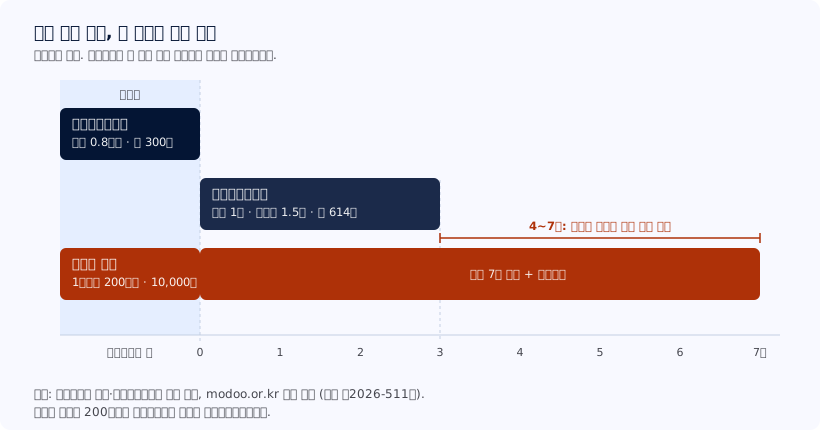
The 2026 page splits about 614 selections across three tracks. 일반형 (general) takes 400, 딥테크 (deep tech) 146, and 투자연계형 (investment-linked) 68.
The funding ceiling tracks the track. 일반형 and 투자연계형 reach KRW 100 million; 딥테크 reaches KRW 150 million.
| 예비창업패키지 | 초기창업패키지 | |
|---|---|---|
| Who applies | No registration or company representative power on the 공고's cutoff date (22 Jan 2026) | Registered, within 3 years of founding |
| Commercialisation funding | Average KRW 40 million, two stages (2026 공고) | Up to KRW 100M · KRW 150M (딥테크) |
| 2026 selections | about 300 | about 614, three tracks |
| Budget | KRW 49.125 billion | KRW 55.852 billion |
| Cycle, as printed | Call late Feb 2026, funding from June | Call Dec 2025, funding from March 2026 |
The 예비창업패키지 cutoff date and average come from its 2026 공고. Every other figure comes from the two programme pages KISED publishes. Both were read on the same day, and both mark their dates as planned.
What the money and programmes cover
The commercialisation fund (사업화자금) covers prototype production, marketing, and IP filing and registration. Same spending categories as the rung below.
The programme side shifts upmarket with the company. Each administering institution tailors its support around market entry (시장진입), early investment attraction (초기 투자유치), and pilot validation (실증검증).
The 2025-26 cycle, as printed
The page prints four steps. The 공고 came in December 2025.
Applications ran January to February 2026, selection and agreement February to March, funding from March. The later steps carry 예정 (planned).
Note the season. The pre-startup rung calls in late February and funds from June; this rung called in December and funds from March. The two windows do not compete for the same calendar space.
That is what makes riding both rungs in sequence practical.
Applying
Applications go online through the K-Startup portal (k-startup.go.kr), with a business plan (사업계획서) and supporting documents.
The page lists two contact points. The MSS office is 중소벤처기업부 신산업기술창업과, on 044-204-7648 or 7666. KISED's is 초기도약실, on 044-410-1831, 1834, 1836 or 1864.
Frequently asked questions
- What is the difference between 예비창업패키지 and 초기창업패키지?
- Registration and tenure. 예비창업패키지 takes founders who, on a cutoff date its 공고 sets (22 January 2026 for the 2026 call), hold no business registration in their own name and no power to represent a company; 초기창업패키지 takes registered companies within three years of founding (업력 3년 이내). The ceilings, budgets and cycle seasons also differ — the early-startup rung pays more and opens earlier in the year.
- My company is four years old. Can I apply?
- Not under the printed criterion. KISED's page defines the target as 초기창업기업 within 업력 3년 — three years of business tenure. Past that line, this page does not offer a rung.
- How much does 초기창업패키지 pay?
- Up to KRW 100 million (1억원) for the 일반형 and 투자연계형 tracks, and up to KRW 150 million (1.5억원) for 딥테크 — covering prototype production, marketing, and intellectual-property filing and registration.
- What are the three tracks?
- The 2026 page prints a scale of about 614 companies across three tracks: 일반형 (general) 400, 딥테크 (deep tech) 146, and 투자연계형 (investment-linked) 68. What qualifies a company for each track is set in the announcement, not on this overview page.
- When did the 2026 cycle run?
- The page prints: announcement December 2025, applications January to February 2026, selection and agreement February to March 2026, funding from March 2026. The later steps are marked 예정 (planned), so the live announcement is the binding document.
- Who do I contact about 초기창업패키지?
- The page lists the MSS office (중소벤처기업부 신산업기술창업과) at 044-204-7648 or 7666, and KISED's 초기도약실 at 044-410-1831, 1834, 1836 or 1864.
Sources
- KISED, 초기창업패키지 programme page — eligibility, budget, tracks, funding ceilings, 2026 schedule, contacts — read 2026-09-01
- KISED, 예비창업패키지 programme page — comparison figures for the pre-startup rung — read 2026-09-01
- Hero photograph: WeWork Jongno Tower, Seoul, by Steve46814, Wikimedia Commons, CC BY-SA 4.0 — read 2026-09-01
- 2026년도 예비창업패키지 예비창업자 모집 수정 공고, 중소벤처기업부 공고 제2026-207호 (revised 2026-03-24), with its Q&A attachment (별첨 4) — eligibility cutoff, funding, schedule, foreigner identity check — read 2026-09-18
Everything above is the rule as published. See how it applies to your case.
Read next
- ProgramsKorea Expressway youth AI startup pilot (한국도로공사 청년 AI 스타트업): who counts as 청년
- ProgramsStartup Water 2026 (물산업 혁신 창업대전): K-water's water startup competition
- ProgramsWhat Early Startup Package hosts run beyond the grant: open innovation meetups and IR contests
- ProgramsThe TIPS family for foreign founders: Pre-TIPS to Global TIPS, track by track