GovTech and public-sector competitions in Korea: read the line before the prize
GovTech 공공부문 창업경진대회 읽는 법
A public-sector competition is not one generic grant. K-Startup classifies notices by support line and publishes the current announcement, operator and attachment. Use the GovTech line as a route for matching a public problem to the notice that actually accepts your company.

On this page
Public-sector competitions can look like ordinary pitch calls. The material difference is the problem owner: a ministry, local government, public agency or other public institution may define the need and the route to participate.
Start with the K-Startup line
K-Startup groups notices into lines such as commercialization, R&D, facilities and incubation, mentoring, events and networks, loans, personnel and global support. The portal also lists current public-sector notices under the responsible institution and support category.
The GovTech line should therefore be read as a route through the notice system, not as a promise that every public-sector competition has the same benefit. The individual notice controls.
Separate the problem owner from the operator
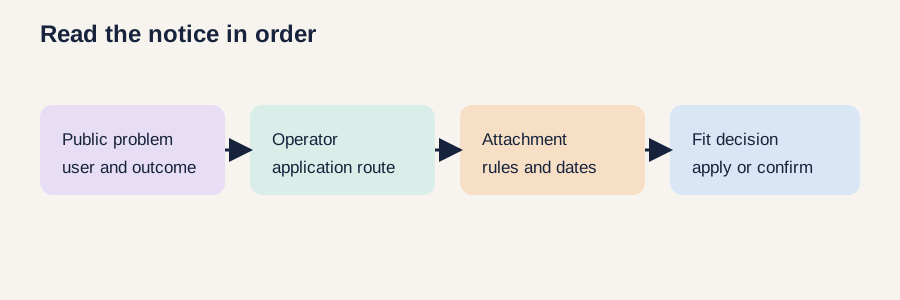
The institution with the problem may not be the organisation receiving applications. K-Startup identifies an operator or responsible organisation for each notice, while the attached document may describe the public institution's challenge.
Record both. The problem owner helps you test whether your product fits the use case. The operator tells you where to submit, which form to use and which questions the programme asks.
| Notice field | Decision it supports |
|---|---|
| Support line | What kind of support route this is |
| Problem or challenge | Whether your product addresses the stated need |
| Operator | Who manages the application or programme |
| Dates | Whether the opportunity is open for your preparation cycle |
| Attachment | The actual eligibility and submission instructions |
Treat the attachment as the rulebook
The K-Startup reference library publishes programme management standards and guidance as separate materials. That separation matters because a form or management standard for one programme is not automatically the form for another.
Do not carry a prize amount, pilot promise, equity term or selection score from a blog post or old announcement. If the current attachment does not state it, write “confirm against the current 공고” in your internal notes and leave it out of the public article.
Test the public problem before pitching
Translate the challenge into a short problem statement. Name the public service, user group and measurable failure described by the notice. Then explain what your product changes and what evidence you already have.
Avoid writing “the government needs innovation” as the problem. That sentence does not identify a service, operator, user or testable outcome.
For a foreign-founded company, also test the practical route. The notice may define an applicant category, a Korean business requirement, a consortium condition or a delivery boundary. These are notice-specific questions, not assumptions to fill from another programme.
Keep competition and funding separate
Some public-sector opportunities may include support, but the portal's category alone does not tell you the exact benefit. “Event and network,” “commercialization” and “facility” are different support lines with different consequences.
Read the benefit section and the eligibility section together. A company can fit the public problem and still fail an applicant condition. Conversely, an eligible company can still be a poor fit if it cannot deliver the stated public use case.
Prepare a notice-specific file
Keep the current notice, attachment, company registration evidence, product description, public-problem fit and delivery plan in one folder. Use the operator's own terminology when you answer.
The K-Startup portal is the discovery layer. The current notice and attachment are the decision layer. That distinction keeps a useful public-sector opportunity from becoming an unsourced promise in your plan.
Review the current opportunities on the programmes page, then confirm eligibility with the notice operator before submitting.
Frequently asked questions
- Is GovTech one fixed Korean grant programme?
- No. Treat it as a route through public-sector startup notices. The current announcement controls its support, eligibility and submission rules.
- Where should I find a public-sector competition?
- Start with K-Startup's current notices, then open the specific announcement and its attachment.
- Who is the operator?
- The operator is the organisation identified by the notice as managing the application or programme. Record it separately from the public problem owner.
- Does a competition guarantee a government contract?
- Not unless the current notice says so. Do not convert a challenge, selection or pilot description into a procurement promise.
- Can a foreign-founded company apply?
- Check the current notice's applicant and delivery conditions. Do not infer eligibility from another public-sector programme.
Sources
- K-Startup 창업지원포털 - current recruitment notices — read 2026-09-21
- K-Startup official reference library — read 2026-09-21
- KISED official site and K-Startup portal link — read 2026-09-21
Everything above is the rule as published. See how it applies to your case.
Read next
- ProgramsThe Korean startup 공고 season: why January to March feels heaviest
- ProgramsCorporate open innovation calls: what BOUNCE shows a startup should prepare
- ProgramsTokyo PMF and GTM programmes: how to read an overseas expansion line
- ProgramsSVC Seoul Startup Venture Campus: the global membership line