The Korean startup 공고 season: why January to March feels heaviest
한국 창업지원사업 공고 시즌과 11월 준비법
Korean startup-support notices do not all open on one national deadline. Still, January to March often feels heavy because the annual integrated notice is published before the year starts and many KISED programme pages place notices, applications and selection steps across the first quarter. Use November to prepare a system, not to guess next year's dates.

On this page
The Korean word 공고 means an official public notice. For a founder, the important point is not that every programme opens in January. It is that the year's support information and many major application windows begin moving before a founder who starts in January has finished collecting evidence.
The Ministry of SMEs and Startups publishes an annual integrated startup-support notice covering central government and local-government programmes. K-Startup presents programme notices and a schedule view. KISED programme pages then show that individual lines use different publication, application, evaluation and support periods.
The season is a rhythm, not a deadline
The first quarter is a useful planning signal, not a promise. KISED's published calendars show notices in December and March, with applications running through January and February, depending on the line. One programme can open in January while another publishes its notice in March or runs applications later.
That variation is normal. The integrated notice makes the system discoverable; it does not replace each programme's own notice. A founder should use the annual notice to build a search list, then use the operator's current page to verify the active call.
The season also varies by support line. Business-commercialization, technology development, facilities, mentoring, finance and global programmes do not need to follow the same calendar. A regional programme may depend on a local budget or operator, while a central programme may publish through K-Startup.
Why November is the preparation month
November gives you time to make evidence reusable. Prepare a short company description, founder biographies, registration records, product screenshots, customer evidence, intellectual-property records and a clear explanation of the problem you solve. Keep each item dated and label what it proves.
For a foreign founder, add a translation plan. Decide which records need Korean translation, which source document remains authoritative and who will verify names, dates and company identifiers. Do not wait for an open call to discover that two documents romanize a name differently.
The aim is not to complete every possible application in November. The aim is to remove work that should not be repeated when a suitable notice opens.
| Prepare in November | Why it helps in the first quarter | What still needs current verification |
|---|---|---|
| Founder and company evidence | Reuses facts across applications | Required file type and issue date |
| Customer and traction record | Shows what has actually happened | Whether that evidence fits the programme |
| One-page programme profile | Makes screening faster | Eligibility and programme line |
| Korean terminology list | Reduces translation drift | Official Korean field names |
| Calendar and alert system | Prevents missed notices | Published opening and closing time |
This checklist is preparation, not an application. A notice may require a new form, a newly issued certificate, a different company age calculation or an operator-specific attachment.
Read the annual integrated notice correctly
The MSS integrated notice is a map of the support system. It groups programmes by support type and brings central and local programmes into one information source. That makes it useful for discovering a line you did not know existed.
It is not proof that your company qualifies for every programme in a category. Eligibility can depend on business age, location, sector, founder status, prior support, intellectual property, investment or other conditions in the individual notice.
Use the integrated notice to record four fields: programme name, support line, issuing body and where the detailed notice will appear. Then open the detailed notice and copy its exact application route into your tracker.
Build a programme tracker before the rush
A useful tracker does more than store URLs. Record the date fetched, operator, eligibility summary, required documents, application route, closing time, contact point and your own readiness status. Add a note whenever the page says that details may change.
Use a status that reflects evidence, not optimism. “Watching” means the line might fit. “Verify” means a current notice exists but a condition is unresolved. “Ready” means the required facts and documents are available. “Submitted” means the portal or operator gave you a receipt.
For Korean notices, keep the original title and the English working label. Translation is a navigation aid, not a replacement for the official wording. This matters when similar English names describe different programme lines.
Follow the operator, not just the portal
K-Startup is the central discovery surface, but KISED programme pages often show the line-specific sequence. The pages fetched for this post place different programmes on different rhythms: one begins with a December notice and January-to-February application period, while others place notices and applications in February or March.
That is why an alert for the programme operator can matter as much as a general portal search. Follow the issuing body named in the programme page. If the programme is regional, follow the regional operator as well.
The portal can tell you that a notice exists. The operator's current notice tells you what the applicant must actually do.
Avoid the three seasonal traps
First, do not prepare from a screenshot of last year's dates. It may show the right programme but the wrong eligibility or application route.
Second, do not wait for the deadline before checking the documents. A certificate issued after the notice date may not satisfy a requirement, and a portal may require a format that takes time to produce.
Third, do not treat every March notice as a last chance. Some lines open later, some run more than one round and some are local. The current notice decides whether a missed window can be replaced by another route.
Plan around decisions, not dates
Your November plan should end with decisions. Which customer evidence is strong enough to reuse? Which programme lines are plausible? Which eligibility questions need an operator answer? Which documents need renewal? A date without a decision owner is just a reminder that can be ignored.
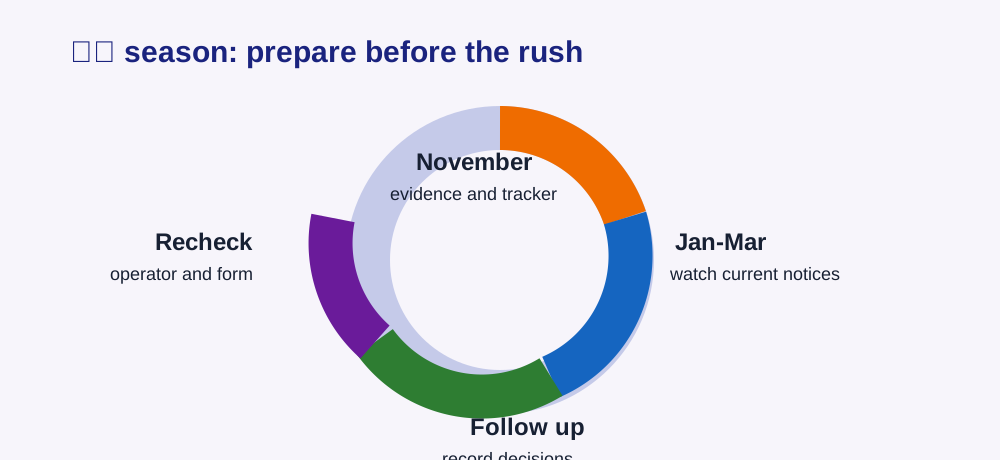
In January, review active notices and reject poor fits quickly. In February and March, prepare the applications whose eligibility and evidence are confirmed. After each window, record what changed so the next season starts with better information.
This rhythm is more durable than a list of deadlines because it survives changes in programme names and publication dates. It also gives a foreign founder time to resolve translation and company-status questions before the portal is busy.
Use the live programmes directory to compare current lines, then validate your fit in the idea validation workflow. The dates belong to the current notice, not to this article.
Frequently asked questions
- When is the Korean startup 공고 season?
- January to March often feels busiest, but there is no single national deadline. Individual programmes publish their own notices and schedules.
- Why should I prepare in November?
- November gives you time to organize reusable company, founder, customer and translation evidence before first-quarter notices begin moving.
- Does the annual integrated notice control my application?
- No. It is a discovery map. The detailed current programme notice controls eligibility, documents, dates and submission route.
- Do all Korean startup programmes open in January?
- No. Official KISED calendars show notices published in December for some lines and March for others, with applications running in between.
- What should be in a programme tracker?
- Record the operator, current notice URL, fetched date, eligibility, required documents, application route, closing time, contact point and readiness status.
- Can I reuse last year's application dates?
- Use last year's rhythm only for planning. Replace every deadline and requirement with facts from the current official notice before applying.
Sources
- MSS - 2026 integrated central and local startup-support notice — read 2026-09-21
- KISED - official programme announcements — read 2026-09-21
- KISED - Re-Challenge Success Package programme calendar — read 2026-09-21
- KISED - TIPS programme calendar — read 2026-09-21
- K-Startup - official portal schedule and programme notices — read 2026-09-21
Everything above is the rule as published. See how it applies to your case.
Read next
- ProgramsCorporate open innovation calls: what BOUNCE shows a startup should prepare
- ProgramsTokyo PMF and GTM programmes: how to read an overseas expansion line
- ProgramsSVC Seoul Startup Venture Campus: the global membership line
- ProgramsKorean startup programmes by sector and stage: which line fits you?