Corporate open innovation calls: what BOUNCE shows a startup should prepare
기업 오픈이노베이션 공고와 BOUNCE 준비법
Corporate open-innovation calls are usually about a specific company problem, not a general startup pitch. BOUNCE is a useful worked case: its official notice describes private one-to-one meetups between startups and large or mid-sized companies, so founders should prepare a problem-matched collaboration proposal rather than a generic deck.
On this page
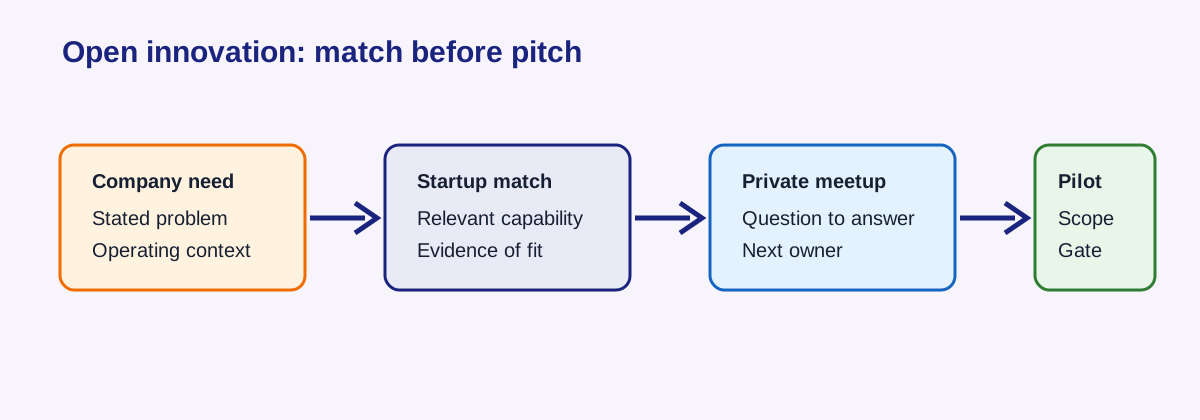
Corporate open innovation is a matching process with an operating question behind it. The company is not only asking whether your startup is interesting. It is asking whether your product could fit a real need, team, workflow or market opportunity.
The Korea Institute of Startup & Entrepreneurship Development describes public-private open innovation as a support system for partnerships between corporates and startups. Its programme page separates company-needs recruitment, collaboration-project evaluation, startup recruitment, evaluation, selection and implementation. That sequence is more useful than a vague promise to “network.”
Read the company problem before the event name
An event brand can attract attention, but the company problem decides whether a meeting is useful. Read the demand topic, desired technology, target customer or operating constraint in the current notice. Then decide whether your product answers that specific need.
The official BOUNCE 2026 notice described a startup open-innovation festival run by the Busan Center for Creative Economy and Innovation. It targeted startups located nationwide with less than seven years of operating history as of the notice date and offered one-to-one private meetups with matching partner companies.
That eligibility description does not establish a nationality rule for founders. A foreign founder should check the current notice against the Korean company's location, registration and age evidence rather than assume that a foreign passport either qualifies or disqualifies the company.
BOUNCE is a worked case, not a universal template
The BOUNCE notice is specific. It describes a private meetup format and a meeting length of around 25 minutes. It does not turn every open-innovation programme into a 25-minute meeting, and it does not promise that every meeting becomes a contract.
The distinction matters because KISED's broader public-private open-innovation page describes several programme types. Its published procedure includes demand-led, problem-solving and self-proposal pathways, with details varying by type. Some support can include commercialization funding or an R&D linkage, but those are programme-level descriptions, not automatic BOUNCE benefits.
| Question | BOUNCE worked case | What to verify in another call |
|---|---|---|
| Who is involved? | Matching partner companies and startups | The named corporate or public demand holder |
| Meeting format | Private one-to-one meetup | Online, in-person, group or staged format |
| Meeting length | Around 25 minutes in the notice | The current notice's stated duration |
| Intended outcome | Mentoring and a collaboration proposal opportunity | Pilot, proof of concept, procurement, investment or another outcome |
| Eligibility | Nationwide startup with less than seven years in the notice | Location, age, sector and company-status rules |
Use the table as a reading method, not as a promise about the next BOUNCE round. A new notice may change partner companies, eligibility, format or application evidence.
Build the first minute around the match
Twenty-five minutes is short enough that a generic company history can consume the useful part of the meeting. Start with the partner's stated need. Say what you do, where your evidence fits that need and what small test could prove the match.
The first minute should answer four questions. Which problem are you addressing? Why can your team address it? What evidence reduces the partner's uncertainty? What can the partner decide after the meeting?
Do not lead with every feature. A corporate partner needs to understand the boundary of the proposed collaboration: the user, process, data, integration, site, country or business unit involved.
Bring proof that matches the partner's risk
Evidence should answer the risk the partner cares about. A usage record can show that customers use a workflow. A pilot result can show that the workflow works in a defined setting. A security review, integration note or delivery plan can address adoption risk.
Do not present a broad market statistic as proof that one partner's process will improve. Name what the evidence demonstrates and what it does not demonstrate. If the evidence comes from a different sector or country, state that difference before the partner has to ask.
For a foreign-founded company, explain the Korean operating context that is already real. A Korean customer, local partner, language capability or integration is useful only when it exists and can be documented. Do not turn an intention to enter Korea into a local traction claim.
Define the proposed collaboration
“Let us work together” is not a pilot. Define the smallest collaboration that can answer the partner's question. It might involve a limited workflow, a controlled user group, a technical integration review or a short validation exercise. The appropriate form depends on the partner's notice and internal process.
Set out the partner contribution and your contribution. The partner may provide access to a process, users, data, facilities or technical staff. Your team may provide software, implementation, analysis or support. If either side needs approval, identify that dependency.
The proposal should also have a stop condition. If the test does not meet the agreed measure, both sides should know whether to revise, pause or end it. This makes the proposal safer to evaluate than an open-ended promise.
Prepare for the handoff after matching
The meeting is only useful if the next step has an owner. End by confirming the question to be answered, the document to exchange and the person who will make the next internal decision. Record the partner's words accurately; do not fill a gap with an assumption.
If the company asks for a technical review, prepare a short architecture or integration note. If it asks for a commercial proposal, prepare scope, assumptions and a decision timeline. If it asks for another meeting, ask what evidence should be present before that meeting.
KISED's broader open-innovation procedure includes collaboration-project implementation after selection and agreement steps. That is a reminder that matching is one stage in a longer process. A founder should be ready for the operational work after the introduction, not only the pitch.
Check the current notice before applying
The official BOUNCE notice used for this worked case had its own eligibility, application route and meeting description. Its details should not be copied into a later round without checking the new notice. K-Startup and the programme operator are the places to confirm the active call.
For an English-speaking founder, the safest workflow is to save the Korean notice, identify the issuing operator, translate only the fields you need and keep the original wording beside your application notes. If the notice does not answer a point, ask the operator instead of relying on a summary page.
Review the active programmes before applying. For the application itself, use the idea validation workflow to test whether your proposed collaboration has a customer, evidence and a clear next step.
Frequently asked questions
- What is a corporate open-innovation call?
- It is a structured opportunity to match a startup's capability with a company or public-sector need and explore a defined collaboration.
- What did the BOUNCE 2026 notice offer?
- The official notice described private one-to-one meetups with matching partner companies, with meetings around 25 minutes, plus mentoring and a collaboration proposal opportunity.
- Does a BOUNCE meetup guarantee a contract?
- No. A meetup or collaboration proposal opportunity is not a contract, investment, purchase order or guaranteed pilot.
- Can a foreign founder apply?
- Do not infer a nationality rule from the event name. Check the current notice against the Korean company's location, registration, age and other stated eligibility requirements.
- What should I bring to the meeting?
- Bring one problem match, one relevant proof point, one small proposed test and a clear next decision. Keep technical and commercial details ready for follow-up.
- Is every open-innovation programme funded?
- No. KISED describes several programme types and possible support routes. Confirm whether the specific call offers funding, R&D linkage, mentoring, a pilot or another outcome.
Sources
Everything above is the rule as published. See how it applies to your case.
Read next
- ProgramsTokyo PMF and GTM programmes: how to read an overseas expansion line
- ProgramsSVC Seoul Startup Venture Campus: the global membership line
- ProgramsKorean startup programmes by sector and stage: which line fits you?
- ProgramsTIPS and the private-public matching route: the investor decides first, the government funds follow