Tokyo PMF and GTM programmes: how to read an overseas expansion line
도쿄 PMF·GTM 프로그램 읽는 법
An overseas PMF or GTM programme should be read as a market-validation route, not as a travel budget or a guaranteed sales channel. Use the Tokyo line as a worked case: define the target market, prepare evidence, and verify the current notice before relying on dates or support details.

On this page
“Overseas programme” is not a single type of support. One line may offer mentoring, another may arrange market meetings, and another may support a defined localization or validation project. The useful question is what the selected company must prove and what work the programme actually enables.
PMF and GTM answer different questions
Product-market fit asks whether a particular customer group has a problem worth solving and keeps choosing the response. Go-to-market asks how the company reaches that group, sells to it, delivers the product and learns from the market.
The two belong together but should not be collapsed. A founder can have a strong product hypothesis with no reliable sales route. Another founder can have a distribution partner but weak evidence that the product solves a local need. An overseas programme can expose both gaps.
The KISED global line is a useful reference
KISED’s Global Market Expansion Program describes support for startups seeking overseas expansion. Its page names accelerating modules such as business localization and mentoring, a staged process from announcement through agreement and support, and application through the K-Startup website.
That description gives a shape for reading other overseas lines. It does not prove that every destination programme has the same amount, schedule, applicant rule or deliverable. A Tokyo notice must be read as its own round.
K-Startup’s global catalogue also shows that overseas support covers different models. Its listings include market expansion, global startup centres, corporate collaboration and overseas validation. A destination is therefore a clue, not a category.
Read the Tokyo line as a test plan
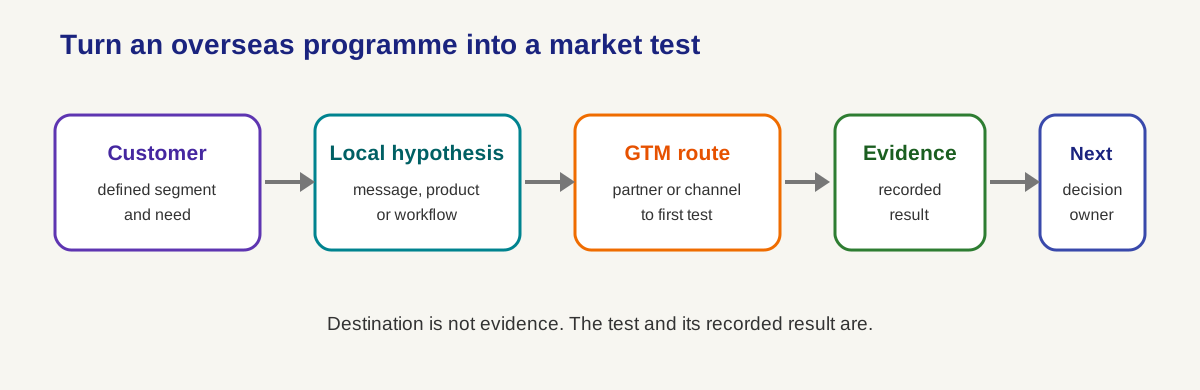
For the Tokyo PMF and GTM worked case, begin with the local customer and buying context. Name the segment, the problem, the current alternative, the language required, the route to a first conversation and the result that would change the next decision.
| Application question | Evidence to prepare |
|---|---|
| Who is the Tokyo customer? | Segment, role, company type and buying context |
| What needs local validation? | A product, message, price hypothesis or workflow |
| How will you reach the market? | Partner, channel, event, outbound or existing network |
| What will count as learning? | Qualified meetings, pilot decision, repeat use or another defined result |
| What happens after the programme? | Owner, follow-up date and decision rule |
Avoid claiming that a meeting is traction. A meeting is an activity. A pilot, purchase, repeat use or written decision can be evidence of a stronger kind, but only if it actually occurs and is recorded.
Separate the programme from the market
The operator may provide mentoring or introductions. It does not become the customer, distributor or investor merely because it runs the programme. The founder still owns the market hypothesis, the evidence and the follow-up.
For a foreign founder in Korea, also identify the applying entity. A Korean company, an overseas company and an individual can face different applicant rules. A global label does not settle that issue. Read the notice’s eligibility sentence and attachments.
Resolve the current notice before applying
KISED’s pages say that global programme application periods are announced through K-Startup. On 2026-09-21, the public K-Startup pages I fetched exposed current global listings and Silicon Valley GTM notices, but not a retrievable Tokyo PMF/GTM detail page. That is a source-availability conflict, not permission to fill the gap with a secondary summary.
Use the programmes directory as a discovery aid, then save the current official notice, attachments, issuing body, application window, applicant definition and deliverables. If the Tokyo line is closed or renamed, update the application plan rather than assuming the old label still controls.
Check the programmes directory for the current overseas listing and keep the official K-Startup notice with your application record.
Frequently asked questions
- What is the difference between PMF and GTM?
- PMF tests whether a defined market strongly needs and chooses the product. GTM is the route used to reach, sell to and deliver the product to that market.
- What does KISED describe for global expansion?
- KISED describes acceleration modules such as localization and mentoring, with staged application and support through the K-Startup route. The current notice controls each round.
- What should I prepare for a Tokyo PMF programme?
- Define the Tokyo customer, local problem, validation task, route to a first conversation, evidence to record and decision that follows the test.
- Does a programme meeting count as traction?
- No. A meeting is an activity. A pilot, purchase, repeat use or documented customer decision can provide stronger evidence if it actually occurs.
- Where can I confirm Tokyo programme dates and eligibility?
- Check the current K-Startup notice and its attachments, plus the named operator. Do not rely on a secondary page when the official detail is unavailable.
Sources
- KISED - Global Market Expansion Program overview, support model and application route — read 2026-09-21
- KISED - Global Accelerating Support Program overview — read 2026-09-21
- K-Startup - official global programme catalogue and current listings — read 2026-09-21
- K-Startup - official ongoing notices — read 2026-09-21
Everything above is the rule as published. See how it applies to your case.
Read next
- ProgramsSVC Seoul Startup Venture Campus: the global membership line
- ProgramsKorean startup programmes by sector and stage: which line fits you?
- ProgramsTIPS and the private-public matching route: the investor decides first, the government funds follow
- ProgramsCOMEUP 2026 lands at COEX on 9 December — and the K-Startup Grand Challenge window is still unannounced