Korean startup programmes by sector and stage: which line fits you?
업종과 성장단계에 맞는 창업지원사업 찾기
Korean startup support is organized into lines that include commercialization, R&D, space, mentoring, global support and more. Choose by company stage and sector first, then verify the current notice rather than treating every programme as interchangeable grant funding.

On this page
“Which Korean programme should I apply to?” is usually too early. First identify the need.
You may need customer validation, technical development, workspace, advice, hiring support, overseas expansion or finance. Those needs sit in different lines.
Stage tells you what kind of help is useful
An idea-stage founder may need evidence that the customer problem is real.
A product company may need development, testing, sales or market-entry support. A later-stage company may seek investment connections, export support, facilities or a specialist partner.
These are working categories, not promises about every notice. Each current notice can define its applicant type and exclusions.
Use stage to narrow the search. Then read the eligibility section as the controlling document.
K-Startup's official portal lists 8 support lines. They cover commercialization, R&D, facilities and incubation, mentoring and consulting, events and networking, loans, personnel and global support.
That menu prevents a space programme from being compared directly with a technology-development programme.
Sector narrows the operator and evidence
Sector is more than a keyword. It can change the proof, operator and facility that fit the need.
A manufacturing company may need equipment or technical validation. A software company may need customer access, data governance or a global market route.
A life-science company may need a specialised review path.
Do not infer eligibility from the sector heading alone. A notice can restrict applicants by incorporation, company age, location, ownership, prior support or business activity.
If the notice does not cover a foreign-founded company, leave the point open. Confirm it with the operator.
| Filter | Question to answer | Evidence to prepare |
|---|---|---|
| Stage | What has already happened? | Incorporation, product, users, revenue or development record |
| Sector | What market or technology is central? | Product description, customer, classification or technical material |
| Bottleneck | What changes after support? | A measurable milestone and delivery plan |
| Applicant | Which entity applies? | Registration, representative, address and ownership documents |
| Line | What kind of support is offered? | Notice, budget rules, matching or reimbursement conditions |
The MSS English site lists 11 major policy areas. Startups sit alongside venture businesses, technology innovation, human resources and export.
That list maps policy. It does not create one application window. K-Startup notices supply the operational detail.
Match the line to the deliverable
Commercialization support fits a plan that turns a product or service into a market result.
R&D fits a technical deliverable. Facilities and incubation fit a need for space or an operating base.
Mentoring, consulting and education fit a capability gap. Global support fits a defined overseas expansion task.
The labels do not tell you whether support is a grant, reimbursement, loan, voucher, service or selection into a network. Read what the notice says the selected company receives and what the company must contribute. “Support” is not a synonym for unrestricted cash.
For a foreign founder, add 2 checks. First, identify the Korean entity that would apply.
Second, check whether the notice limits the programme to a region, company type or Korean-national applicant. A sector match cannot cure an applicant mismatch.
Use the portal as a map, not a shortcut
The K-Startup portal links to current notices, programme introductions, reference materials and application management. Its reference library also carries management standards and programme guidance. KISED links founders to K-Startup for support notices, while MSS supplies the policy-level context.
That division is useful. The ministry explains the policy environment.
KISED and the portal expose programme information and operational material. The operator's notice explains the round.
Use that last layer for dates, forms, documents and eligibility.
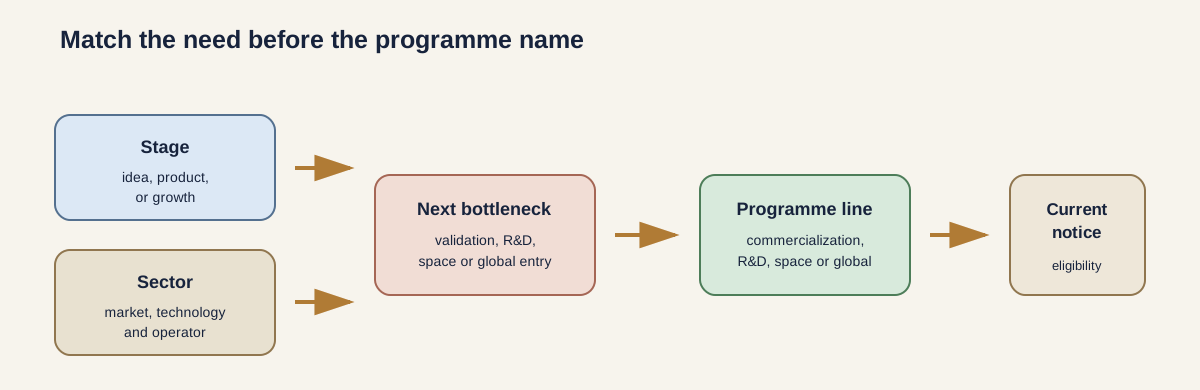
Use the programmes directory to keep the shortlist, but confirm each row against the issuing body before preparing an application.
Frequently asked questions
- How do I choose a Korean startup programme?
- Start with the company stage and the next bottleneck, then use the sector to narrow the operator. Verify eligibility and documents in the current notice.
- What programme lines does K-Startup show?
- The portal separates information into lines including commercialization, R&D, facilities and incubation, mentoring and consulting, events and networking, loans, personnel and global support.
- Does a sector match prove that I am eligible?
- No. A notice can add rules about company age, incorporation, geography, ownership, prior support and applicant type. The notice and attachments control.
- Is every startup support programme a grant?
- No. The word support can cover different forms of assistance. Read what the notice provides and what the selected company must contribute or reimburse.
- Where should a foreign founder check eligibility?
- Identify the applying entity, then read the current K-Startup notice and its attachments. If the notice does not clearly cover your situation, confirm with the listed operator.
Sources
- K-Startup 창업지원포털 - programme lines and current notices — read 2026-09-21
- K-Startup official reference library — read 2026-09-21
- KISED official site - support portal description — read 2026-09-21
- MSS official English site - startup policy areas — read 2026-09-21
Everything above is the rule as published. See how it applies to your case.
Read next
- ProgramsTIPS and the private-public matching route: the investor decides first, the government funds follow
- ProgramsCOMEUP 2026 lands at COEX on 9 December — and the K-Startup Grand Challenge window is still unannounced
- ProgramsTry Everything 2026 at DDP, and the investor meetup door that shut on 19 July
- ProgramsKorea's 예비창업패키지 in 2026: an average of KRW 40 million in two stages, and a 22 January cutoff