Try Everything 2026 opens at DDP on 9 September — and the investor meetup door shut on 19 July
트라이 에브리싱 2026, 9월 9일 DDP 개막 — 1:1 밋업 신청은 7월 19일 마감
Seoul's global startup festival runs 9-10 September 2026 at the DDP Art Hall. Registration is free and closes 8 September, but the 1:1 investor meetup window closed seven weeks before the doors open. What is actually on the floor, and what this event is not.
On this page
- Who runs Try Everything, and where it sits
- The four dates, and the two that have already passed
- What is actually on the floor
- The four tracks, in Seoul's own words
- The 2025 numbers, and what they do and do not measure
- Who is on the stage list
- The half of the roster nobody reads: the public bodies
- What Try Everything is not
- Working two days with no scheduled meetings
- If you are reading this on 7 or 8 September
Seoul runs one startup event a year that the rest of the world buys a plane ticket for. It opens in two days.
Try Everything 2026 fills the DDP on 9 and 10 September. Registration is still open, still free, and takes about as long as ordering a coffee.
The part of it that moves money closed on 19 July. Almost no English-language coverage mentions that, which is how a fair number of founders will walk in on Tuesday expecting meetings that were booked six weeks ago.
Who runs Try Everything, and where it sits
Try Everything is the Seoul Metropolitan Government's annual global startup festival. Maekyung Media Group co-runs the 2026 edition.
The secretariat works out of Seoul Startup Hub in Mapo-gu. Seoul holds the festival every September.
This year's slogan is "AI Changes Everything, Now Try Everything". The programme leans hard on it: keynotes, corporate pavilion and most of the exhibition all sort by AI application.
The venue is the DDP Art Hall — Halls 1 and 2 plus the Conference Hall. Doors open at 10:00 and close at 18:00 on both days.
The four dates, and the two that have already passed
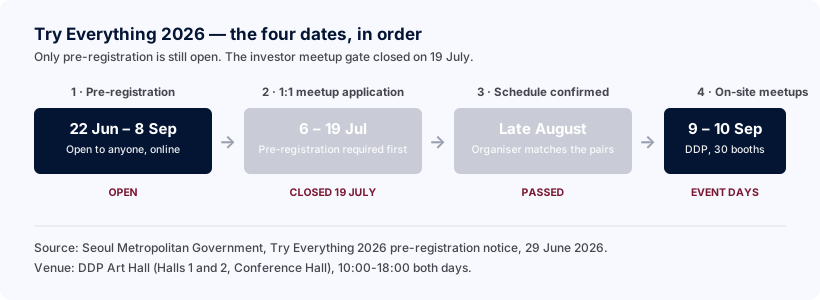
Seoul published the meetup funnel as a four-step table back in June. Three of those four steps now sit behind us.
| Step | Window | Status on 7 September |
|---|---|---|
| Pre-registration | 22 June – 8 September | Open. Closes tomorrow |
| 1:1 meetup application | 6 – 19 July | Closed |
| Final meetup schedule confirmed | Late August | Done |
| On-site 1:1 meetups | 9 – 10 September | The event itself |
The order matters more than any single date. Meetup applications opened only to people who had already pre-registered.
So the two windows nest, and the inner one shut first. Register late and you inherit the festival, not the meetings.
A founder who signs up on 8 September gets the floor, the talks and every booth. They do not get a scheduled investor meeting, because the organiser matched those pairs in late August.
What is actually on the floor
The exhibition runs 80 startup booths, Korean and overseas.
Above them sits a corporate pavilion. Six companies took space, and each one published what it wants to see.
| Corporate pavilion | What it is scouting |
|---|---|
| CJ CheilJedang | Food tech, AI |
| Samsung Financial Networks | AI, finance, fintech |
| Hyundai Home Shopping | AI, marketing, living |
| Hyundai Motor Group Robotics Lab | Mobility robots, wearable robots |
| Naver Cloud | AI, cloud, big data |
| Megazone Cloud | AI, cloud, DX |
Read that table as a scouting brief, not a sponsor list. A founder in wearable robotics knows exactly which booth to stand in front of.
A separate global pavilion holds overseas startup-support agencies, investment houses and government bodies. Foreign founders usually under-rate that room.
Seoul also doubled the dedicated meetup booths, from 15 in 2025 to 30 this year. About 40 overseas investors, corporates and institutions had confirmed when the June notice went out, and the organiser kept recruiting through August.
There is also a PLAVE Zone, built around the virtual idol group that serves as Seoul's startup ambassador. A K-pop act that does not physically exist is fronting a government startup festival, and it has a photo booth. Seoul has never been a subtle city.
The four tracks, in Seoul's own words
The organiser breaks the two days into four headline blocks. They are worth reading literally, because they tell you which parts have a gate and which do not.
| Track | What it covers | Can you still join? |
|---|---|---|
| Talks and seminars | Keynotes and conference sessions | Yes, with a badge |
| Pitching and contests | IR pitching, competitions | As audience, yes |
| Exhibits and meetups | 80 booths, 30 meetup booths | Booths yes, meetups no |
| Networking | Open floor, corridors, receptions | Yes |
Three of the four are open to anyone who registers by tomorrow. The scheduled meetups are the one door that shut in July.
The event's own description of itself is blunt about the target. It says the festival gathers founders chasing technical collaboration, investment and overseas expansion, alongside the partners who back them.
It names North America, Europe and Asia as the source regions for its attending ecosystem players. That is the market Seoul is buying, and a foreign founder already in Korea is on the cheap side of that trade.
The 2025 numbers, and what they do and do not measure
The organiser publishes last year's totals on the front page.
| Try Everything 2025 | Reported total |
|---|---|
| Attendees | 7,700+ |
| VCs and accelerators | 1,620+ |
| Startups | 1,400+ |
| Investment | KRW 126 billion |
| Meetups held | 540+ |
Treat the attendance and meetup counts as gate figures. Someone counted badges and booked slots, and a venue can actually produce those numbers.
The KRW 126 billion is a different kind of number. Seoul reports it next to the event without publishing a method for attributing it.
That does not make it false. It makes it a headline figure rather than an evidence figure: no attribution window, no definition of which rounds count, no method. Hold it loosely, and do not book flights against it.
Who is on the stage list
The published speaker roster runs well past a hundred names. A few sketch the shape of the room.
Erik Brynjolfsson of Stanford is on it. So are Alberto Onetti and Marco Marinucci of Mind the Bridge, the scale-up research outfit that publishes the annual open-innovation reports.
The Korean investment side brings Kakao Ventures, IMM Investment, Antler Korea, SoftBank Ventures Asia, BluePoint Partners, Storm Ventures and New Paradigm Investment. Mark & Company, Factorial Funds and Riverbend Investment fill in around them.
Corporate scouts come from Palantir, Plug and Play, LG NOVA, Salesforce Ventures, Samsung Electronics, CJ ENM, Amorepacific, InBody, ANA Holdings, Mitsubishi Estate and Anthropic's APAC startup partnerships team.
The half of the roster nobody reads: the public bodies
Now count the government entries. Nobody reads this half of a speaker list, which is exactly why it is the useful half.
The list carries Estonia's ambassador to Korea, Tanel Sepp, plus a deputy mayor of Tallinn and Tallinn's head of overseas business development. It carries an officer from the Tokyo Metropolitan Government and a trade officer from the state of New South Wales.
It carries a deputy secretary from West Virginia's Department of Commerce. It carries the Korea director of the Hong Kong Trade Development Council and the deputy ambassador of India.
Finland shows up twice — Helsinki Partners and Enter Espoo, both city investment-promotion agencies. So does India's diaspora infrastructure, through Indians in Korea and the Indian Women's Chamber of Commerce Korea chapter.
Add the Korea-Israel Industrial R&D Foundation, IIT Kanpur's incubation centre, and KIST's Seoul Hongneung cluster director.
That mix explains what the festival is for. Seoul sells itself to foreign ecosystems, and foreign ecosystems sell themselves back.
For a founder, the practical read is simple. The foreigner-facing bodies you would normally chase across six websites are standing in one hall for two days.
What Try Everything is not
It is not a support programme. There is no application form, no grant, no matching fund and no voucher. Korean programmes pay against a 모집공고, and Try Everything publishes none.
It does not move your visa. Two days at a festival are not incubation, not education and not an IPR, so nothing here lands on the OASIS points matrix.
It also does not replace the announcement calendar. The programmes that fund you post their own deadlines, which is what the programme catalogue tracks.
Working two days with no scheduled meetings
Sixteen hours of floor time is the whole budget. Spend it deliberately.
Start at the corporate pavilion. Six companies published their sectors, so you already know which two are worth your morning and which four are not.
Bring one artefact, not a deck. A demo on a phone survives a noisy hall. Nobody in the history of standing up has been won over by slide 31.
Then walk the global pavilion twice. Once to read the signage and once to talk, because the first pass tells you which desks belong to your home market.
Ask every public-body desk the same question. Not "what do you do", but "what do you fund, and when does it open".
That question is the whole reason a trade agency staffs a booth. Most of them run programmes with their own deadlines, and none of those deadlines appear on Korean portals.
Leave the 30 meetup booths alone. Those pairs were fixed in late August and the queue you would join does not exist.
Finish each day with one written follow-up per conversation, sent that night. A festival badge buys you a name and forty seconds of attention. What you do with it afterwards is the actual product.
If you are reading this on 7 or 8 September
Register today. The window shuts on 8 September, and there is no version of waiting that improves your position.
Then plan the two days around the two pavilions rather than the keynotes. Talks get recorded. A scout from Naver Cloud standing at a booth does not.
Skip the 1:1 meetup queue. Those thirty booths run a schedule fixed in August, and walking up will not put you on it.
Frequently asked questions
- When and where is Try Everything 2026?
- 9 and 10 September 2026, 10:00 to 18:00 on both days, at the DDP Art Hall in Seoul — Halls 1 and 2 plus the Conference Hall.
- Can I still register?
- Yes, until 8 September 2026. Seoul opened pre-registration on 22 June and says anyone may apply online, including members of the public who are neither founders nor investors.
- Can I still apply for a 1:1 investor meetup?
- No. The application window ran from 6 to 19 July 2026 and was open only to people who had already completed pre-registration. The organiser confirmed the final meetup schedule in late August.
- Is Try Everything open to foreign founders?
- Yes. Seoul's notice places no nationality condition on pre-registration, and the event runs a global pavilion of overseas startup-support agencies, investment institutions and government bodies.
- Does attending Try Everything help a D-8-4 visa application?
- No. The OASIS points matrix scores items such as incubation, education, intellectual property rights and Korean language ability. Attending a festival is none of those.
- Which companies are exhibiting in the corporate pavilion?
- Six: CJ CheilJedang (food tech, AI), Samsung Financial Networks (AI, finance, fintech), Hyundai Home Shopping (AI, marketing, living), Hyundai Motor Group Robotics Lab (mobility and wearable robots), Naver Cloud (AI, cloud, big data) and Megazone Cloud (AI, cloud, DX).
- How big was the 2025 edition?
- The organiser reports over 7,700 attendees, over 1,620 VCs and accelerators, over 1,400 startups, over 540 meetups, and KRW 126 billion in investment. Seoul does not publish a method for attributing that investment figure to the event.
- Who organises Try Everything?
- The Seoul Metropolitan Government, with Maekyung Media Group. The secretariat is based at Seoul Startup Hub in Mapo-gu.
Sources
Everything above is the rule as published. See how it applies to your case.
Read next
- ProgramsKorea's 예비창업패키지 pays up to KRW 80 million — to founders who have not yet registered a business
- Programs초기창업패키지 starts where 예비창업패키지 stops: registered, three years in, up to KRW 150 million
- ProgramsWhich Korean startup programmes actually name foreigners — and which pages say nothing at all
- ProgramsGrant, matching, voucher: three ways Korean programmes pay, and how each one arrives