Getting a K-Startup portal account as a foreigner: identity, ARC and certificates
K-Startup 포털 외국인 회원가입
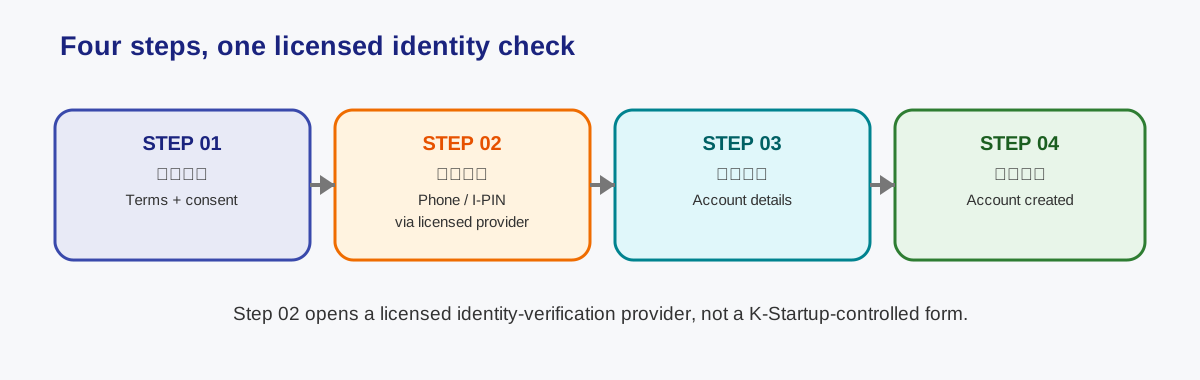
K-Startup's own sign-up flow splits accounts into a domestic (내국인) and a foreign national (외국인) individual member type from the first screen. Both types run through the same four-step process and the same mobile-phone or I-PIN identity check, handled by a licensed verification service, not a form K-Startup itself controls.

On this page
- The portal separates foreign and domestic accounts from the first screen
- The account is built in four steps
- Identity verification runs through a licensed third party
- The terms of use spell out what an account unlocks
- Account withdrawal and cancellation both exist, on different terms
- The portal is not promised to be always on
- What changes once the account exists
- Support exists if the flow stalls
- Why this matters more for a foreign founder than it looks
A K-Startup account gates most of the site. Browsing past a programme notice's summary needs one. Applying through the portal needs one.
K-Startup's own sign-up flow shows exactly what that account asks for, and where.
The portal separates foreign and domestic accounts from the first screen
Land on K-Startup's member sign-up page, and two individual account types sit side by side. One reads "개인회원(내국인)," for a member of Korean nationality. The other reads "개인회원(외국인)," for a member of foreign nationality.
Each option carries its own "가입하기" (sign up) button. Each starts the same numbered process, independently of the other.
That split sits at the very top of the flow. It is not buried behind a domestic-first form. A foreign founder does not fill out a Korean citizen's form and hope a stray field somewhere accepts a passport number instead.
The account is built in four steps
K-Startup names four steps for the foreign national path. Step 01 is 약관동의, terms agreement. Step 02 is 본인인증, identity verification.
Step 03 is 정보입력, information entry. Step 04 is 가입완료, registration complete.
The first step covers two things together. One is K-Startup's own terms of use. The other is a personal-information collection and use consent.
Both are required before you can move forward.
That consent notice lists what gets collected at sign-up. It names an ID, password, name, mobile phone number, email and date of birth. It also names two Korean identity-linkage values the verification system itself generates, called 연계정보 (CI) and 중복정보 (DI).
K-Startup's page is direct about how long that data stays on file. It states the information is kept until the member withdraws the account. There is no separate, shorter retention window described.
| Step | What it covers |
|---|---|
| 01 약관동의 | Terms of use and personal-information consent, both required |
| 02 본인인증 | Mobile-phone or I-PIN identity verification |
| 03 정보입력 | Account details: ID, password, contact information |
| 04 가입완료 | Account created |
Identity verification runs through a licensed third party
Step 02 states its own purpose plainly. K-Startup wants to confirm identity, and cut down on anonymous misuse. Two methods do that job: mobile-phone authentication, or I-PIN.
The mobile-phone option splits again. K-Startup's page names the PASS app as one route. An SMS code is the other, for anyone who does not want to install PASS.
One practical warning sits right on that screen. A browser pop-up blocker will stop the verification window from opening at all. K-Startup's own page names this as a known failure point, not a hypothetical one.
Clicking the mobile-phone option opens a request to a specific domain: pcc.siren24.com. That is a licensed 본인확인기관, an identity-verification institution recognized under Korean law. K-Startup does not run that screen itself; it hands the check to this outside provider.
This post did not go past that hand-off point. K-Startup's own page does not show what the Siren24 screen itself asks a foreign national to submit.
Confirm that document requirement directly at Step 02. It is commonly an Alien Registration Card number for a foreign resident, but this post cannot state that as a fetched fact.
The terms of use spell out what an account unlocks
K-Startup's own terms of use, shown at Step 01, name two member-only benefits directly. One is board-posting authority: K-Startup's community boards allow writing and counseling requests only for registered members, not for visitors browsing without an account.
The other is 마이페이지, or My Page. The terms describe it as support for storing information a member needs to keep separately, drawn from what K-Startup provides across the site. Neither benefit is available to a non-member visitor.
The same terms also state something worth knowing before you rely on any one feature staying put. K-Startup's own service content is decided by K-Startup's policy, and can change or stop. That applies to the account and its features generally, not only to a specific programme notice.
Account withdrawal and cancellation both exist, on different terms
A member can leave voluntarily. K-Startup's terms describe withdrawal through the site's own procedure, or by phone or email request, at the member's choice.
K-Startup can also end a membership from its side, without prior notice, in specific listed cases. Using someone else's ID and password is one. Knowingly damaging or misusing another person's information is another.
A false sign-up application is treated the same way. So is a duplicate sign-up under the same identity.
Neither of these termination routes is unique to a foreign national account. They apply to the same terms of use both account types agree to at Step 01, since K-Startup runs one shared terms document across both sign-up paths.
The portal is not promised to be always on
K-Startup's terms also cover when the service itself can pause. The listed reasons include natural disasters, a national emergency, and a change in the government budget behind the site. Maintenance or a fault in the service equipment is another named reason.
Overloaded demand counts too. So does an outage at a telecommunications carrier the site depends on. None of these list a specific recovery time; the terms describe when service can stop, not how fast it comes back.
That matters most around a deadline. If a programme notice closes on a fixed date and K-Startup is down for one of these reasons, the terms do not promise an extension. Build in margin before a deadline rather than assuming the portal will be reachable at the last hour.
Sign-up itself is not exempt from this. An outage during Step 02's identity verification, whether at K-Startup or at the licensed provider it hands off to, has the same effect as any other outage. Do not leave account creation for the same day you plan to submit an application.
What changes once the account exists
Once Step 04 completes, the account behaves the same way regardless of which sign-up path created it. K-Startup's terms do not describe a reduced feature set for a foreign national account anywhere in the material fetched for this post.
That means the practical next step is the same for everyone: find a live programme notice, and read its own eligibility section closely. An account gets you into the system. It does not, by itself, say anything about whether a specific programme accepts a foreign-founded company.
Support exists if the flow stalls
K-Startup's sign-up page lists one phone line for stuck registrations and general startup questions: 1357. Stated hours run from 09:00 to 18:00 on weekdays.
An online consultation option sits alongside that phone line. K-Startup names both as its own support channels, not a generic customer-service inbox routed somewhere else.
Why this matters more for a foreign founder than it looks
A domestic applicant clears Step 02 against systems already tied to their resident registration number. A foreign founder does not have that number. The mobile-phone or I-PIN path is the substitute K-Startup's own flow offers instead, run through the same licensed verification layer either way.
That substitution is not documented as a separate track with separate rules on K-Startup's own sign-up pages. The steps are identical; only the identity document behind Step 02 differs by nationality. Plan for that document before starting the flow, not mid-way through it.
A founder new to Korea's verification system often assumes a passport alone will clear this step. That is what many other countries' online registrations expect.
K-Startup's own flow does not support that assumption. The identity check runs on Korean mobile-network or I-PIN rails, not on a passport number typed into a form field.
None of this replaces reading a specific programme's own eligibility notice. It only clears the gate to reach one. The account is infrastructure, not an answer to whether your company qualifies for anything specific.
Confirm the exact identity-verification document requirement directly at Step 02 of the sign-up flow. Then use the programmes catalogue, once the account exists, to find a notice worth applying to.
Frequently asked questions
- Does K-Startup have a separate sign-up option for foreign nationals?
- Yes. K-Startup's own member sign-up page lists 개인회원(외국인) (foreign national individual member) as a distinct option alongside the domestic one, each with its own sign-up button.
- What are the steps to create a K-Startup account?
- K-Startup's step indicator names four steps: terms agreement, identity verification, information entry, and registration complete.
- How does K-Startup verify identity during sign-up?
- K-Startup's page offers mobile-phone authentication (the PASS app or an SMS code) or I-PIN, run through a licensed identity-verification provider rather than a form K-Startup itself controls.
- What personal information does K-Startup collect at sign-up?
- K-Startup's own consent notice lists an ID, password, name, mobile phone number, email, date of birth, and two identity-linkage values used by the verification system, retained until account withdrawal.
- Does this post confirm what document the identity check asks a foreign national for?
- No. This post reached the point where K-Startup's flow opens a licensed third-party verification provider, but did not complete that provider's own form, so it does not state exactly what document or number it requests.
- Who do I contact if sign-up does not work?
- K-Startup's own sign-up page lists phone counseling at 1357, weekdays 09:00 to 18:00, plus an online consultation option.
Sources
Everything above is the rule as published. See how it applies to your case.
Read next
- FounderCraftHometax for foreign founders: VAT, filings and the certificates you will be asked for
- FounderCraftThe four major insurances when you make your first hire
- FounderCraftThe business address: what a tax office and the visa file accept
- FounderCraftWorking with a Korean patent attorney (변리사): what the role is and how to brief one