Working with a Korean patent attorney (변리사): what the role is and how to brief one
한국 변리사와 협업하기
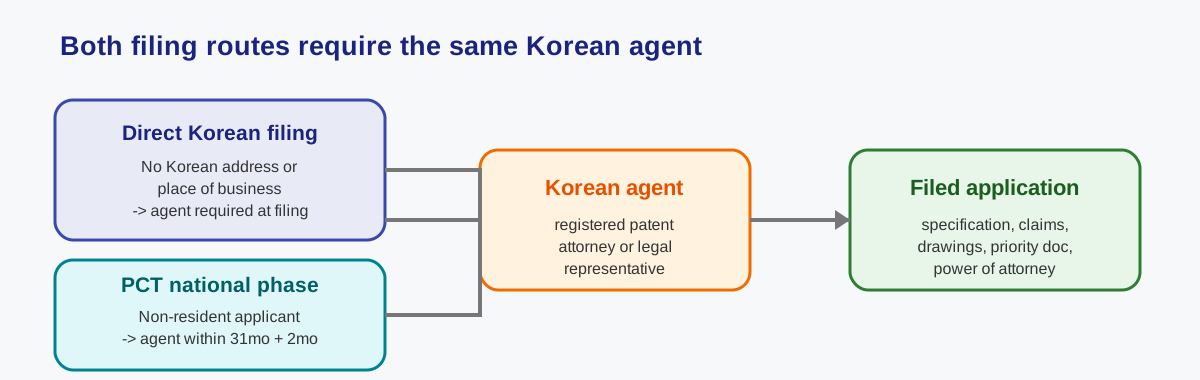
KIPO's own pages state that a foreign applicant without a Korean address or place of business cannot file a patent, utility model or PCT national phase application without a Korean agent. That agent role is filled by a registered patent attorney (변리사) or a legal representative. This post covers what KIPO requires of the filing, not the licensing exam or discipline of the profession, which this post's sources do not cover.
On this page
- The requirement comes from KIPO's own formality rules, not custom
- The same rule reaches a PCT application entering Korea
- What the attorney actually receives and files
- Filing status and representation are two separate records
- First-to-file makes the attorney's timing job matter
- Korea does not waive the power-of-attorney paperwork
- The attorney relationship outlives the filing itself
- The agent rule sits inside a larger representation system
A Korean patent attorney is not an optional convenience here. For most foreign applicants, KIPO's own procedural rules make one mandatory. The filing itself runs through the attorney's name before the office.
The requirement comes from KIPO's own formality rules, not custom
KIPO's patent overview names the source directly: the Enforcement Regulation of the Patent Act. Several listed defects send an application back to the sender under that rule. KIPO then treats it as though the applicant never filed it at all.
One of those defects is the agent rule. It catches an application from someone with no Korean address and no Korean agent. KIPO's utility model guidance states the identical rule for utility model filings.
This is a formality check, not a judgment on the invention. It runs before substantive examination even starts. An application that fails it never reaches that stage at all.
The same rule reaches a PCT application entering Korea
This requirement does not stop at a first Korean filing. The WIPO PCT Applicant's Guide's Korea national chapter requires agent appointment for a non-resident applicant too. The window is two months, counted from Korea's 31-month national phase deadline.
The same chapter names who can fill that role. Any registered patent attorney qualifies. So does a legal representative more broadly.
KIPO's own pages, in the material fetched for this post, name no separate agent category for design or trademark filings. Treat the patent and utility model rule as the governing pattern until you check a design- or trademark-specific page directly.
What the attorney actually receives and files
KIPO's patent overview lists what a patent filing needs. An application naming the inventor and applicant comes first. A specification follows, with a detailed description and claims.
Drawings come next, where relevant, along with an abstract. Claim priority, and you need a priority document too, with its Korean translation. KIPO's overview adds one more item: a power of attorney, wherever the applicant uses an agent.
A foreign founder's brief to an attorney follows that same list. Give a technical description detailed enough to draft claims from. Bring any existing foreign specification and priority filing for translation and adaptation.
Sign the power of attorney last. That signature is what turns a technical conversation into a filing the attorney can actually submit on your behalf.
The filing language does not change, regardless of where your material originates. KIPO's utility model guidance requires Korean for the application itself. The attorney files in that language no matter what language your original material arrives in.
| What KIPO requires in the filing | Where it comes from in a briefing |
|---|---|
| Application naming inventor and applicant | Your company and inventor details |
| Specification, description and claims | Drafted by the attorney from your technical description |
| Drawings, where relevant | Supplied by you or drafted from your description |
| Priority document plus Korean translation | Your earlier foreign filing, if priority is claimed |
| Power of attorney | Signed by you, naming the attorney as agent |
Filing status and representation are two separate records
KIPO's page on formality examination describes what happens when a document goes missing. Say the power of attorney, or the representative's name, is not there. KIPO issues a notice of amendment, with its own deadline to supply the missing piece.
Miss that deadline, and KIPO nullifies the application. An otherwise-ready filing can stall on paperwork alone. That single missing signature carries real weight.
Keep two records separate and current. One is the attorney's authority. The other is the invention's own status.
A change of attorney is a formality event under KIPO's rules. So is a change of applicant address, or a lapse in the power of attorney. None of these depend on whether the underlying invention is patentable.
First-to-file makes the attorney's timing job matter
KIPO's patent overview names Korea's governing rule directly: first-to-file. Two applicants covering the same invention do not both get a right. The one who files first is the one the rule recognizes.
That makes timing part of what an attorney manages, not just paperwork completeness. A delay in briefing, translating or signing a power of attorney is a delay in the filing date itself. Under first-to-file, that date is the whole game if a competing filing exists.
KIPO's overview draws the applicant question narrowly too. The inventor of an invention can file, or that inventor's assignee can file. A company assignee is common for a founded startup, but the underlying inventor still has to be named correctly in the application your attorney submits.
A first-to-file system punishes slow paperwork the same way it punishes a slow idea. Every step your attorney needs from you counts toward that date. The technical description, the signed power of attorney, the inventor details: treat each as part of a filing-date race, not an administrative afterthought.
Korea does not waive the power-of-attorney paperwork
Some PCT designated offices waive the requirement to submit a separate power of attorney, or a copy of a general one already on file. Korea is not one of them. The WIPO PCT Korea national chapter states plainly that the Office has not waived either requirement.
That means a foreign founder cannot assume a general, standing authorization covers a new filing automatically. Each case still needs its own submitted power of attorney, per the same chapter, unless a particular instance states otherwise.
The chapter also addresses what happens if an agent withdraws mid-process. A waiver of power of attorney does not apply in that case. It specifically covers an agent or common representative filing a notice of withdrawal during the international phase.
That withdrawal has to go through its own formal notice. An informal handoff between two attorneys does not substitute for it.
The attorney relationship outlives the filing itself
A patent or utility model right does not end its administrative life at registration. KIPO's fee structure, described elsewhere in this post's source material, keeps annual fees running for years after registration. Someone has to track those payments, and a Korean patent attorney is typically who does.
Address changes are another ongoing item. If your company moves, or changes its registered representative, that change has to reach KIPO's own records. An attorney managing the filing is also usually the one managing that kind of update.
The same applies across a PCT national phase filing. Once entry happens and the local agent is appointed, that agent is on record with MOIP going forward. Swapping attorneys later means updating that record too, not just handing over your own files.
None of this is exotic. It is closer to how any registered agent relationship works: filing is the starting event, not the whole engagement. Budget for the attorney relationship accordingly, rather than treating the initial filing fee as the full cost of the arrangement.
The agent rule sits inside a larger representation system
KIPO's broader IP protection material frames representation as part of a wider push. Its page on IP protection describes recent statutory changes to infringement remedies. Korea added punitive treble damages to the Patent Act in July 2019.
That same change later reached the Trademark Act and the Design Protection Act. It reached the Unfair Competition Prevention and Trade Secret Protection Act too.
That context matters for briefing an attorney on more than a filing. A properly appointed agent also represents the company if a dispute or infringement question comes up later. Filing and dispute representation point toward one working relationship, not two separate ones.
This post skips licensing, discipline and how to find a specific attorney. Its sources are KIPO's and WIPO's own procedural pages, not the Korea Patent Attorneys Association's registry material.
Nothing here substitutes for that verification step. This post explains why the role is mandatory and what it needs from you; it does not vouch for any individual practitioner. A mandatory role and a trustworthy individual are two separate questions, and only KIPO's rules answer the first one.
Confirm a specific attorney's standing directly before engaging one. Then see the KIPO patent and utility model filing guide for how the OASIS operator scores the resulting filing status.
Frequently asked questions
- Do I need a Korean patent attorney to file a patent in Korea?
- If your company has no address or place of business in Korea, yes. KIPO's own patent and utility model pages state such a filing without a Korean agent is treated as never having been submitted.
- Does the same rule apply to a PCT application entering Korea?
- Yes. The WIPO PCT Korea national chapter requires a non-resident applicant to appoint a Korean agent within two months of the 31-month national phase entry deadline.
- Who is allowed to act as that agent?
- The WIPO PCT Korea national chapter states any registered patent attorney or legal representative can act as agent.
- What does KIPO require in the filing itself?
- KIPO's patent overview lists an application naming the inventor and applicant, a specification with description and claims, drawings where relevant, an abstract, a priority document with Korean translation where claimed, and a power of attorney where an agent is used.
- What happens if the power of attorney is missing?
- KIPO's page on formality examination states it issues a notice of amendment with a deadline to supply missing documents, and nullifies the application if that deadline passes without correction.
- Does this post cover how to find or verify a specific patent attorney?
- No. This post is sourced from KIPO's and WIPO's own procedural pages, not from the Korea Patent Attorneys Association's registry, so it does not cover licensing, exams or verifying an individual attorney's standing.
Sources
- KIPO/MOIP - Overview of the Patent System in Korea (agent requirement, power of attorney, formality examination) — read 2026-09-24
- KIPO/MOIP - Overview of the Utility Model System (Korean-language and agent requirement) — read 2026-09-24
- WIPO PCT Applicant's Guide - National Chapter, Republic of Korea (KR), current version — read 2026-09-23
- KIPO/MOIP - IP Protection (statutory changes to infringement remedies, treble damages) — read 2026-09-24
Everything above is the rule as published. See how it applies to your case.
Read next
- FounderCraftHometax for foreign founders: VAT, filings and the certificates you will be asked for
- FounderCraftGetting a K-Startup portal account as a foreigner: identity, ARC and certificates
- FounderCraftThe four major insurances when you make your first hire
- FounderCraftThe business address: what a tax office and the visa file accept