Registering a corporate research institute (기업부설연구소)
기업부설연구소 설립 신고 안내
A corporate research institute registration is a reporting-system status, not a licence, held with the Korea Industrial Technology Association. The number of dedicated researchers it requires scales with company size. The page fetched for this post does not itself state that registration is the basis for an R&D tax credit; the legal basis it cites is the enforcement rule of the Industrial Technology Research Association Act.

On this page
A corporate research institute is not a physical inspection or a licence application. It is a reporting-system status, filed and held through the Korea Industrial Technology Association's own portal.
What the system actually checks
The reporting system's overview page names two options: a full corporate research institute (기업부설연구소), or a dedicated R&D department (연구개발전담부서). Both must occupy a separately partitioned space, on the same page's own wording.
The choice between the two options is mostly about headcount. A department needs only one qualifying researcher; a full institute needs several, scaled by company type.
The researcher headcount, by company type
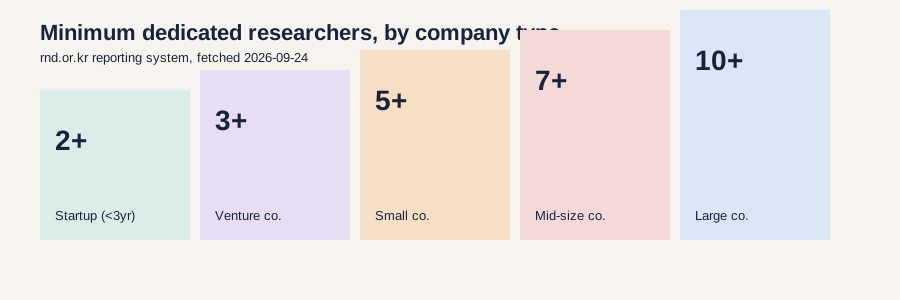
The reporting system's own requirements page sets a minimum number of dedicated researchers (연구전담요원) for each company category.
| Company type | Minimum dedicated researchers |
|---|---|
| Startup, within 3 years of founding | 2 or more |
| Venture company (certified) | 3 or more |
| Small company | 5 or more |
| Mid-size company (중견기업) | 7 or more |
| Large company | 10 or more |
What counts as a qualifying researcher
The same page sets a qualification standard for each researcher: a bachelor's degree or higher, or a high-school diploma plus a qualifying technical certification. This applies to the people actually counted toward the minimum headcount above.
A founder who spends most of their time on sales or operations, rather than research, likely does not count toward this headcount even with a technical degree. The reporting system evaluates the researcher's actual role, not only their qualification on paper.
The registration's stated legal basis
The page fetched for this post does not itself state that registration is the basis for an R&D-related tax credit. Its cited legal basis is the enforcement rule of the Industrial Technology Research Association Act. Registration does not, on its own, pay a company anything.
Registration is also commonly a precondition for entering many government R&D grant programmes, which typically ask for an institute or department reporting number as part of the application. Each programme sets its own additional eligibility rules on top of that.
Two names for the underlying law
Government pages disagree slightly on which law authorizes this system. The reporting system's own overview page names one law; other legal-database results reference an amended article of a related, older statute on basic research promotion.
This is a naming question, not a dispute about the requirements. The researcher headcounts and space rule above come from the same reporting system regardless of which statute currently governs it.
What a foreign-founded company should check first
Nothing on the reporting system's fetched pages ties eligibility to a founder's or shareholder's nationality. The requirements are about the company's size category, its researchers' qualifications, and its physical space.
A foreign founder should still confirm two practical points before filing: whether the company's registered business type is one the associated tax credit actually applies to, and whether the intended researchers meet the degree-or-certificate-plus-experience standard above.
For programmes that expect this registration as a prerequisite, see EastStartup's programme guide.
Frequently asked questions
- What is a corporate research institute (기업부설연구소)?
- It is a reporting-system status held with the Korea Industrial Technology Association, confirming a company has a qualifying research unit with a separately partitioned space and a minimum number of dedicated researchers.
- How many researchers does it require?
- The reporting system's own page sets a minimum by company type: 2 or more for a startup within three years, 3 or more for a venture company, 5 for a small company, 7 for a mid-size company, and 10 for a large company.
- Is there a smaller option than a full institute?
- Yes. A dedicated R&D department (연구개발전담부서) needs only one qualifying researcher, on the same reporting system's page.
- What does registration unlock?
- The page fetched for this post does not itself state that registration is the basis for an R&D tax credit; its cited legal basis is the enforcement rule of the Industrial Technology Research Association Act, and registration is commonly a precondition for entering government R&D grant programmes.
- What qualifies someone as a dedicated researcher?
- The reporting system requires a bachelor's degree or higher, or a high-school diploma plus a qualifying technical certification, for each person counted toward the minimum headcount.
- Does this apply to a foreign-founded company?
- The reporting system's fetched pages do not tie eligibility to a founder's or shareholder's nationality; the requirements are about company size, researcher qualifications and physical space.
Sources
Everything above is the rule as published. See how it applies to your case.
Read next
- FounderCraftHometax for foreign founders: VAT, filings and the certificates you will be asked for
- FounderCraftGetting a K-Startup portal account as a foreigner: identity, ARC and certificates
- FounderCraftThe four major insurances when you make your first hire
- FounderCraftThe business address: what a tax office and the visa file accept