Gyeongbuk Technopark: a network of sector centres, not one office
경북테크노파크 조직과 센터 안내
Gyeongbuk Technopark (GBTP) is a foundation that runs six departments and a set of named specialist centres across Gyeongsan, Gumi, Gyeongju, Yeongju, Seongju and Chilgok. Its own site does not state a foreign-company or foreign-investment condition; the current notice for a specific centre decides that.

On this page
Gyeongbuk Technopark describes itself as a partner for the region's industrial development. Its own site names a structure that matters more than the label.
Six departments run a network of sector-specific centres. It is not a single office building.
The organisation runs six departments
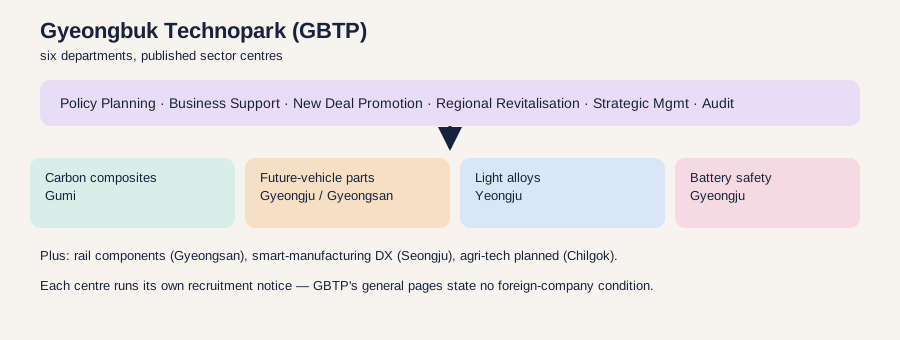
GBTP's English page lists six units. A Policy Planning Group handles strategy and data. A Business Support Group runs technology transfer.
A Gyeongbuk New Deal Promotion Group covers regulatory reform and future mobility. A Regional Revitalisation Promotion Team covers 23 cities and counties.
Two more units round out the list. A Strategic Management Support Office handles administration. An Audit Office runs ethics oversight.
That split tells a founder where to start. A technology-transfer question goes to the Business Support Group. A question about a named centre goes to that centre directly, not to the head office switchboard.
Named centres cover specific materials and mobility sectors
GBTP's centre-information page lists a working set of specialised centres. Two sit in Gumi and focus on materials: a Carbon Composite Commercialisation Centre and an Artificial Graphite Application Technology Centre. A Carbon Materials Recycling Centre sits in Gyeongju.
Mobility gets its own cluster. A Future Vehicle Advanced Materials Forming Centre and a Rail Vehicle Convergence Components Centre both sit in Gyeongsan or Gyeongju. A Future Vehicle Components Technology Centre adds a third mobility site nearby.
Three more centres round out the list. A Light Alloy Composite Technology Centre operates in Yeongju. A Shared Battery Safety Research Centre sits in Gyeongju.
A Smart Manufacturing DX Support Centre serves Seongju.
| Centre | City | Sector |
|---|---|---|
| Carbon Composite Commercialisation Centre | Gumi | Carbon composite design and testing |
| Artificial Graphite Application Technology Centre | Gumi | Semiconductor and battery materials |
| Carbon Materials Recycling Centre | Gyeongju | Circular economy for carbon parts |
| Future Vehicle Advanced Materials Forming Centre | Gyeongju | EV material processing |
| Future Vehicle Components Technology Centre | Gyeongsan | EV component testing |
| Rail Vehicle Convergence Components Centre | Gyeongsan | Rail industry components |
| Light Alloy Composite Technology Centre | Yeongju | Aerospace and automotive alloys |
| Shared Battery Safety Research Centre | Gyeongju | Electric two-wheeler battery safety |
| Smart Manufacturing DX Support Centre | Seongju | Digital transformation for root industries |
What a tenant company can expect
GBTP's own summary of these centres names four things: meeting space, business incubation, equipment access and R&D collaboration. Tenant companies get these. So do some outside organisations that never move in.
That distinction matters. Some services do not require tenancy at all. A founder can sometimes reach a centre's equipment or expertise without renting a desk there.
An agricultural-technology platform is listed as planned in Chilgok County. That shows the network is still growing, not closed. A founder in a listed sector should check whether a relevant centre already exists or is still under construction.
Foreign eligibility is not addressed on the site
Neither GBTP's Korean pages nor its English page state a nationality or foreign-investment condition for tenancy or centre access. That silence is not a yes. The current recruitment notice for a specific centre, published when a round opens, is where an eligibility condition would appear.
GBTP's English page mentions one international activity: exporting the "K-TP model." That points to outreach at the organisational level. It does not describe a programme a foreign-founded company in Korea can apply to, and none should be inferred from it.
The organisation is reachable by phone in Gyeongsan for general enquiries, but a specific application depends on the centre and the notice, not the head office number alone.
Use the ecosystem guide to see how a regional technopark fits alongside national agencies and city hubs in Korea's startup-support system.
Frequently asked questions
- What is Gyeongbuk Technopark?
- It is a foundation that runs six departments and a network of named, sector-specific centres across several cities in Gyeongsangbuk-do, according to its own English and Korean pages.
- Is Gyeongbuk Technopark one building?
- No. Its centre-information page lists separate named centres in Gumi, Gyeongju, Gyeongsan, Yeongju and Seongju, each focused on a specific materials or mobility sector.
- Can a foreign-founded company apply to a GBTP centre?
- GBTP's own pages state no foreign-company or foreign-investment condition either way. Check the current recruitment notice for the specific centre before assuming eligibility.
- Which departments does GBTP run?
- Its English page lists a Policy Planning Group, a Business Support Group, a Gyeongbuk New Deal Promotion Group, a Regional Revitalisation Promotion Team, a Strategic Management Support Office and an Audit Office.
- Are all listed centres open now?
- No. GBTP's own page describes at least one centre, for electric-vehicle crash safety, as still under development, so a founder should confirm a centre is operating before applying.
- Does GBTP offer services to non-tenant companies?
- Its own summary describes meeting space, incubation, equipment access and R&D collaboration as available to outside organisations as well as tenants, though terms depend on the specific centre.
Sources
- Gyeongbuk Technopark (GBTP) - homepage — read 2026-09-24
- Gyeongbuk Technopark - centre information page — read 2026-09-24
- Gyeongbuk Technopark - English page — read 2026-09-24
Everything above is the rule as published. See how it applies to your case.
Read next
- InstitutionsKorea's regional technopark network: what a technopark is and who can use one
- InstitutionsRegional startup academies and open lectures: what they actually offer
- InstitutionsJeonbuk Global Game Center: tenancy, game support and the internship line
- InstitutionsUniversity business incubation centres in Korea: tenancy as a startup route