Regional startup academies and open lectures: what they actually offer
지역 창업 아카데미와 공개 강좌 활용법
Regional startup academies can be useful entry points for learning, mentoring and local connections, but an open lecture is not automatically a funding or residency route. Read the operator's notice for audience, schedule, language, selection and follow-up conditions.

On this page
“Startup academy” covers several formats. It can mean a lecture series, a staged education programme, an accelerator-linked course, a local founder school or a sector-specific training route. The name is not enough to tell a foreign founder whether attendance is open, whether a company may apply, or whether the programme includes anything beyond learning.
K-Startup's official mentoring, consulting and education page lists regional examples alongside national and sector programmes. The fetched page includes a city startup academy for prospective founders, a regional startup academy connected to a technology district, a bio startup academy, and other education or mentoring offerings. Their summaries describe educational or founder-development purposes, but the current operator notice remains the controlling source for participation.
Separate lecture, academy and support route
An open lecture is usually the least selective format, but “open” still needs a definition. It may mean open registration for a session, open to residents of a specific district, or open to a selected cohort after registration. An academy may add attendance, assignments, mentoring or a completion condition. A support route may add screening, space, funding or a separate application.
Use the operator's words. If a page says “education,” do not call it an accelerator. If it says “mentoring,” do not promise investment. If it says “selection,” identify what is selected: attendees, companies, teams, speakers or a later support cohort.
| Format | What the listing may describe | What to verify before relying on it |
|---|---|---|
| Open lecture | A public session or information event | Registration, language, place and attendance limit |
| Academy course | Several learning sessions or a curriculum | Cohort rules, attendance and completion conditions |
| Mentoring programme | Advice or founder support | Matching, session count and eligible participants |
| Regional accelerator | Local or sector business development | Company age, location, selection and follow-on terms |
| Facility-linked programme | Learning connected to a local space | Whether tenancy is separate from education |
The table prevents a common category error. An academy can be valuable without being a grant. A lecture can create a useful contact without creating a right to apply for a local facility. Keep the result you want matched to the format that actually provides it.
Read the regional boundary carefully
Regional programmes often use geography in different ways. The region may describe the operator, the venue, the target industry, the founder group or the company location. Do not assume that a programme named after a city accepts every founder who can travel there.
Look for the applicant field and the delivery field separately. A lecture may be delivered in a technology district but accept online attendees nationwide. A cohort may be operated by a local body and require a local company. A sector academy may accept founders from other regions but still require attendance at a named venue.
For a foreign founder, record where the founder lives, where the company is incorporated, where the company operates and who will attend. These facts can affect the answer, but they do not create eligibility unless the notice uses them. If the notice does not state the rule, ask the operator instead of translating a regional name into a restriction.
K-Startup's directory helps locate programmes by support line. It does not turn every local programme into a national entitlement. Open the operator's announcement and keep the answer to any eligibility question with your application record.
Use an open lecture as a research step
An open lecture can be useful before a formal application because it lets a founder learn the operator's vocabulary and hear which questions recur. Record the programme name, speaker or operator supplied by the page, date and the questions that remain unanswered. Do not turn a lecture statement into a rule unless the issuing body publishes that rule in a notice or attachment.
A lecture can also reveal whether the academy is a fit. The subject may be business basics, a sector technology, investor preparation, local settlement or a founder support process. Choose based on the stated subject rather than the prestige of the venue.
For Korean-language delivery, ask whether slides, interpretation or English registration exist. Do not promise that a foreign founder can complete every activity in English unless the operator says so. Keep a Korean copy of the programme title and registration instructions so the operator can locate the same item.
That last distinction matters. You can attend a public lecture, prepare a question or check a notice without claiming that you belong to a selected cohort. A clean record preserves trust with the operator and makes later applications easier to audit.
Match the academy to the founder's stage
Use the academy's description to decide whether the level matches your current record. A prospective-founder academy may suit an idea that needs structure. A technology or sector academy may suit a team with a defined technical question. An accelerator-linked course may expect a company that can discuss customers, execution and growth.
Do not invent stage labels that the source does not use. “Pre-startup,” “early,” “growth,” “resident,” “participant” and “selected company” can have different meanings across notices. Quote the operator's term and confirm the definition in the current call.
The same founder may use more than one route, but keep the purpose of each route separate. An open lecture can improve the founder's understanding. An academy can produce a work product. Mentoring can test a decision. A later support notice can ask for that record. None of these steps automatically guarantees the next one.
For a foreign founder, add the practical constraints to the plan: travel, schedule, language, company documentation and the person who will attend. These are planning facts, not claims about the programme's eligibility. The operator's notice decides the boundary.
Verify the follow-up before you join
Before registering, search for the current announcement rather than relying on an old calendar entry. Verify the registration deadline, session dates, venue or online platform, attendance method, required documents and contact channel. If the page is a directory card, follow its link to the operator.
Ask what happens after attendance. Is there a certificate, mentoring match, cohort review, pitch, facility referral or simply a completed lecture? Use the exact published term. A certificate may prove attendance, not selection. A referral may provide a contact, not admission. An academy may offer education without a funding decision.
Keep screenshots or PDFs of the notice with the date fetched. Public programme pages change. A future founder should be able to see which version supported the decision to register. If the page later disappears, the record still shows what was and was not promised.
Do not pay a third party for access based only on a public listing. If a fee, deposit or required purchase appears in an operator notice, verify the amount and payment conditions there. If the primary source does not state a cost, omit the amount and ask the operator.
Build a small regional learning plan
A regional academy is most useful when it connects to a defined next action. Before the first session, write the question you want answered. During the sessions, collect only material relevant to that question. Afterward, record what changed in the business plan or application record.
The output might be a customer interview plan, a revised pitch, an IP question, a local partner list or a decision to apply to a different support line. Do not call the output a programme result unless the operator uses that term.
This approach also helps foreign founders compare programmes without flattening them into one national system. A city academy, a sector academy and an open lecture can sit next to each other in a portal directory while serving different people and producing different outputs.
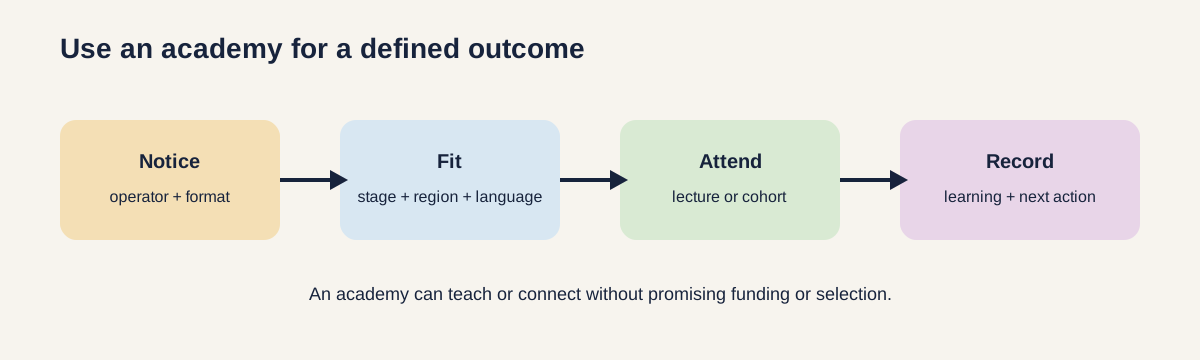
Use the ecosystem directory to understand the organisations behind a programme, then confirm the current academy notice before registering. An open lecture is a useful first step, not automatic selection.
Frequently asked questions
- What is a regional startup academy?
- It can be a lecture series, education cohort, mentoring route or sector programme. The operator's current notice defines the actual format.
- Does attending an open lecture mean I am selected?
- No. Attendance, cohort selection, mentoring and later support are separate outcomes unless the operator explicitly connects them.
- Can a foreign founder attend a regional academy?
- Possibly. Check the notice's applicant, geography, language, registration and company conditions rather than inferring them from the programme name.
- Where can I find Korean startup academies?
- K-Startup lists mentoring, consulting and education programmes. Open the operator's current announcement for the participation route.
- What should I record after an academy session?
- Record the published fact, the question that remains open and the business or application action that follows. Do not describe attendance as a funding or selection result.
Sources
- K-Startup - mentoring, consulting and education programme listings — read 2026-09-21
- K-Startup 창업지원포털 - 모집중 사업공고 — read 2026-09-21
- KISED - official K-Startup portal link — read 2026-09-21
Everything above is the rule as published. See how it applies to your case.
Read next
- InstitutionsGyeongbuk Technopark: a network of sector centres, not one office
- InstitutionsKorea's regional technopark network: what a technopark is and who can use one
- InstitutionsJeonbuk Global Game Center: tenancy, game support and the internship line
- InstitutionsUniversity business incubation centres in Korea: tenancy as a startup route