University business incubation centres in Korea: tenancy as a startup route
한국 대학 창업보육센터 입주와 창업자 지원
A university business incubation centre can be more than an affordable room. It may connect a startup with university expertise, students, equipment, mentoring and regional networks, but each centre sets its own eligibility, selection, contract and support terms. Use the centre's own notice as the rulebook.

On this page
Tenancy can change the quality of a founder's next six months. A university business incubation centre may put the company near researchers, students, equipment, mentors and other resident companies. It may also create obligations: a registered address, on-site work, fees, reporting and a review before renewal.
The Ministry of SMEs and Startups describes business incubation centres as places that can use institutional strengths to solve startup problems. Its specialized BI guidance distinguishes university-industry cooperation, industry specialization and regional hub types. A university centre is therefore a route into an operating network, not simply a room with a key.
A university BI is a tenancy route with conditions
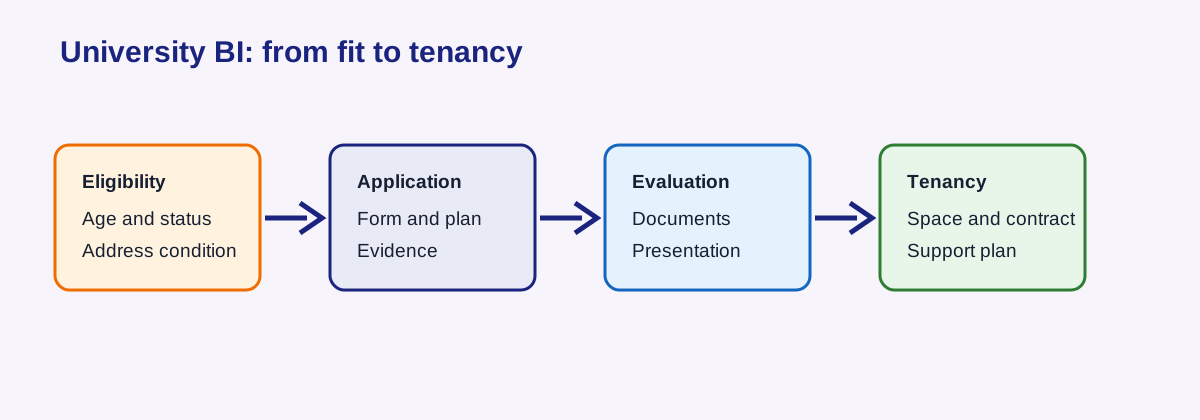
The first question is whether the company can legally and practically occupy the centre. A centre may accept an aspiring founder, a newly formed company or a company below a stated age. It may require the headquarters or a company research institute to move to the centre after selection.
Chungnam National University's incubation-centre page gives one concrete example. It lists founders or prospective founders covered by the Startup Support Act, requires a move of the headquarters within a stated period for an eligible company, and sets a separate window for a prospective founder to establish a company after entry. Those are that centre's conditions, not a national rule.
The centre may also exclude industries or applicants under its notice. Check prohibited business categories, tax status, existing BI occupancy, headquarters location and any requirement for employees to work on site.
What the university connection can add
The university connection is useful when it solves a real constraint. MSS describes university-linked BI work that can connect resident companies with professors and students for technical advice, talent and practical programmes. A centre may also connect companies to equipment, research activity, internships, commercialization support or local partners.
Do not list every possible benefit as though it is included in your centre. Identify the specific resource you need and the person or office that controls access. “University network” is too broad. “A named laboratory can review this technical question” is a testable request if the centre confirms it.
The connection can work in both directions. A startup may receive technical or talent support, while students may gain a project or internship opportunity. The founder still needs to define confidentiality, supervision, intellectual-property ownership and delivery responsibility before sharing sensitive work.
| Potential resource | What to verify with the centre |
|---|---|
| Office or laboratory space | What space is available and who may use it |
| Faculty or technical advice | Whether matching is offered and under what process |
| Student projects or internships | Programme terms, supervision and timing |
| Shared equipment | Access rules, training and usage charges |
| Mentoring and investment links | Whether the service is scheduled or only referral-based |
| Regional networks | Which partners and events are active for residents |
The table is a due-diligence list. It is not a promise that every university BI provides every item.
The selection process tests the business plan
University centres commonly need enough information to judge both the company and the use of the space. Chungnam National University publishes an example sequence: application, eligibility review, presentation review, selection and space allocation, followed by approval, contract and payment of the stated occupancy charge.
The presentation is not only an investor pitch. Explain what the company does, why the centre is relevant, what you will do during the tenancy and what support you need. A centre wants to see a credible use of its space and resources.
The business plan should therefore include a tenancy plan. Name the work that will happen in the centre, the people who will be present, the university or regional connection you need and the result you expect. Avoid promising research access or a university partnership that has not been agreed.
The rules vary sharply by centre
There is no single university BI package. Chungnam National University publishes its own eligibility and space-allocation process. KAIST's incubation guidance describes a different eligibility window, evaluation process and route for general companies compared with faculty or student startups.
Those differences are not contradictions in the national system. They show why a founder must read the centre's own notice. Age limit, contract length, fees, renewal, address transfer, presentation format and required evidence can all be centre-specific.
For the same reason, do not infer that a university centre is free, that it guarantees a university research partnership or that entry creates access to a visa or government grant. Confirm each benefit with the centre and keep its written answer.
Check the address and operating commitment
Address transfer is a material decision for a foreign founder. It can affect company records, mail, employees, tax administration and the practical location of work. The centre's notice may require a headquarters or research-office move by a stated date.
Treat the requirement as part of the application decision. Ask whether a virtual address is allowed, whether employees must work on site, how long the move may take and what happens if the company cannot satisfy the condition. Do not assume that a desk licence and a registered company address are the same product.
If the company is not yet incorporated, confirm the order of events. A centre may accept a prospective founder but require registration after entry. Another centre may use a different rule.
Build a support plan for the tenancy
The first month should have a concrete operating plan. Introduce the company to the centre manager, confirm access and safety rules, schedule the support meetings you were promised and document who can approve equipment, student work or external events.
Track the support you actually receive. This protects the relationship and helps you decide whether renewal makes sense. It also prevents a vague “incubation” claim from replacing evidence of product work, customer discovery or technical progress.
For a foreign founder, add Korean-language administration to the plan. Keep translated names for the company and representative consistent, and ask the centre which documents need Korean submission. The centre's own form controls the required wording.
Decide whether tenancy fits the company
The right BI is the one that removes a real constraint. If you need laboratory equipment, faculty expertise, student talent or a regional industrial link, a university centre may be a strong route. If you only need a postal address, compare the obligations and total cost with other permitted options.
Ask five questions before applying: What work will happen there? Which resource is unique? What must the company move or disclose? What does the contract require? What result should exist at renewal?
Use the ecosystem guide to map institutions, then check current centre notices through the programmes directory. A university BI is one possible route; its own application notice remains the controlling source.
Frequently asked questions
- What is a university business incubation centre?
- It is a startup-support facility operated through a university or related institution that can combine tenancy with mentoring, expertise, facilities and networks.
- Who can enter a university BI?
- The centre's notice decides. It may accept prospective founders, companies below a stated age or another defined group, with conditions such as address transfer or on-site work.
- What does a university BI provide?
- Possible support includes space, faculty or student connections, technical advice, equipment, mentoring, investment links and regional networks. Confirm each item with the specific centre.
- Is university BI tenancy free?
- Do not assume that. The centre's contract and notice control rent, management charges, deposits, utilities and other occupancy terms.
- Does entering a university BI create a university partnership?
- No. A tenancy may create access to stated programmes, but research, student, faculty and intellectual-property arrangements need separate confirmation.
- What should a BI application business plan explain?
- Explain the business, why the centre fits, what work will happen there, which resources you need, who will operate the company and what result you expect during the tenancy.
Sources
- MSS - specialized-capability Business Incubation Centres and university-industry cooperation — read 2026-09-21
- KISED - official facilities and incubation programme guidance — read 2026-09-21
- Chungnam National University Future Startup Center - incubation-centre entry guidance — read 2026-09-21
- KAIST Technology Business Incubation Center - admission process and conditions — read 2026-09-21
Everything above is the rule as published. See how it applies to your case.
Read next
- InstitutionsMSS, KISED and K-Startup: who sits above a Korean startup notice?
- InstitutionsMost Korean startup funding is administered by 창업진흥원 (KISED). Here is what it runs and who it answers to.
- InstitutionsKorea's regional startup centres — the 창조경제혁신센터, where support stops being one-size-fits-all
- Institutions모두의 창업 is a competition, not an information portal — and round one takes 10,000