KICXUP: the industrial-complex open-innovation programme and its Seoul tenancy
킥스업(KICXUP) 산업단지 오픈이노베이션
KICXUP is a Korea Industrial Complex Corporation programme, run with the Credit Guarantee Fund, that pairs startups with industrial-complex firms. The 2026 Seoul tenancy offered three rooms at 600,000 or 900,000 won a month, and the 2026 challenge notice invited domestic and overseas startups.

On this page
KICXUP is not a grant line and not a plain coworking desk. It connects young companies with the large and mid-sized firms in Korea's industrial complexes.
In 2026 it ran a tenancy in Seoul and a challenge round. Our catalogue lists them as the Seoul tenancy and the Challenge and Local call.
What is KICXUP, and who is behind it?
The 2026 Challenge notice names two hosts. KICOX and the Credit Guarantee Fund (신용보증기금, KODIT) run the programme together to build open-innovation links in industrial complexes. For KODIT's wider role, see our guide to KIBO and KODIT guarantees.
The Seoul tenancy notice adds a third party. 씨엔티테크(주), a company that staffs the "KICXUP Seoul operations office", takes questions and runs the growth programmes. The applications go to its email, kicxup@cntt.co.kr.
So there are three roles. KICOX provides the office and industry links, KODIT provides financial products, and CNT Tech runs the day-to-day programme.
What does the Seoul tenancy include?
The August 2026 notice describes the tenancy as office infrastructure plus three support streams. KICOX adds office infrastructure and open-innovation programmes. KODIT adds a dedicated guarantee organisation with tailored guarantee products, plus matching with industrial-complex firms and commercialisation funding.
CNT Tech adds consulting from a mentor panel, seminars and IR sessions with VC reviewers as judges. It also adds marketing at trade fairs and showcases, networking, and global links to investors in the US, Japan, Vietnam and Singapore.
The notice also lists U-CONNECT as a route to private investment from VCs. It names guarantee-linked investment and trade-receivable insurance as blended products.
How much do the rooms cost?
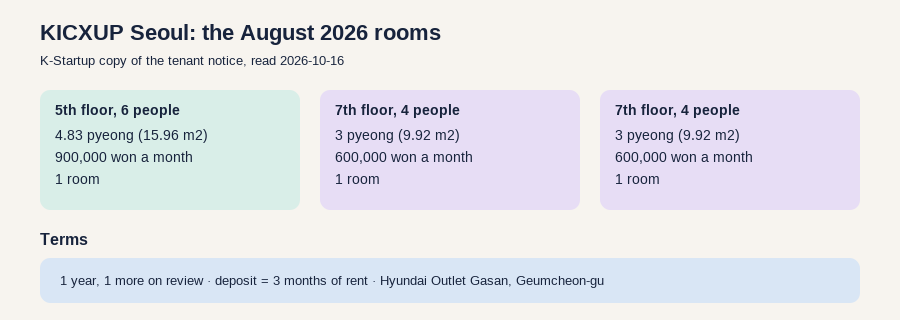
The August 2026 notice prints the rent, which many Korean notices do not. It offered three rooms in the Hyundai Outlet Gasan building at 9 Digital-ro 10-gil, Geumcheon-gu, Seoul. One was a 6-person room on the 5th floor, and two were 4-person rooms on the 7th floor.
The 6-person room measured 4.83 pyeong.
| Room | Size | Monthly rent |
|---|---|---|
| 5th floor, 6 people | 4.83 pyeong (15.96 m²) | 900,000 won |
| 7th floor, 4 people (two rooms) | 3 pyeong (9.92 m²) each | 600,000 won each |
A deposit of three months' rent is paid once on move-in. That works out to 2.7 million won for the 6-person room and 1.8 million won for a 4-person room.
Who could take a Seoul room?
The notice confirmed the age limit: a startup founded under seven years ago. It excludes companies with unpaid national tax, local tax or four social insurance premiums. It also lets KICOX refuse any applicant it judges unsuitable.
The paperwork is a move-in application, a business plan and a personal-data consent. It also asks for a business registration copy, a corporate registry extract, a shareholder register and a four-insurance roster. The tenancy lasts one year, and a review can add one more.
The selection process runs in five steps. Recruitment comes first, then a first selection and a final selection. After the result, a tenant attends an orientation and signs the move-in contract.
The window ran from 11 to 31 August 2026 at 18:00, by email only. It is closed. The notice also warns that more rooms may open after posting as tenants move out.
How do the Challenge and Local tracks work?
The 2026 notice invites startups that want to team up with industrial-complex demand companies. The notice runs two tracks, KICXUP Challenge and KICXUP Local. The Local track selects consortia and needs a collaboration pledge or MOU.
The notice plans a document review that selects 140 companies for the Challenge track and 8 consortia for the Local track. The second stage is a presentation of up to 7 minutes plus 3 minutes of questions.
That stage narrows the Challenge track to about 70 companies and the Local track to 4 consortia. The application window, 13 to 18 August 2026, has closed.
For example, a company that passes the document stage must join KODIT's "BASA" service and take its AI-based company diagnosis. The notice says the diagnosis is limited to domestic startups.
What does the Challenge track pay?
Selected teams could receive proof-of-concept money of up to 15 million won per project. The notice also lists investment and TIPS-linkage support, links to overseas demand companies, and KODIT's financial and non-financial help. Teams that want a desk get bonus points for KICXUP Seoul.
The applicant field was wide. It covered corporations and pre-founders up to seven years old, including universities and research institutes, plus sole proprietors. Deep-tech firms in ten named fields, such as AI, robotics and quantum technology, could be up to ten years old.
Can a foreign-owned startup apply?
The two notices differ. In practice, the Seoul tenancy notice sets no nationality rule, but every document it asks for is a Korean registration record.
The Challenge notice goes further. It describes the target as domestic and overseas startups that want technology collaboration with industrial-complex firms.
However, the BASA diagnosis is limited to domestic startups, and the notice does not say what an overseas startup does at that step. Ask the KICXUP office at kicxup@cntt.co.kr before you invest in the application.
For example, a Korean-registered subsidiary of a foreign firm matches the paperwork. Our guide to open innovation festivals shows other large-company routes.
To place KICXUP among other bodies, use our ecosystem guide.
Frequently asked questions
- What is KICXUP?
- It is an open-innovation programme of the Korea Industrial Complex Corporation (KICOX) with the Credit Guarantee Fund. It matches startups with firms in industrial complexes through a Seoul tenancy and challenge tracks.
- How much does a KICXUP Seoul room cost?
- The August 2026 notice listed 900,000 won a month for the 6-person room and 600,000 won a month for each 4-person room, plus a one-time deposit of three months' rent.
- How long can a company stay in KICXUP Seoul?
- The base term is one year, and a review can extend it by one more year, per the August 2026 notice.
- Which company age does the Seoul tenancy accept?
- The notice asks for a startup founded under seven years ago and excludes companies with unpaid taxes or social insurance premiums.
- How much money does the Challenge track give?
- The 2026 notice lists proof-of-concept support of up to 15 million won per project, plus investment and TIPS linkage and Credit Guarantee Fund support.
- Can a foreign startup join KICXUP?
- The Challenge notice targets domestic and overseas startups, but limits the BASA company diagnosis to domestic startups and does not explain the overseas case. The Seoul tenancy notice sets no nationality rule and asks for Korean registration documents.
- Who runs KICXUP Seoul day to day?
- The notice names CNT Tech (씨엔티테크) and its KICXUP Seoul operations office, reachable at kicxup@cntt.co.kr, with KICOX and the Credit Guarantee Fund providing programmes.
Sources
Everything above is the rule as published. See how it applies to your case.
Read next
- InstitutionsSeoul Campus Town (캠퍼스타운): the university-district startup programme, with Soongsil as the worked case
- InstitutionsDigital Content Enterprise Growth Support Center (디지털콘텐츠기업 성장지원센터): tenancy and who runs it
- InstitutionsOne-person creative enterprise support centres (1인 창조기업 지원센터): what a solo founder gets
- InstitutionsTIPS Town in Seoul, Pohang and Daejeon: what tenancy actually requires