Digital Content Enterprise Growth Support Center (디지털콘텐츠기업 성장지원센터): tenancy and who runs it
디지털콘텐츠기업 성장지원센터 입주 안내
The Digital Content Enterprise Growth Support Center in Anyang has 25 tenant spaces, full rent support and a four-year maximum stay. Its 2026 first-round notice named three public backers, asked for at least three years of operation, and was silent on nationality.
On this page
- What is the Digital Content Enterprise Growth Support Center?
- Who runs it and who pays for it?
- What do the tenant spaces look like?
- How long can a company stay, and what does it cost?
- What does a tenant get beyond a desk?
- Who could apply in the 2026 first round?
- When have tenant rounds happened before?
- Can a foreign-owned company apply?
The Digital Content Enterprise Growth Support Center is a Korean tenant centre where public money covers the whole rent. Its 2026 first-round call, mirrored in our catalogue, also shows a strict filter. You need three years of operation, so it is not a first-year founder's door.
What is the Digital Content Enterprise Growth Support Center?
The centre's own overview says it exists to grow capable domestic digital content firms into small global champions. It sits in Dongan-gu, Anyang, at 11-41 Simin-daero 327beon-gil. The centre uses floors 1 and 2, then floors 4 to 6.
The page gives the floor area as 2,310 m² over five floors. It also lists 25 tenant spaces in total.
The centre was called the Smart Content Center until June 2019. Its history page then shows a rename to the current name. It marked its 14th anniversary in May 2026, so it dates from 2012.
Who runs it and who pays for it?
The 2026 first-round notice answers both questions in its first sentence and confirmed the three operators by name. The Ministry of Science and ICT, the National IT Industry Promotion Agency (NIPA) and Anyang City operate the centre. They do this to grow strong small digital content firms.
For example, the same notice names an association as the contact. 차세대융합기술산업협회 takes applications by email and answers questions on 070-8676-3854. That association also appears on the centre's resident list.
Vacancies are announced on the centre's site or NIPA's site, according to the overview page. That is why the two links in our sources matter.
What do the tenant spaces look like?
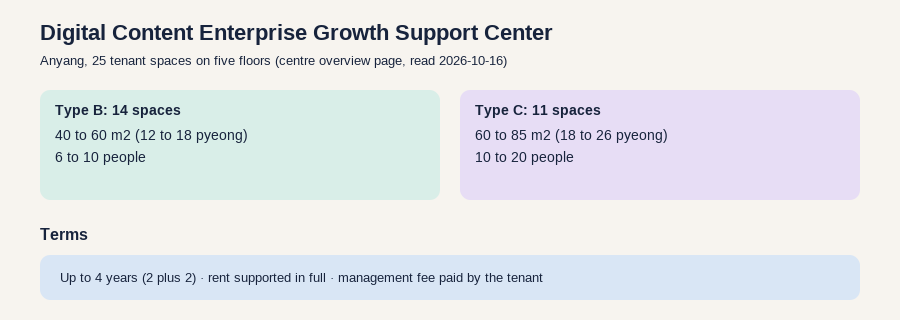
There are two sizes. The overview lists 14 B-type spaces and 11 C-type spaces. B suits 6 to 10 people and C suits 10 to 20 people.
| Type | Floor area | Suggested headcount | Spaces |
|---|---|---|---|
| B | 40 to 60 m² (12 to 18 pyeong) | 6 to 10 | 14 |
| C | 60 to 85 m² (18 to 26 pyeong) | 10 to 20 | 11 |
| Total | 25 |
In practice, the 2026 first-round call did not fill all of those. It took 4 B-type companies at most, and 1 C-type company at most.
How long can a company stay, and what does it cost?
The maximum stay is four years. The base term is two years, and a further two years are possible. The notice says an extension needs a performance evaluation.
On cost, the centre supports the rent in full. The tenant pays the management fees. The overview page says the tenant firm bears them entirely.
The centre also reviews residents twice a year. It calls this a mid-term evaluation, and it uses the results to manage performance.
What does a tenant get beyond a desk?
The facility page lists three shared areas. An experience zone lets teams try VR devices and digital content. An exhibition zone shows products of selected content firms and 5G content.
A test lab lends smartphones and tablets by maker and operating system, with an online request.
The business pages list the programmes for tenant and graduate companies. They include business-model and strategy consulting, coordinator mentoring and one-point IR mentoring. Experts also advise on management, accounting and law.
On publicity, the centre arranges domestic and overseas press coverage and feature interviews. It also supports promotional videos and runs a group of social-media reporters. Its history page records IR pitching days in 2021, 2022 and 2023, and overseas crowdfunding support on Kickstarter and Indiegogo from 2017.
Who could apply in the 2026 first round?
The notice targeted small and medium enterprises under Article 2 of the Framework Act on SMEs. Each had to make and supply digital content using new technology such as XR, VR, AR or AI. Each also had to have operated for at least three years on the closing date.
The age count follows paperwork. A sole proprietor counts from the opening date on the business registration certificate. A corporation counts from the date on its corporate registry.
The call ran from 20 July to 21 August 2026 at 14:00. That window is closed now. The application process was email only, and the notice rejects post and walk-in submissions.
When have tenant rounds happened before?
The history page gives a rough rhythm. It records tenant selection and move-in completed in February 2016, December 2016, December 2017, December 2018 and September 2020. The latest is a first round in 2026, which the notice calls the 2026-1st.
Those dates show that rounds follow vacancies, not a fixed calendar. The overview page says it adds tenants when a space falls vacant. Watch the centre's board rather than waiting for a seasonal window.
For another gateway into Gyeonggi, read our guide to the Pangyo Startup Campus.
Can a foreign-owned company apply?
The notice says nothing about nationality, ownership or the founder's residence. It does not welcome foreign-owned firms, and it does not exclude them. The tests it states are SME status, digital content activity and three years of operation.
The documents are Korean. The call counts years from a Korean business registration or corporate registry. A foreign-owned company with a Korean registration can match that wording.
However, the notice does not say the centre accepts such firms, so the centre decides.
Ask 차세대융합기술산업협회 whether a foreign-invested company that meets the SME definition qualifies. For the registration steps, see registering a business in Korea as a foreigner.
For more institutions like this, browse our ecosystem guide.
Frequently asked questions
- Who runs the Digital Content Enterprise Growth Support Center?
- The 2026 first-round notice says the Ministry of Science and ICT, NIPA and Anyang City operate it. It names 차세대융합기술산업협회 as the contact that takes applications.
- How many tenant spaces are there?
- The centre's overview page lists 25 spaces in total, 14 of type B (40 to 60 m²) and 11 of type C (60 to 85 m²), across five floors totalling 2,310 m².
- How long can a company stay?
- Up to four years, which is a two-year base term plus up to two more years. The notice says the extension needs a performance evaluation.
- Is the rent really free?
- The notice and overview say rent is supported in full. The tenant pays the management fee, and neither page prints an amount, so ask before signing.
- Can a startup under three years old apply?
- Not under the 2026 first-round notice. It asked for at least three years of operation on the closing date, counted from the business registration or corporate registry date.
- Does the notice say anything about foreign founders?
- No. It sets no nationality or residence rule either way. It tests SME status, digital content activity with XR, VR, AR or AI, and three years of operation.
- How do I apply?
- The 2026 first round accepted email only, to dcc@ncia.kr, by 21 August 2026 at 14:00. It refused post and walk-in submissions and counted an application only when all documents arrived.
Sources
- Digital Content Enterprise Growth Support Center - 2026-1st tenant recruitment notice (no. 2477) — read 2026-10-16
- Digital Content Enterprise Growth Support Center - centre overview, tenant spaces and history — read 2026-10-16
- Digital Content Enterprise Growth Support Center - resident list — read 2026-10-16
- Digital Content Enterprise Growth Support Center - facilities — read 2026-10-16
- Digital Content Enterprise Growth Support Center - capability-building programmes — read 2026-10-16
- Digital Content Enterprise Growth Support Center - business-development programmes — read 2026-10-16
Everything above is the rule as published. See how it applies to your case.
Read next
- InstitutionsSeoul Campus Town (캠퍼스타운): the university-district startup programme, with Soongsil as the worked case
- InstitutionsKICXUP: the industrial-complex open-innovation programme and its Seoul tenancy
- InstitutionsOne-person creative enterprise support centres (1인 창조기업 지원센터): what a solo founder gets
- InstitutionsTIPS Town in Seoul, Pohang and Daejeon: what tenancy actually requires