One-person creative enterprise support centres (1인 창조기업 지원센터): what a solo founder gets
1인 창조기업 지원센터 안내
A 1인 창조기업 지원센터 gives a solo founder a desk, mentoring and some commercialisation money. The Gyeonggi Job Foundation's Suwon centre took one company in its 2026 second-half round, scored it out of 100, and asked for a Gyeonggi address.

On this page
A solo founder in Korea can rent a desk, or can apply to a 1인 창조기업 지원센터 and get one with mentoring attached. The Suwon centre run by the Gyeonggi Job Foundation shows how tight the door can be. Its 2026 second-half call, listed in our catalogue, offered one place.
What is a 1인 창조기업 지원센터?
It is a centre that hosts solo founders and early companies. The Ministry of SMEs and Startups (MSS) backs the line, and KISED (창업진흥원) executes it. A 2023 call on Bizinfo, the government's grant portal, shows the structure.
In that 2023 call, applicants were corporations or organisations with incubation capacity, not founders. The chosen host had to put up at least 10% of the government subsidy in cash. The call named KISED's regional startup office as the contact.
So the centre you apply to is a host body's centre. The Gyeonggi Job Foundation, for example, runs the one in Suwon.
None of the pages we fetched prints a full list of centres. We therefore give no network total. The K-Startup space platform has a centre finder for the current list.
Who runs the Suwon centre, and what is in it?
The Gyeonggi Job Foundation (경기도일자리재단) runs it through its Southern Business Division. The 2026 notice says MSS and Gyeonggi Province support it. The centre sits on the first floor of the Foundation's building at 46 Gwonjung-ro, Suwon, and covers 470 m².
On the K-Startup space platform, the centre lists an open zone of 10 free-seating desks. It also lists three meeting rooms seating 5, 5 and 9 people, plus a product photo studio that the page limits to women founders and tenants. Opening hours for the space are 09:00 to 19:00.
| Item | What the sources print |
|---|---|
| Operator | Gyeonggi Job Foundation, Southern Business Division |
| Supporters | MSS and Gyeonggi Province |
| Space | 470 m², shared and dedicated desks |
| Cost to the company | None (the notice says 비용부담 없음) |
| Term | 1 year, extendable to 3 years on evaluation |
What does a resident actually get?
The 2026 notice lists four kinds of help. Infrastructure covers shared and dedicated desks, a copier, a scanner, free Wi-Fi, a café, a canteen and parking. Commercialisation help pays for product development, sales channels, intellectual property and publicity.
Management help is one-to-one mentoring from experts. The rest is a business network, sales-channel programmes, and training for the founder.
The Foundation's own programme page describes the same package in short form. It offers shared-office space plus commercialisation money, with mentoring and sales-channel programmes. It says the line runs all year, but the 2026 notice ran for a fixed window.
Who could apply in the 2026 second-half round?
In practice, the notice set two routes. A pre-founder needed a home address in Gyeonggi on the announcement date and no job elsewhere. A founded company needed its main office in Gyeonggi, an age of 7 years or less, and a founder with no job elsewhere.
A pre-founder who won had to register the business within 6 months. Three groups were excluded. They were people already supported by a national or local-government one-person centre, people in excluded sectors under the SME Startup Support Act's enforcement decree, and people in debt default.
How did the 2026 round score applicants?
The selection process had two steps. A document check came first, covering qualifications such as sector and address. Those who passed gave an in-person presentation, and the founder had to present personally with no proxy.
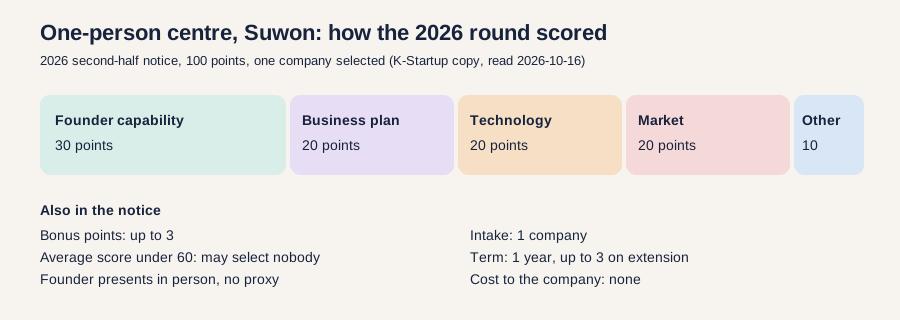
The panel scored 100 points. Founder capability carried 30, and business-plan fit, technology and market carried 20 each.
Other reasons for moving in carried 10. Bonus points reached 3 at most.
When do these rounds open?
The centre's space-platform page describes a twice-yearly rhythm. The first-half call comes in February, with screening in March and move-in in April. The second-half call comes in August, with screening in September and move-in in October.
The 2026 notice confirmed that the second-half window ran from 4 August to 11 September 2026. Those dates are closed now. Watch for the same pattern next year, and confirm it against the current notice.
For other regional entry points, see our guide to regional startup academies and the list of foreigner-facing bodies.
Can a foreign founder apply?
The notice is silent on nationality. It does not say foreigners may apply, and it does not say they may not. The only hard filters are the Gyeonggi address, the 7-year limit, no other job and the exclusions above.
The paperwork is where a foreign founder may stall. The list asks pre-founders for a 주민등록등본 (resident register extract). It also asks for a health-insurance eligibility record and tax-payment certificates for the founder.
However, the notice does not say what a foreign resident submits instead. Call the centre on 031-270-9788 before you spend time on the form. Our guide to an office address for business registration covers the Gyeonggi address problem.
What should a solo founder prepare?
Gather the required papers first. They are the application with a business plan, a consent form, a founder résumé with photo, a health-insurance eligibility record, and local and national tax certificates. Founded companies add a business registration and a corporate registry extract.
Some papers apply only to some applicants. A 1인 창조기업 member confirmation, last year's VAT base certificate, and a four-insurance roster are in that group. Bonus evidence must be submitted up front or it does not count.
Next, see the other support bodies in our ecosystem guide.
Frequently asked questions
- What is a 1인 창조기업 지원센터?
- It is a centre that hosts solo founders and early companies. The Ministry of SMEs and Startups backs the line and KISED executes it, while a host body such as a foundation, university or technopark runs each centre.
- How many companies did the Gyeonggi Job Foundation centre take in 2026?
- The 2026 second-half notice set the intake at one company. It also says no one may be selected if the average score stays under 60.
- How long can a company stay?
- The 2026 notice says one year, extendable to three years after an extension evaluation. The K-Startup space platform page says up to 24 months, so follow the notice.
- What does the notice say about foreign founders?
- Nothing about nationality, either way. It asks for a Gyeonggi address, a 7-year age limit and a founder with no other job, and it lists a resident register extract for pre-founders without naming a foreign substitute.
- Does it cost anything to move in?
- The 2026 notice states that the company bears no cost (비용부담 없음). It does not describe any other fee.
- When do rounds usually open?
- The centre's space-platform page describes two rounds a year, with a February call and April move-in, and an August call and October move-in. The 2026 second-half window ran from 4 August to 11 September.
- How is a candidate scored?
- Out of 100 points, the 2026 notice gives founder capability 30, business-plan fit 20, technology 20, market 20 and other reasons 10, plus bonus points up to 3.
Sources
- K-Startup - 2026 Gyeonggi Job Foundation One-Person Creative Enterprise Support Center second-half recruitment notice — read 2026-10-16
- Gyeonggi Job Foundation - One-Person Creative Enterprise Support Center programme page — read 2026-10-16
- K-Startup space platform - Gyeonggi Job Foundation One-Person Creative Enterprise Support Center — read 2026-10-16
- Bizinfo - 2023 One-Person Creative Enterprise Support Center new recruitment notice (host organisations) — read 2026-10-16
Everything above is the rule as published. See how it applies to your case.
Read next
- InstitutionsTIPS Town in Seoul, Pohang and Daejeon: what tenancy actually requires
- InstitutionsTIPS operators by type, region and sector: what the 145-operator list shows a foreign founder
- InstitutionsSeoul Global Center: business consultation for foreign residents
- InstitutionsPangyo Startup Campus: 60 seats, and a "Global" track that still wants a Pangyo address