PSST Problem section: what a Korean reviewer needs to understand first
PSST 문제정의 섹션 작성법
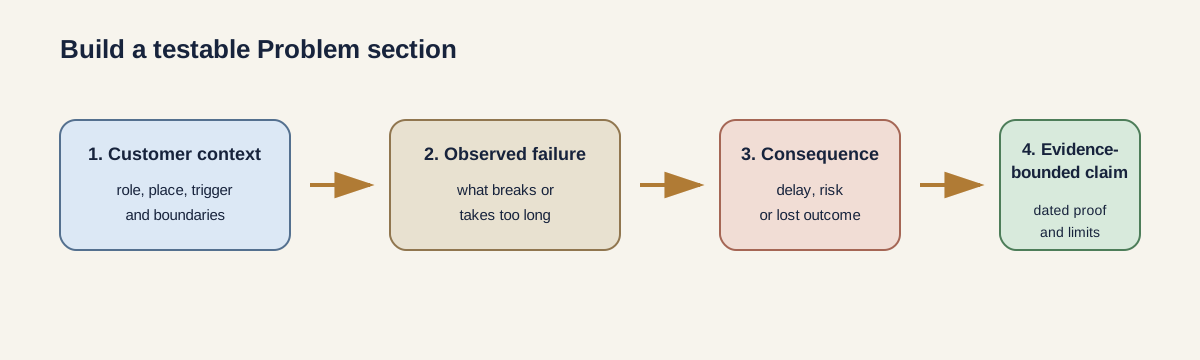
The Problem section is the part of a PSST plan that makes the opportunity testable. Define the affected customer, the failure they experience, the evidence you have, and the alternative they use now without pretending an old form is the current rule.

On this page
K-Startup's portal currently groups support into 8 lines. They include commercialization, research and development, facilities, mentoring, events, loans, personnel and global support. Each notice can use its own form and criteria.
A problem statement is a testable claim
Start with one customer group. “Small businesses” is too broad for most PSST drafts. Name the role, setting and trigger instead.
A Korean retailer may struggle while onboarding foreign customers. A founder may struggle while preparing an application. A clinic may struggle with a recurring administrative task.
Describe the failure in observable terms.
What takes too long? What gets rejected?
What does the team copy into a spreadsheet? Which decision waits?
A reviewer should picture the moment without a product explanation. That test keeps the Problem section separate from the Solution section.
Evidence need not be a market statistic. It may be a dated interview note, support ticket or repeated workflow. It may also be a signed letter of intent, measured drop-off or customer document.
Label what you observed. Label what you inferred. Keep those two claims separate.
Separate the customer from the consequence
The person who feels the problem may not pay the bill. Name both people when they differ.
An operations manager may lose time to reconciliation. A founder may absorb the delay cost. That distinction changes whom you interview.
It also changes the evidence you need. The manager can describe the task. The founder can describe the business consequence.
| Question | What to put in the Problem section |
|---|---|
| Who is affected? | A specific customer role and operating context |
| What fails? | The repeated task, delay, risk or rejected outcome |
| How do they cope now? | The existing tool, manual process or outside service |
| What is the consequence? | Time, lost sales, risk, delay or another observed effect |
| What proves it? | Evidence you can identify and date |
The existing workaround matters because it competes with your proposal. A customer may use a spreadsheet, consultant or messaging group. Some customers may do nothing.
Name that alternative. Do not call the market “unserved” when a costly workaround exists.
Put scope around the problem
A useful Problem section has boundaries. Say which customer belongs in scope and which customer does not.
Say when the problem occurs. It may appear during an application window, cross-border launch or monthly close.
Do not import a statistic just to make a paragraph sound substantial. If the current notice has no number, leave it out.
The K-Startup reference library lists separate guidance for different programmes. A form for one programme does not automatically fit another.
Make the reviewer’s next question easy
After reading the section, a reviewer should know what evidence to check next. Show the abandonment point if users leave a process.
Show the task and recorded charge if a manual task costs money. Explain the access constraint if a customer cannot reach a service.
Foreign founders also need geographic precision. Do not write “Korean customers” when the evidence covers one Seoul company.
Name the geography, customer type and language or regulatory context in the evidence. A reader should have enough detail to challenge the claim.
That challenge improves the plan. A reviewer may request a larger sample, another segment or a better measure.
When the problem is clear, continue to the Solution section. Keep the same customer and evidence trail.
Use the PSST assistant for drafting. Confirm every field against the current programme attachment before submission.
Frequently asked questions
- What belongs in the PSST Problem section?
- Name the affected customer, the concrete failure, the current workaround, the consequence and the evidence you actually have. Keep the product explanation for the Solution section.
- Should I use an old PSST template?
- Use it only as a drafting aid. K-Startup notices and their current attachments control the form, fields and instructions for the programme you are applying to.
- Do I need a market-size statistic in the Problem section?
- Not unless the current notice or your evidence supports it. A dated interview, workflow record, customer document or measured event can be more useful than an unsourced market number.
- How specific should the customer be?
- Specific enough to identify a role, operating context and trigger. Replace broad labels such as small businesses with the customer group your evidence actually covers.
- Can I describe a manual workaround as competition?
- Yes. A spreadsheet, consultant, messaging group or deliberate inaction is part of the customer’s current alternative and should be described honestly.
Sources
- K-Startup 창업지원포털 - programme lines and ongoing notices — read 2026-09-21
- K-Startup official reference library - programme management standards and guidance — read 2026-09-21
- KISED official site - K-Startup portal link — read 2026-09-21
Everything above is the rule as published. See how it applies to your case.
Read next
- FounderCraftKIPRIS: how to search Korean trademarks and patents before you file, and what IP scores for D-8-4
- FounderCraftRegister a business in Korea as a foreigner: sole proprietor or corporation, and what your visa needs
- FounderCraftToss Payments: why the webhook, not the redirect, decides a sale
- FounderCraftSending Korean customer data to a foreign AI API: what PIPA Article 28-8 asks