KIPRIS: how to search Korean trademarks and patents before you file, and what IP scores for D-8-4
KIPRIS 상표·특허 검색과 D-8-4 지식재산 점수
KIPRIS is Korea's free patent and trademark search, run for MOIP (formerly KIPO). How to search it, what a clean result cannot show, how a founder living in Korea can file without a patent attorney and for how much, and what patents, designs and applications are worth on the D-8-4 matrix.

On this page
- KIPRIS is free, Korean-first and run for MOIP
- Searching in English
- Running a trademark search: the fields that matter
- Running a patent or design search
- What a clean KIPRIS result does not prove
- Filing: who may file, in what language, for how much
- A founder living in Korea can file without an agent
- Official fees
- After you file
- Filing abroad: priority and Madrid
- Where IP sits on the D-8-4 matrix
- Trademarks have no line
- IP registered abroad
- Two more places IP appears
The English pages that rank for a KIPRIS search are mostly law firms and IP agencies. They write for brand owners abroad, who do need a Korean representative to file.
A founder who lives in Korea is in a different position, and the statute says so. This guide covers the search, its blind spots, the filing rules and fees, and what IP is worth on the start-up visa (D-8-4) points matrix.
KIPRIS is free, Korean-first and run for MOIP
On 1 October 2025 KIPO (특허청) became the Ministry of Intellectual Property: 지식재산처, or MOIP in English. Older English pages still say KIPO. This guide says MOIP from here on.
KIPRIS runs under MOIP together with 한국특허정보원 (KIPI), whose name sits in the site footer. MOIP's English page calls KIPRIS "the most comprehensive free industrial property information search system in Korea".
You need no account to search. The KIPRIS FAQ says membership is free and only unlocks extras, such as online downloads and a personal folder. Membership is personal only; a company cannot join under its business registration number.
The Korean site covers domestic and overseas patents and utility models, designs, trademarks, trials (심판) and papers.
Searching in English
The site header carries a language toggle, labelled 영문으로 번역하기, that switches the interface to English. For patents and utility models, KIPRIS translates between Korean and English by machine, free of charge. It also translates Japanese and Chinese into Korean.
The FAQ warns that machine translation can mistranslate and should not replace a qualified translator. It also asks you to type a security code (보안문자) before it machine-translates a Korean patent.
For professional English, use KPA, the Korean Patent Abstracts. The FAQ says professional translators translate these abstracts.
We could not load a separate English KIPRIS site on 18 September 2026, so this guide describes only the main site at kipris.or.kr.
Running a trademark search: the fields that matter
The detailed trademark search offers rights type, mark type, administrative status, free text, mark name, number, classification, person and date fields. The trademark help page explains them. These are the ones a founder needs first:
- 상표명칭 (mark name). Ticking 완전일치 returns only names identical to what you typed.
- 상품분류 (Nice class). The international list that sorts goods and services into 45 classes.
- 유사군 (similar-group code). A finer code grouping goods so alike that a shared name could confuse buyers.
- 지정상품 (designated goods). The specific goods or services an applicant names for the mark.
- 도형코드 (Vienna code). A number standing for the pictures or logo shapes in a mark.
- 출원인 (applicant). Searchable by name, business registration number or corporate registration number.
- 행정상태 (administrative status). Values include 출원, 공고, 등록, 거절, 무효, 소멸, 취하 and 포기.
KIPRIS also carries overseas trademarks from the US, Japan, Australia, Canada and Europe. Result filters include whether an earlier owner consented to coexistence (공존동의여부) and whether the filing went through Madrid.
Every right number starts with a type prefix. A number starting 10 is a patent, 20 a utility model, 30 a design and 40 a trademark.
Running a patent or design search
The patent search runs in four modes: domestic, overseas in English, overseas in Korean, and KPA. The overseas English mode searches patents from 27 countries, in English.
Content fields cover the title, the abstract, the claims, the full specification, or all four at once. Classification works by IPC or CPC, each with an input helper. A 검색어확장 option widens a search to words with similar meanings.
Keyword search accepts Korean, English and numbers. The 한글-영어 option also searches the English translation of a Korean word. The help page's own example finds both 자동차 and "vehicle".
KIPRIS splits Korean input into morphemes, so a compound word also matches its parts. Phrase search uses double quotes. The operators below come from the search help page.
| Operator | Symbol | Rule from the help page |
|---|---|---|
| AND | * | Both terms |
| OR | + | Either term |
| NOT | ! | Only together with AND |
| NEAR | ^ | Proximity search; the help page says up to 3 words |
| Truncation | ? | As in the help page's example, ?-2012-0001234 |
A similar-patents button returns up to 10 documents with similar content. Members can download results: up to 500 per download from 09:00 to 19:00, and up to 5,000 at other times.
The FAQ gives idea-stage founders a direct instruction. An idea alone cannot become a patent; it needs concrete technology. Search the prior art in your field, then read several other applicants' specifications before you draft your own.
What a clean KIPRIS result does not prove
KIPRIS does not show a filing on the day someone files it. The FAQ says a right becomes searchable only after publication, and the timing differs by right:
- Patents and utility models appear at publication or registration. MOIP publishes a patent application 18 months after the filing date, or after the priority date if one is claimed. An applicant can ask for earlier publication.
- Designs appear only on early publication or at registration.
- Trademarks become findable by application number or applicant within 1-2 weeks of filing, and by mark name after 3-4 weeks. A correction during formality examination can stretch that past a month.
So a rival's patent filing can sit out of view for up to 18 months, and a trademark filed three weeks ago may not match your name search yet.
The mark name KIPRIS displays comes from MOIP's formality examiner, and nobody can edit it. Search by applicant and class as well as by name.
An examiner, not a database, decides whether a mark can register, in substantive examination. MOIP's English page names distinctiveness as one requirement.
Filing: who may file, in what language, for how much
Korea is first-to-file for patents and for trademarks. MOIP's patent page says the right goes to the first applicant, whoever invented the invention. A trademark needs no prior use before you file.
The Trademark Act does not protect unregistered marks. It protects well-known or famous ones only by blocking similar registrations, and an infringement claim for those runs under the Unfair Competition Prevention Act.
A founder living in Korea can file without an agent
Patent Act Article 5 defines a 재외자 as a person with no address or place of business in Korea. A 재외자 must act through a representative with a Korean address, the 특허관리인. The exception applies while that person, or a company's representative, is staying in Korea.
Trademark Act Article 6 sets the same rule for trademarks, with a 상표관리인.
MOIP's English patent fee page puts it plainly. With a residential address in Korea, "you are legally entitled to handle application procedures yourself".
A non-resident needs a representative with a Korean address. MOIP's patent fee page says that person "could be a friend or relative, not necessarily a patent attorney". The trademark fee page repeats the rule but drops that sentence.
MOIP's wording also differs between pages. Its patent page says MOIP returns an application a non-resident files "without using an agent". Its trademark page says "without coming through a patent agent in the Republic of Korea".
Neither statute requires a patent attorney (변리사); both require a representative with a Korean address.
Two conditions apply to everyone. Every document must be in Korean, and MOIP returns an application that is not, with no filing number. Paying fees online also needs a Korean address, because Korea uses its own online certificate system.
Official fees
MOIP's Korean fee table, dated 1 January 2025, sets these filing fees:
| Filing | Electronic | Paper |
|---|---|---|
| Trademark, per Nice class | KRW 52,000 | KRW 62,000 |
| Trademark, per class, notified goods names only | KRW 46,000 | KRW 56,000 |
| Each designated good over 10 in one class | +KRW 2,000 | +KRW 2,000 |
| Patent, filed in Korean | KRW 46,000 | KRW 66,000 |
| Patent, filed in a foreign language (English only) | KRW 73,000 | KRW 93,000 |
| Patent examination request | KRW 166,000, plus KRW 51,000 per claim | not split by format |
| Design, examined (심사), per design | KRW 94,000 | not listed here |
| Design, partial examination (일부심사), per design | KRW 45,000 | not listed here |
The English fee pages say their fees have been "in effect since August 1, 2023". They print the same base figures: KRW 52,000 per trademark class, KRW 46,000 per patent, KRW 166,000 plus KRW 51,000 per claim for examination.
The English pages lag the Korean table in two places. They omit the KRW 46,000 notified-goods trademark rate and the KRW 73,000 foreign-language patent rate. This guide follows the Korean table.
MOIP publishes no fees for patent attorneys or filing agents, so none appear here.
After you file
A trademark application designates goods by Nice class, with an extra fee for each class. MOIP examines trademarks automatically in filing order, and examination generally takes about 5 months from filing. After publication, anyone may oppose within two months, and that window cannot be extended.
A trademark right lasts 10 years from registration and renews every 10 years. A registered mark left unused for three or more consecutive years is open to cancellation.
A patent application reaches an examiner only once someone requests examination, within 5 years of filing. A patent lasts 20 years and a utility model 10.
Filing abroad: priority and Madrid
A Korean filing can claim priority from an earlier foreign one. The window is 12 months for a patent and 6 months for a trademark.
Korea acceded to the Madrid Protocol on 10 January 2003, in force from 10 April 2003, according to WIPO. MOIP's history page also says Protocol, joined in 2003. One older MOIP English page says KIPO applied to join the "Madrid Agreement" instead.
Through Madrid you file one international application and pay one set of fees for protection in the 133 countries covered. You need a national or regional application or registration first. KIPRIS describes the route as one language (English, French or Spanish) and one currency (Swiss francs).
Where IP sits on the D-8-4 matrix
The operator's matrix sets the start-up visa (D-8-4) threshold at 60 points, including at least one prerequisite item. It also requires a degree or a Global Start-up Immigration Center letter, and a corporation. Our D-8-4 matrix guide covers the full route.
IP fills three of the prerequisite items: holder, co-inventor and applicant. Each splits into patent, and utility model or design:
| Prerequisite item | Patent | Utility model or design |
|---|---|---|
| Holder (registrant) of IPR | 60 | 30 |
| Co-inventor of registered/acquired IPR | 30 | 10 |
| Applicant of IPR | 10 | 5 |
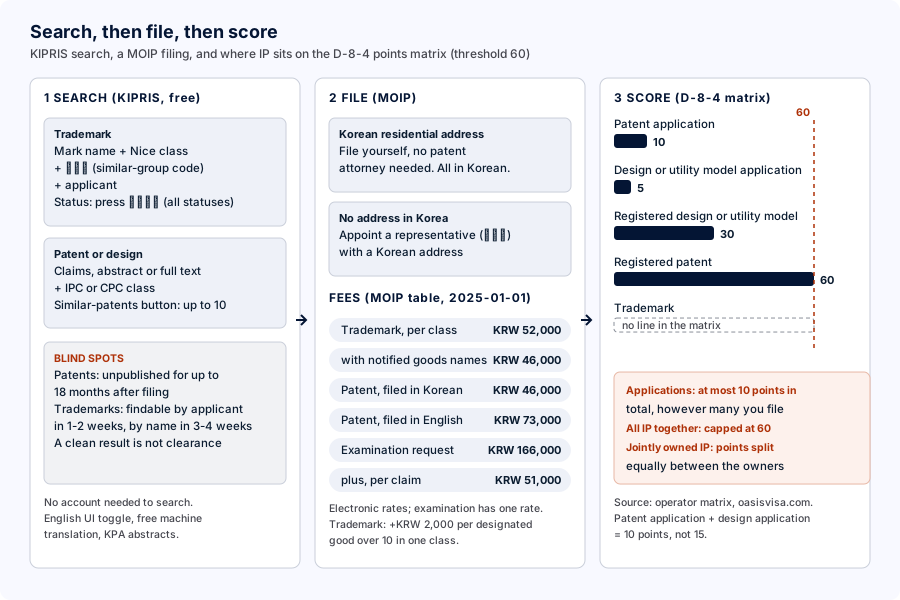
Two caps sit under the table, in one sentence on the operator's page. Overlapping IP points count up to a maximum of 60. Applications count for up to 10 points, however many you file.
So a registered patent and a registered design together score 60, not 90. A patent application and a design application together score 10, not 15. The other items that move a total are in what changes an OASIS score.
One more rule covers shared ownership. For jointly owned IP, the operator divides the points equally among the joint participants.
The operator's own "Example of 60 Points" uses a patent application as its prerequisite item. It adds OASIS-4 (10), OASIS-5 (15), OASIS-8 (15), OASIS-1 (10) and a patent application (10), which totals 60.
Trademarks have no line
The operator's matrix lists patents, utility models and designs. It prints no line for trademarks, and its OASIS-3 filing support excludes them by name: "only for patent, utility model and design (trademark is excluded)".
A trademark still matters for the business, because Korea is first-to-file. It is simply not an item the matrix names.
IP registered abroad
The operator's page carries one footnote on this. It reads: "Holders of intellectual property rights registered in OECD countries are eligible for OASIS-2 education exemption and point recognition."
Two more places IP appears
The OASIS-2 course lists a "2.0Hr Prior art search and practice for patent information" module. The operator also lists IP ownership (registration) among its criteria for a visa extension.
Check where your IP leaves your total on the D-8-4 points simulator, or browse the OASIS courses that add elective points on /oasis.
Frequently asked questions
- Is KIPRIS free, and do I need an account?
- KIPRIS is free and you can search patents, utility models, designs, trademarks and overseas patents without an account. Membership is also free and unlocks extras such as online downloads and a personal folder. Only individuals can join; a company cannot register under its business registration number.
- Can I search KIPRIS in English?
- Partly. The site header has a toggle that switches the interface to English, patent search offers free Korean-English machine translation, and KPA provides Korean patent abstracts translated by professional translators. The overseas English mode searches patents from 27 countries. A separate English KIPRIS site did not load when we checked on 18 September 2026.
- If my brand does not show up on KIPRIS, is it safe to file?
- A clean search is not clearance. A new trademark becomes findable by applicant within 1-2 weeks and by name only after 3-4 weeks, and patent applications stay unpublished until 18 months from filing unless published early. A MOIP examiner decides registrability, and Korea is first-to-file.
- Do I need a Korean patent attorney to file?
- Not if you have a residential address in Korea: MOIP says you are legally entitled to handle the procedure yourself, in Korean. Patent Act Article 5 and Trademark Act Article 6 require a representative with a Korean address only for people with no address or business in Korea, except while they are staying in Korea. MOIP's patent fee page says that representative could be a friend or relative, not necessarily a patent attorney.
- How much does it cost to file a trademark or a patent in Korea?
- MOIP's Korean fee table (as of 1 January 2025) sets a trademark at KRW 52,000 per class filed electronically, or KRW 46,000 using only MOIP-notified goods names, plus KRW 2,000 for each designated good over 10 in a class. A patent filed electronically in Korean is KRW 46,000, or KRW 73,000 in English, and an examination request is KRW 166,000 plus KRW 51,000 per claim. The English fee page omits the 46,000 and 73,000 rates.
- Does a trademark count toward D-8-4 points?
- The operator's matrix has no trademark line. Its IP items cover patents, utility models and designs only, and its OASIS-3 filing support excludes trademarks by name.
- How many D-8-4 points is a patent application worth, and do several add up?
- A patent application is worth 10 points and a utility model or design application 5. The operator counts applications for up to 10 points however many you file, and caps all IP points together at 60. Jointly owned IP splits the points equally among the owners.
Sources
- MOIP press release, 2025-09-30: KIPO becomes the Ministry of Intellectual Property (지식재산처) on 1 October 2025 — read 2026-09-18
- MOIP (English) - KIPRIS and KPA description — read 2026-09-18
- KIPRIS home page - coverage, operator, language toggle — read 2026-09-18
- KIPRIS FAQ - membership, machine translation, publication timing, trademark names, prior art — read 2026-09-18
- KIPRIS help - trademark search fields — read 2026-09-18
- KIPRIS help - patent search modes and fields — read 2026-09-18
- KIPRIS help - basic search, operators, similar patents, downloads — read 2026-09-18
- MOIP (English) - patent application, publication, examination request, priority — read 2026-09-18
- MOIP (English) - first-to-file rule for patents — read 2026-09-18
- MOIP (English) - utility model and patent term comparison — read 2026-09-18
- MOIP (English) - requirements for trademark registration — read 2026-09-18
- MOIP (English) - patent fees and payments (residents, non-residents, representatives) — read 2026-09-18
- MOIP (English) - trademark and design fees — read 2026-09-18
- MOIP (Korean) - fee table FAQ, 2025. 1. 1. basis — read 2026-09-18
- Patent Act (특허법) Article 5, law.go.kr — read 2026-09-18
- Trademark Act (상표법) Article 6, law.go.kr — read 2026-09-18
- MOIP (English) - history (Madrid Protocol, 2003) — read 2026-09-18
- WIPO Lex - Madrid Protocol contracting parties (Republic of Korea) — read 2026-09-18
- WIPO - the Madrid System — read 2026-09-18
- OASIS operator (Global Start-up Immigration Center) - D-8-4 points matrix — read 2026-09-18
Everything above is the rule as published. See how it applies to your case.
Read next
- FounderCraftRegister a business in Korea as a foreigner: sole proprietor or corporation, and what your visa needs
- FounderCraftToss Payments: why the webhook, not the redirect, decides a sale
- FounderCraftSending Korean customer data to a foreign AI API: what PIPA Article 28-8 asks
- FounderCraftThe Business Model Canvas, mapped onto what a Korean 사업계획서 actually has to prove