The startup SME tax reduction (창업중소기업 세액감면): who qualifies and for how long
창업중소기업 세액감면 제도
Article 6 of Korea's Restriction of Special Taxation Act reduces income or corporate tax for a qualifying startup SME. The rate depends on founder age, location and founding date, the reduction runs for up to five tax years, and the statute itself does not address a foreign founder's eligibility.
On this page
Korea's startup tax reduction sits in one article of one law. Article 6 of the Restriction of Special Taxation Act (조세특례제한법) sets the rate, the years and the founding deadline. This post reads that article as fetched from the National Law Information Center, not a summary of it.
Who the article covers
Article 6 covers a small or medium enterprise that starts a qualifying business by 31 December 2027. It also covers a person designated as a startup incubator operator under the SME Startup Support Act. Both categories come from the statute's own text.
The reduction is not open to every business a founder might register. The Enforcement Decree lists specific eligible business types, and this post could not fetch that full list. Confirm your registered 업종 code against the current Decree before assuming the reduction applies.
What "young founder" means here
The National Tax Service's own guide to this reduction defines a young founder (청년창업) as someone aged 15 to 34 at the time of founding. Military service extends that window: up to six years of service time is deducted from the founder's age for this test.
For a corporation, the young founder must also be the company's largest shareholder (최대주주), not merely an employee or a minority holder. The same NTS guide states this requirement directly, alongside the age rule.
The same NTS guide names an approved-sector count: 18 business sectors qualify, including manufacturing, construction and information technology. It does not print the full list of all 18. Check your own registered sector against the current Enforcement Decree.
A separate, additional reduction tied to hiring
The NTS guide also describes an additional reduction on top of the base rate, tied to growing headcount after founding. A manufacturing business needs at least 10 employees, and a business in another qualifying sector needs at least 5, to reach this additional layer.
This additional reduction is a separate calculation from the base rate table below. The guide named the employee thresholds but did not print the add-on percentage. Confirm the exact rate with the National Tax Service before counting on it.
The rate depends on three things at once
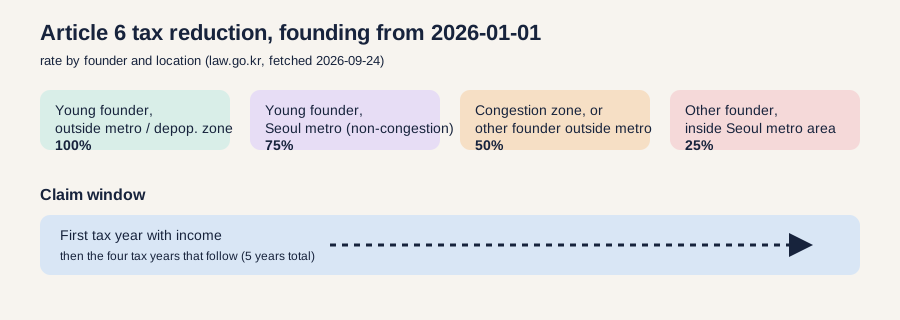
The rate is not one number. It depends on the founder's age category and the business location. It also depends on whether the business was founded before or after 1 January 2026, when the tiers changed.
| Founding date | Founder and location | Reduction rate |
|---|---|---|
| By 2025-12-31 | Young founder, outside the Seoul metropolitan area | 100% |
| By 2025-12-31 | Young founder in the Seoul metro area, or any other founder outside it | 50% |
| From 2026-01-01 | Young founder outside the Seoul metro area, or in a depopulation zone | 100% |
| From 2026-01-01 | Young founder in the Seoul metro area, outside its congestion zone | 75% |
| From 2026-01-01 | Young founder in the congestion zone, or other founder outside the metro area | 50% |
| From 2026-01-01 | Other founder inside the Seoul metro area | 25% |
| Any date | Designated startup incubator operator | 50% |
Two dates matter here, not one. The first is 1 January 2026, when the rate tiers changed. The second is 31 December 2027, the statute's own deadline for founding a business at all; founding after that date sits outside Article 6 entirely.
How many years, and how much
The reduction runs from the tax year a business first earns income through the fourth tax year that follows. That gives a business up to five tax years of relief, starting only once income exists.
The text fetched for this post does not print an annual cap in won. A separate summary elsewhere states one, but this post could not confirm it from law.go.kr or easylaw.go.kr, so no figure appears here.
Applying is a separate step
The reduction is not automatic. The statute requires the taxpayer to apply for it, under a procedure set by presidential decree. In practice, that means filing the claim with the return, through Hometax or a tax accountant.
Where a foreign founder should stop and ask
The version of Article 6 fetched for this post uses the term 내국인 for the class of taxpayer it covers. It does not separately address a foreign national or a foreign-invested company anywhere in the text.
This is exactly the kind of foreign-eligibility question the statute leaves silent. It is decided in practice by the National Tax Service or a Korean tax accountant reading your company's specific registration, not by this article.
Where this sits among a founder's other early filings
This reduction sits next to other decisions a foreign founder makes at incorporation. Which business type to register, and whether the company counts as a startup SME under this article, come first. Whether the company will also seek other certifications is a separate question with its own benefits.
None of those other certifications change what Article 6 itself says. Each has its own eligibility text, its own primary source, and its own answer to the foreign-founder question above.
For registration and compliance support beyond this one article, see EastStartup's services.
Frequently asked questions
- What is the startup SME tax reduction?
- It is the reduction in income or corporate tax under Article 6 of the Restriction of Special Taxation Act for a small or medium enterprise that starts a qualifying business, at rates the statute sets by founder age, location and founding date.
- How long does the reduction last?
- From the tax year the business first earns income through the fourth tax year that follows, up to five tax years in total, on the text of Article 6 fetched for this post.
- Does every new business qualify?
- No. Article 6 applies to specific business types listed in the Enforcement Decree and to businesses founded by 31 December 2027. The text fetched for this post did not include the full business-type list, so confirm your own registered type separately.
- Is the reduction automatic?
- No. The statute requires the taxpayer to apply for it under a procedure set by presidential decree, typically filed together with the tax return.
- Does this apply to a foreign founder's company?
- The fetched text uses the term 내국인 and does not separately address a foreign national or a foreign-invested company. Confirm your company's status with the National Tax Service before relying on it.
- Is there an annual cap on the reduction, in won?
- This post could not confirm an annual cap from law.go.kr or easylaw.go.kr, so no figure is stated here.
- What counts as a young founder for the higher rate?
- The National Tax Service's own guide defines a young founder as aged 15 to 34 at founding, with up to six years of military service deducted from that age. For a corporation, the young founder must also be the company's largest shareholder.
Sources
- National Law Information Center (law.go.kr) - Restriction of Special Taxation Act, Article 6 (창업중소기업 등에 대한 세액감면) — read 2026-09-24
- easylaw.go.kr (Ministry of Government Legislation) - tax reduction at startup (창업 시 조세감면) — read 2026-09-24
- National Tax Service (nts.go.kr) - corporate tax filing guide for startup SMEs (창업한 중소기업에 대한 법인세 신고안내) — read 2026-09-24
Everything above is the rule as published. See how it applies to your case.