PSST Team section: show who can deliver the plan
PSST 팀 구성 섹션 작성법
The PSST Team section should connect named people to the work a current programme plan proposes. Use the current notice and attachment, then show roles, relevant evidence and gaps without inventing a required score or team size.

On this page
The Team section is not a short company biography. It is an explanation of who will perform the work described elsewhere in the PSST plan and what evidence supports that assignment.
Start with the current programme attachment
K-Startup publishes support notices by line, including commercialization, research and development, facilities, mentoring, events, loans, personnel and global support. Each notice can carry its own form and instructions.
That means an old PSST template is not a current rule. Open the notice for the named programme, download its attachment, and confirm the Team fields before you draft.
Map people to work packages
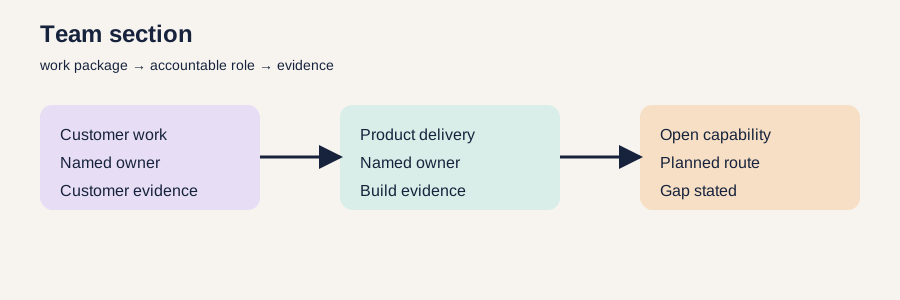
Start with the plan, not the resume. For each major work package, name the person accountable for the next decision or deliverable.
| Plan question | Team evidence to show |
|---|---|
| Who owns the product work? | Named person, role and relevant build evidence |
| Who owns customer work? | Named person, market experience and customer evidence |
| Who owns compliance? | Named person, responsibility and verified specialist support |
| What remains open? | Capability gap, proposed route and timing to confirm it |
The relationship should be explicit: a founder owns a decision, a technical member owns a build task, and an external adviser supports a defined need. Do not imply that an adviser is a co-founder.
Use evidence, not status words
“Experienced,” “global” and “technical” are labels, not evidence. Replace them with a shipped product, a dated customer conversation, an employment record, an identified patent application or another document you can actually provide.
The evidence must support the claim you make. A degree can support education. It does not by itself prove that someone can deliver a production system or sell into a particular market.
The current KISED reference library shows that programme-specific management standards and detailed criteria are published separately. Use the attachment for the programme you name, rather than importing a requirement from a different line.
Treat missing capability as a planning item
A small team can still be credible when its limits are clear. State which capability is not yet present, what work is affected, and whether the plan uses hiring, contracting, mentoring or another documented route.
Do not present a future hire as a current team member. Use separate labels for founder, employee, contractor, adviser and planned hire so the reviewer can tell what exists today.
The same distinction matters for foreign founders. A Korean partner, overseas co-founder and local service provider can play different roles. Name the legal or operational relationship only when your evidence supports it.
Keep the Team section consistent
Compare the Team section with the Problem, Solution and Scale-up sections. The person who owns customer discovery should appear where that work is described. The person responsible for technical delivery should match the milestones and budget assumptions.
If the sections disagree, fix the plan rather than adding another biography. A reviewer should be able to follow one responsibility chain from the proposed work to the person accountable for it.
Use the PSST assistant to organise the draft, then verify every field against the current K-Startup programme attachment before submission.
Frequently asked questions
- What belongs in the PSST Team section?
- Name the people responsible for the plan, connect them to work packages, and show evidence for the capabilities you claim.
- Is there one required PSST team size?
- Do not assume one. Check the current programme notice and attached form for the fields and instructions that apply.
- Can an adviser be listed as a team member?
- List the adviser by the relationship the evidence supports and define the work they will provide. Do not present an adviser as a co-founder.
- What counts as evidence for a team capability?
- Use evidence that matches the claim, such as a shipped product, dated customer work, employment record or document you can provide.
- Should I hide a capability gap?
- No. State the missing capability, the affected work and the documented route you plan to use to address it.
Sources
- K-Startup 창업지원포털 - current programme notices — read 2026-09-21
- K-Startup official reference library — read 2026-09-21
- KISED official site and K-Startup portal link — read 2026-09-21
Everything above is the rule as published. See how it applies to your case.