Patent and utility model filing in Korea: what the OASIS matrix counts
한국 특허와 실용신안 출원, OASIS 점수에서 세는 항목
KIPO treats patents and utility models as different rights with related filing steps. For the OASIS D-8-4 matrix, registered rights, co-inventor rights and pending applications receive different points, while overlapping intellectual-property points are capped. File according to KIPO rules, then document the status the operator can verify.

On this page
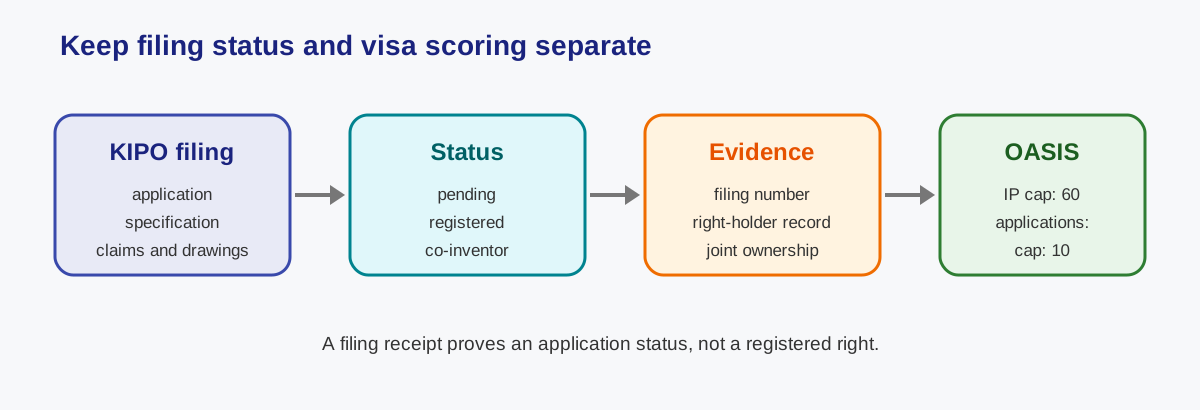
Patent paperwork and visa-point paperwork answer different questions. KIPO decides whether an application has been filed and how the right proceeds. The OASIS operator decides how a documented IP status fits its D-8-4 point matrix. Keep those systems separate.
Patent and utility model are not interchangeable labels
KIPO’s English patent material describes a patent as a right for an invention and a utility model as a right for a device. The same material explains that Korea applies the first-to-file rule. The applicant who files first is the relevant applicant under that rule, not simply the person who says they invented first.
That is a legal distinction, not a recommendation about which route is better. The choice depends on the subject matter, filing strategy, prior-art position and professional advice. An OASIS point entry does not replace a KIPO classification decision.
KIPO’s filing record is the foundation
KIPO’s patent and utility-model pages list the core filing materials. They include an application identifying the inventor and applicant, a specification with a detailed description and claims, drawings where relevant, an abstract, and priority material when a priority right is claimed.
The filing must also meet formal requirements. KIPO states that an application without the required specification or relevant drawings, or an application submitted by someone without a Korean address or place of business who does not use a Korean agent, can be treated as though it had never been submitted. The exact return and correction rules belong to KIPO’s procedure.
For a foreign founder, representation and language are practical checks. KIPO’s utility-model guidance says an application must be written in Korean and that an applicant without a Korean address or place of business must use an agent in Korea. Confirm the current procedure before filing rather than relying on an English checklist from another jurisdiction.
The OASIS matrix counts status, not ambition
The Global Startup Immigration Center’s OASIS page gives the D-8-4 point matrix. It lists prerequisite items such as registered IP, co-inventor status, pending IP applications, government startup support and qualifying investment. The page states that at least one prerequisite item is required and that the overall threshold is 60 points, alongside the other requirements it prints.
| IP status in the operator matrix | Printed points | Limitation |
|---|---|---|
| Holder of a registered patent | 60 | IP overlap remains subject to the 60-point cap |
| Holder of a registered utility model or design | 30 | The matrix groups utility model and design |
| Co-inventor of registered patent | 30 | Joint participation can divide points |
| Co-inventor of utility model or design | 10 | Joint participation can divide points |
| Applicant of a pending patent | 10 | All pending applications together are capped at 10 |
| Applicant of a pending utility model or design | 5 | Pending application recognition remains capped at 10 |
The table is a reading guide to the operator’s matrix, not a KIPO fee schedule or a prediction that an application will register. A filing receipt can establish an application status. It does not establish a registered right.
Apply the caps before you total points
The OASIS page says overlapping registered, acquired, invented or applied-for IP points are allowed within a maximum of 60 points. It separately says IP applications are recognized up to 10 points regardless of the number of applications. The application cap is therefore not an invitation to multiply a single 10-point category by the number of filings.
Joint ownership also needs care. The operator page says points are divided equally among joint participants for jointly owned IP registration, invention or application. The document proving the relationship matters as much as the filing itself.
Read OASIS-3 as support, not a new right
The operator describes OASIS-3 as application support for patent, utility-model and design rights, with trademark excluded from that support description. That is a programme description. It does not change KIPO’s filing requirements or guarantee that an idea will receive a right.
The operator’s page also contains an internal source conflict: its worked 60-point example labels OASIS-4 as a three-day class, while the later OASIS-4 programme description says 20 hours over three weeks. Do not use the example to infer the current course schedule. Verify the operator’s current course notice.
Use the OASIS guide for the wider D-8-4 route, and confirm filing procedure with KIPO or a qualified Korean IP professional.
Frequently asked questions
- What is the difference between a patent and a utility model in Korea?
- KIPO describes a patent as covering an invention and a utility model as covering a device. The rights have related procedures but are not interchangeable labels.
- How many OASIS points is a registered patent?
- The OASIS operator matrix prints 60 points for a holder of registered patent rights, subject to the matrix rules and the overall IP cap.
- How many points can pending IP applications provide?
- The matrix recognizes pending IP applications up to 10 points regardless of the number of applications. A pending application is not a registered right.
- Can I add every registered IP point together?
- No. The operator says overlapping IP points are allowed within a maximum of 60 points. Joint participants can also have points divided equally.
- Does filing an application guarantee OASIS points?
- No. You need the status and evidence recognized by the operator. KIPO filing status and OASIS scoring are separate systems.
- Does OASIS-3 replace KIPO filing requirements?
- No. OASIS-3 describes support for parts of the application process. KIPO’s filing and examination requirements still control the IP procedure.
Sources
- KIPO/MOIP - patents and utility models, first-to-file rule and filing procedure — read 2026-09-21
- KIPO/MOIP - current utility model system and foreign applicant procedure — read 2026-09-21
- KIPO/MOIP - patent and utility-model fees and payment guidance — read 2026-09-21
- Global Startup Immigration Center - OASIS D-8-4 requirements and IP point matrix — read 2026-09-21
Everything above is the rule as published. See how it applies to your case.
Read next
- FounderCraftPSST Solution section: turn a problem into a testable response
- FounderCraftFiling a trademark with KIPO as a foreign founder
- FounderCraftPSST Problem section: what a Korean reviewer needs to understand first
- FounderCraftKIPRIS: how to search Korean trademarks and patents before you file, and what IP scores for D-8-4