PSST Solution section: turn a problem into a testable response
PSST 해결방안 섹션 작성법
The Solution section should show how a defined product or service responds to the specific problem in the plan. Connect each feature to a customer failure, explain what you can deliver, and leave current programme fields to the notice and its attachment.

On this page
The Solution section is the bridge between a customer problem and a plan a reviewer can examine. It should not become a product brochure. A reviewer needs to see the response, the user, the delivery boundary and the test that would show whether the response works.
Start with the problem already defined
Use the same customer and situation from the Problem section. If the problem described a Korean retailer losing time while onboarding foreign customers, the Solution section should explain the workflow that reduces that specific delay. Changing the customer here breaks the logic of the plan.
A solution claim is stronger when it names the mechanism. “We improve onboarding” is broad. “The service collects the required customer fields once, checks missing items, and gives the operator a review queue” tells the reader what changes.
Show the response as a chain
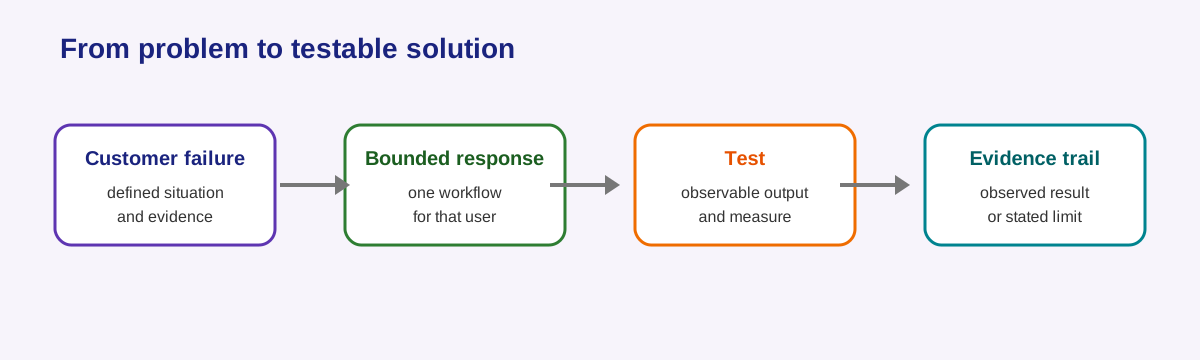
The useful chain is problem, response, user action and observable result. The customer encounters the failure, uses the proposed workflow, and produces an output that can be checked. That output might be a completed application, a verified record, a shorter manual step or a documented decision.
| Solution question | What the draft should answer |
|---|---|
| Who uses it? | The role and operating context named in the Problem section |
| What changes? | The task, decision or hand-off that becomes different |
| How does it work? | The smallest credible workflow, not every future feature |
| What is delivered? | A concrete output the customer can inspect |
| How will it be tested? | A measure linked to the original failure |
This does not require a claim that the solution will succeed. It requires a clear claim that can be tested. State what the first version includes and what it does not include. A narrow boundary gives the reviewer a way to challenge the plan constructively.
Keep the first version narrow
The official KISED programme pages describe commercialization support alongside business-plan submission, documentary evidence, mentoring and programme support. They do not turn every product idea into a universal template. The current notice decides the exact form and supporting documents for the programme you name.
Avoid putting the whole company roadmap into the Solution section. A future marketplace, international expansion plan or advanced automation may matter later, but it can hide whether the first response is feasible now. Put later stages in the section that the current form provides for them.
Connect the solution to evidence
The Problem section carries evidence about the present failure. The Solution section should say what evidence will test the proposed response. A prototype walkthrough, pilot record, completed workflow, user interview or measured task result can all be useful when dated and labelled accurately.
Do not call interest proof of performance. An interview can show that a problem is understood. It does not prove that the proposed workflow saves time. A prototype test can show usability. It does not prove broad demand. Keep observed results, planned tests and assumptions visibly separate.
Use the current form, not a remembered PSST template
KISED’s programme overview identifies a business plan and documentary evidence as application materials, while the K-Startup portal maintains notices and a reference library. Those pages are useful starting points, but a named programme’s current attachment can add, remove or rename fields.
That distinction matters for foreign founders. The Solution section can explain the product response in English, but the application still follows the current notice, applicant definition, submission route and required evidence. Confirm each field before submission.
Continue with the PSST assistant, carrying the same customer and evidence trail from the Problem section into the Solution section.
Frequently asked questions
- What belongs in the PSST Solution section?
- Explain what you will provide, how it responds to the defined customer problem, what the first version includes, and how the response can be tested.
- Should the Solution section list every product feature?
- No. Include the smallest credible workflow and connect each major capability to a customer failure supported by your evidence.
- Is a prototype proof that the solution works?
- No. A prototype can test a workflow or usability claim. Keep planned tests, observed results and broader demand claims separate.
- Should I copy an old PSST template?
- Use old templates only as drafting aids. The current K-Startup notice and its attachment control the fields and instructions for the programme you name.
- How should a foreign founder prepare this section?
- Use the same customer and evidence trail as the Problem section, then confirm the current notice, applicant definition, submission route and required documents.
Sources
Everything above is the rule as published. See how it applies to your case.
Read next
- FounderCraftFiling a trademark with KIPO as a foreign founder
- FounderCraftPSST Problem section: what a Korean reviewer needs to understand first
- FounderCraftKIPRIS: how to search Korean trademarks and patents before you file, and what IP scores for D-8-4
- FounderCraftRegister a business in Korea as a foreigner: sole proprietor or corporation, and what your visa needs