Filing a trademark with KIPO as a foreign founder
외국 창업자의 한국 상표 출원
A foreign founder can file a Korean trademark, but the route depends on whether the applicant has an address or place of business in Korea. MOIP explains the filing documents, Korean-language requirement, representative rule and priority window.

On this page
Foreign founders often confuse filing with registration. Filing sends an application to the Ministry of Intellectual Property, formerly KIPO.
Registration comes after examination. Filing starts the process, but it does not guarantee the result.
Start with the applicant and the mark
MOIP’s English guidance says a person who uses or intends to use a trademark in Korea may apply. Treaty and reciprocity rules govern foreign eligibility.
A company may also apply. The application then needs the required corporate information.
List the applicant, mark, goods or services and classes. A class describes the commercial area for the claim.
List only goods or services that the business genuinely intends to use.
Korea uses a registration system. MOIP still expects a bona fide intention to use the mark.
If the owner leaves a mark unused for 3 consecutive years after registration, another party may seek cancellation. Filing a name only to hold it creates a weak brand position.
A foreign founder’s address changes the route
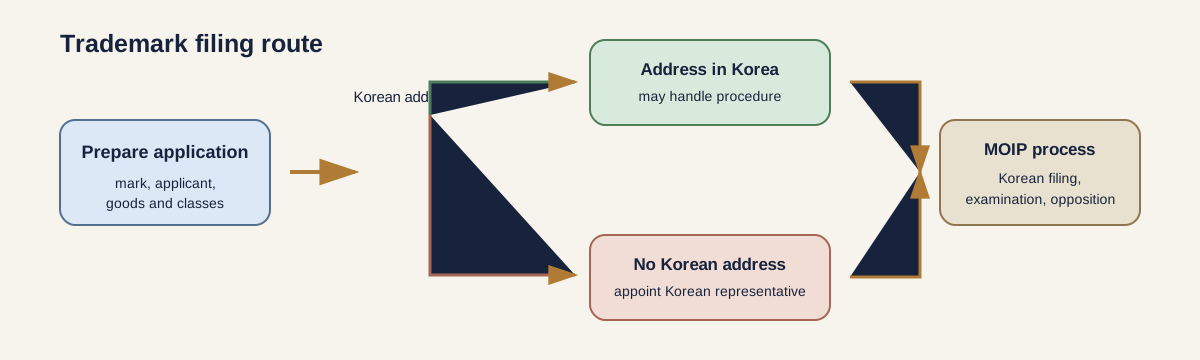
MOIP separates applicants with a Korean residential or business address from applicants without one. An applicant without that address must appoint a representative in Korea.
MOIP's fee and payment guidance lets a person with a Korean residential address handle the procedure. After MOIP issues an application number, the resident filer submits a Certificate of the Facts of Alien Registration.
An applicant without a Korean residential or business address appoints a representative and submits that representative's power of attorney. The rule concerns the address and procedure, not the founder's passport.
| Situation | Route described by MOIP |
|---|---|
| Residential address in Korea | The applicant may handle the procedure themselves |
| No residential or business address in Korea | Appoint a representative with an address in Korea |
| Filing documents | Submit the required information and documents in Korean |
| Foreign priority claim | File in Korea within six months of the priority application |
The word “agent” can cause confusion. MOIP’s procedure page refers to a patent agent in the Republic of Korea for a person without a Korean address. The page does not turn that into a general claim that every founder with a Korean address must hire a patent attorney.
File the information the office expects
MOIP lists the applicant's name and address, mark, designated goods, classes, submission date and priority information. The list also covers specimens, a priority document and a power of attorney when relevant.
If a part is missing, MOIP may issue an amendment notice with a deadline. If the applicant misses the response, the office may nullify the application.
Treat the application number as the start of a case file. Keep reading every notice.
Priority is separate from the Korean filing route. An eligible applicant must file in Korea within 6 months of the priority application.
The applicant must submit the priority document within 3 months of the Korean filing date. MOIP says that period cannot be extended.
Filing starts examination
MOIP says trademark applications move through examination in filing order under the Trademark Act. Its guidance puts examination at about 5 months from filing.
A formality problem can trigger an amendment notice before substantive examination ends.
After MOIP publishes an application in the Trademark Publication Gazette, any person may oppose it within 2 months. MOIP says that opposition period cannot be extended.
Monitor publication closely. It does not make the mark immune from challenge.
The owner may renew a registered mark every 10 years. The right still carries an ongoing use expectation.
Keep evidence of actual use. Keep the registration aligned with the goods and services it protects.
For the wider startup-support workflow, use the idea validation page to record the mark, customer use and evidence before you file. Confirm the current MOIP instructions and the correct class information at the point of filing.
Frequently asked questions
- Can a foreign founder file a trademark in Korea?
- MOIP says a person who uses or intends to use a trademark in Korea may apply, subject to the rules for foreign applicants, including treaty and reciprocity conditions.
- Does a foreign founder need a Korean patent attorney?
- MOIP describes self-handling for an applicant with a residential address in Korea. An applicant without a Korean residential or business address must appoint a representative with an address in Korea.
- Must the trademark application be in Korean?
- Yes. MOIP says an application that is not written in Korean can be returned. Check the current filing system and instructions before submitting.
- How long is the Korean trademark priority window?
- MOIP says an eligible priority claim requires filing in Korea within six months of the priority application. The priority document is due within three months of the Korean filing.
- Does filing mean the trademark is registered?
- No. Filing starts the application process. MOIP examines the application, publishes qualifying applications and allows opposition within two months after publication.
- How long does trademark examination take in Korea?
- MOIP's English guidance says examination generally takes about five months from filing. Current notices and the status of the individual application control.
Sources
- MOIP - Trademarks application procedure — read 2026-09-21
- MOIP - trademark and design fees, payment and address rules — read 2026-09-21
- MOIP - trademark system and eligibility — read 2026-09-21
Everything above is the rule as published. See how it applies to your case.
Read next
- FounderCraftPSST Problem section: what a Korean reviewer needs to understand first
- FounderCraftKIPRIS: how to search Korean trademarks and patents before you file, and what IP scores for D-8-4
- FounderCraftRegister a business in Korea as a foreigner: sole proprietor or corporation, and what your visa needs
- FounderCraftToss Payments: why the webhook, not the redirect, decides a sale