PSST Scale-up section: turn a plan into a credible growth path
PSST 성장전략 섹션 작성법
The PSST Scale-up section should show how a defined customer problem becomes a larger, testable business. Map the growth path, evidence, resources and risks to the current programme attachment instead of copying a generic template or inventing a funding number.

On this page
The Scale-up section is not a second introduction to the idea. It is the bridge between the problem you defined and the operating plan that follows.
K-Startup's portal separates programme notices from its reference library. KISED links founders to K-Startup for startup-support notices and information. That structure matters: a PSST draft should answer the current notice and attachment for the programme you name, not an old internet template.
Start with the growth claim
Write one sentence that says what will grow, for whom and through which route. A useful claim might be that a service will move from a founder-led pilot to repeatable delivery for a defined customer group. It should not be a slogan about becoming a market leader.
The claim needs a boundary. Name the customer segment, geography, channel and operating period covered by the evidence. If your evidence is from three Korean companies in Seoul, do not turn it into proof of nationwide demand.
The current customer and the next customer may differ. Explain the transition rather than hiding it. A founder may have tested with individual users but plan to sell through a Korean enterprise partner. That is a new sales motion, not automatic proof that enterprise demand exists.
Map the path from evidence to expansion
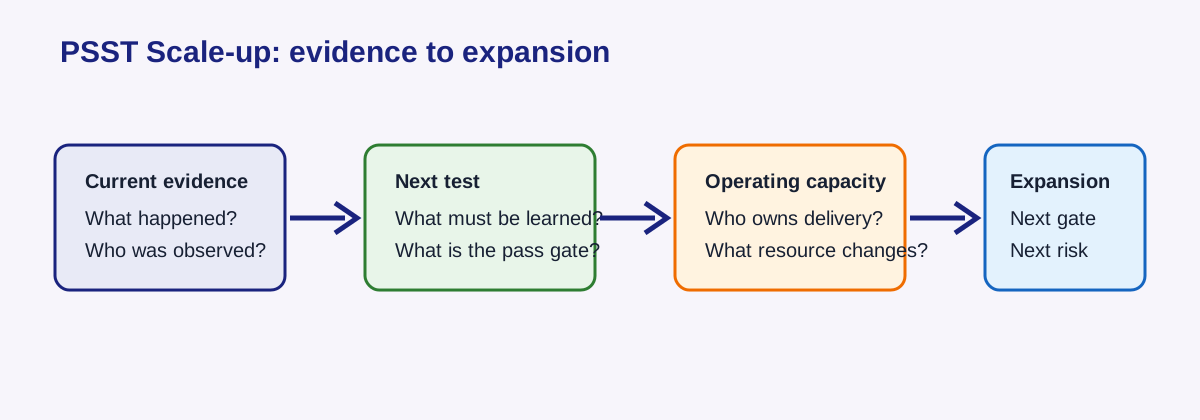
A credible Scale-up section has a sequence. First state what has already been observed. Then state the next test, the resource it needs and the result that would justify the following step.
For example, a plan can move from a working prototype, to a paid pilot, to repeatable onboarding, to a partner-led channel. Those labels are planning stages, not official PSST categories. Use them only when they describe your actual work and when the programme attachment allows the format.
| Stage | Question to answer | Evidence to attach or create |
|---|---|---|
| Current proof | What has happened already? | Pilot record, customer document, usage record or other dated evidence |
| Next test | What must be learned next? | A defined experiment and pass condition |
| Operating step | What changes if the test works? | Delivery process, owner and required resource |
| Expansion gate | What permits the next stage? | A measurable result, signed commitment or verified capacity |
| Risk check | What could stop the path? | A named risk, trigger and response |
The point is not to make a forecast look precise. It is to make the assumptions visible. A reviewer can then ask whether the evidence supports the next step instead of guessing what the plan means.
Separate growth from activity
A list of activities is not a growth strategy. Hiring, attending events, translating a website and running advertisements may be useful. They do not prove that the venture can acquire, serve or retain the next customer.
For each activity, state the business change it is meant to produce. A partner meeting should have a target relationship or decision. A translation task should support a named customer journey. A hire should remove a defined delivery constraint.
This distinction also protects the budget. If a current notice provides a permitted cost category, connect the requested use to the milestone it supports. If the fetched notice does not state an amount or eligible category, write “confirm against the current 공고” rather than importing a number from another year.
Show who owns each step
Growth plans fail when every milestone belongs to “the team.” Assign an owner by role and state the dependency that owner cannot control alone.
For a foreign founder, dependencies may include Korean-language sales support, a local delivery partner, data handling review, a regulated customer process or an immigration condition. Mention a dependency only when it belongs to your actual plan or evidence. Do not present a general legal conclusion without the relevant primary source.
The team section should carry the people and capability facts. The Scale-up section should use those facts to explain execution. If one founder owns sales, product and implementation, name the bottleneck and the order in which capacity will be added.
Use milestones that can change the plan
A milestone earns its place when its result changes what you do next. “Reach 10,000 users” is weak if the plan never says what happens at 9,999 or 10,001. “Complete a paid pilot with a defined customer group, then decide whether to add a channel partner” gives the reader a decision path.
Keep the unit stable. Do not switch from accounts to users to revenue simply because a later number looks larger. If different units matter, define each one and explain the relationship.
The same rule applies to market expansion. A move from Seoul to another region, or from direct sales to a partner channel, creates a new assumption about demand and delivery. Give that assumption its own test.
Make the section fit the current form
K-Startup's official reference library lists materials for different support programmes, including programme-specific management standards. That is a reason to verify the attachment, not a reason to combine every guide into one master template.
Before submission, compare your draft with the current notice and form for the named programme. Check the requested field names, order, file format, evaluation language and any stated limits. This post does not establish those values because the official pages fetched for this draft did not expose one universal Scale-up specification.
Use the PSST assistant to keep the section tied to the rest of the plan. Start with the customer and evidence from the Problem section, then confirm every field against the current K-Startup notice and attachment before submission.
Frequently asked questions
- What belongs in the PSST Scale-up section?
- Explain how the venture moves from current evidence to a larger, testable operation. Connect customers, route to market, milestones, resources, owners and risks.
- Is there one official PSST Scale-up word limit?
- Do not assume one. Check the current notice and attached form for the named programme. The official sources fetched for this draft did not state a universal limit.
- Should I include a grant amount in this section?
- Include an amount only when the current programme notice or attachment states it and it applies to your programme. Otherwise write that it must be confirmed against the current 공고.
- How is a milestone different from an activity?
- An activity is work you do. A milestone includes a result and a decision gate that changes what happens next.
- How specific should the growth target be?
- Name the customer segment, geography, channel, unit and period covered by your evidence. Avoid turning a small test into a claim about an entire market.
- Where should team responsibilities go?
- Put people and capabilities in the Team section, then use the Scale-up section to show who owns each growth step and which dependency must be solved.
Sources
- K-Startup 창업지원포털 - official notices and programme announcements — read 2026-09-21
- K-Startup official reference library - programme management standards and guidance — read 2026-09-21
- KISED official site - K-Startup portal link — read 2026-09-21
Everything above is the rule as published. See how it applies to your case.