Venture company certification (벤처기업확인): routes and what it unlocks
벤처기업확인 제도 안내
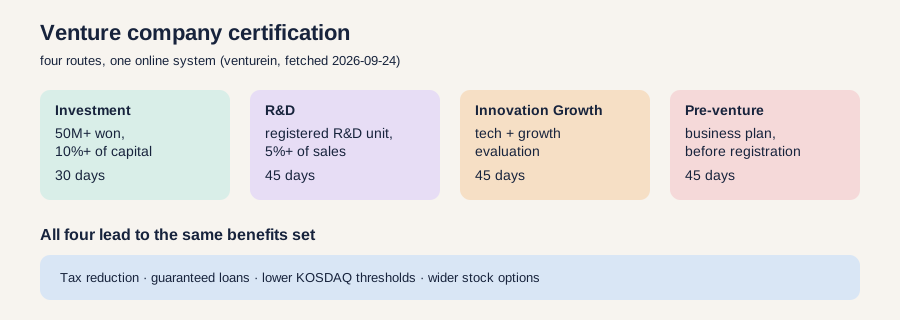
Korea's venture company certification has four separate routes, each with its own evaluator, fee and requirements. The official system's own pages set out an investment route, an R&D route, an innovation-growth route and a pre-venture route, plus a published benefits list covering tax, guaranteed loans, KOSDAQ listing and stock options.

On this page
Venture company certification is not one test. It is four separate routes, run through one official system. Each route is judged by a different body against different numbers.
Four routes, four sets of numbers
The confirmation system lists four types: Venture Investment (벤처투자유형), R&D (연구개발유형), Innovation Growth (혁신성장유형) and Pre-venture (예비벤처유형). A company picks the route its own situation fits, not the other way around.
| Route | Core requirement | Processing time |
|---|---|---|
| Venture Investment | 50M won+ from a qualified investor, 10%+ of capital | 30 days |
| R&D | Registered R&D unit, R&D spend 50M won+ and 5%+ of sales | 45 days |
| Innovation Growth | Favorable evaluation of tech innovation and growth | 45 days |
| Pre-venture | Business plan, before formal registration | 45 days |
The Venture Investment route
This route needs at least 50 million won invested by a qualified institution. That investment must equal at least 10% of the company's total capital, or 7% for a cultural-industry corporation.
The system's own page names a long list of qualifying investors: venture capital firms, the Korea Venture Investment Corporation, venture investment associations, technology financing companies, angel investors, crowdfunding platforms, major banks and public research institutions.
Some of these count only after a stated effective date: 12 February 2021 or 4 July 2023.
The R&D route
This route requires small or medium enterprise status, plus a registered in-house research institute or a dedicated R&D department. It also requires R&D spending of at least 50 million won. That spending must reach 5% or more of sales, over the four quarters before application.
A company under three years old is exempt from the 5%-of-sales test. The system's page names the evaluators: a state-backed technology guarantee fund, and the Korea SMEs and Startups Agency.
The Innovation Growth route
This route has no fixed investment or spending figure. Instead, it asks for a favorable evaluation of the company's technological innovation and growth potential. The system's page names several evaluators, including the Technology Guarantee Fund, a private credit-rating firm, and sector-specific public research bodies.
The fee for a new Innovation Growth certification is 605,000 won, tax included. The government subsidizes 150,000 won of that. Re-certification costs 50,000 won, and results arrive within 45 days of payment.
The Pre-venture route
This route exists for a founder who has not yet registered a corporation or a sole proprietorship. The applicant submits an online business plan. Supporting material can include founder credentials, startup competition awards, or completion certificates from an entrepreneurship program.
The evaluation runs in stages: seven days for review, 28 for expert evaluation, 14 for deliberation, one to issue the certificate. The total fee is 495,000 won; the government covers 150,000 won of it.
What certification unlocks
The system's own benefits page lists a specific set of advantages, not a general promise of support. A company confirmed as a venture within three years of founding can claim a 50% tax reduction, for up to five years.
| Benefit | What the page states |
|---|---|
| Tax | Up to 50% income or corporate tax reduction, up to 5 years, for companies confirmed within 3 years of founding |
| Regional tax | Reduced property acquisition tax for qualifying companies |
| Guaranteed loans | Guarantee limit up to 5 billion won |
| KOSDAQ listing | Lower minimum capital, pre-tax profit and revenue thresholds |
| Stock options | Up to 50% of total issued shares, versus 10-20% for a standard company |
Applying through the system
All four routes run through the same online system, not through a paper application to a ministry. A company creates an account, chooses its route, and submits the required evidence for that route.
None of the four routes mention a founder's nationality. The requirements are about the company's investment, R&D spending, growth evaluation or business plan, not about who owns it.
For programme routes that build on venture status, see EastStartup's programme guide.
Frequently asked questions
- What is venture company certification?
- It is a status confirmed through Korea's official venture confirmation management system, under one of four routes: Venture Investment, R&D, Innovation Growth or Pre-venture, each judged against its own requirements.
- What does the Venture Investment route require?
- At least 50 million won invested by a qualified investor, equal to at least 10% of the company's total capital (7% for a cultural-industry corporation), per the system's own page.
- What does certification unlock?
- The system's benefits page lists a 50% income or corporate tax reduction for up to five years for companies confirmed within three years of founding, a larger guaranteed-loan ceiling, lower KOSDAQ listing thresholds, and a wider stock-option pool.
- How long is a certification valid?
- The benefits page fetched for this post does not state a fixed multi-year validity period for the certification itself. Confirm the current term on the official system.
- Can a foreign-owned company apply?
- None of the four routes' published requirements mention a founder's or shareholder's nationality; each route judges the company's investment, R&D spending, growth evaluation or business plan.
- How much does certification cost?
- Fees vary by route. The Innovation Growth route costs 605,000 won for a new certification (50,000 won to renew), and the Pre-venture route costs 495,000 won, with the government subsidizing part of each new application.
Sources
- Venture Confirmation Management System (venturein) - Innovation Growth Type requirements — read 2026-09-24
- Venture Confirmation Management System (venturein) - Venture Investment Type requirements — read 2026-09-24
- Venture Confirmation Management System (venturein) - R&D Type requirements — read 2026-09-24
- Venture Confirmation Management System (venturein) - Pre-venture Type requirements — read 2026-09-24
- Venture Confirmation Management System (venturein) - preferential support / benefits guide — read 2026-09-24
Everything above is the rule as published. See how it applies to your case.
Read next
- FounderCraftHometax for foreign founders: VAT, filings and the certificates you will be asked for
- FounderCraftGetting a K-Startup portal account as a foreigner: identity, ARC and certificates
- FounderCraftThe four major insurances when you make your first hire
- FounderCraftThe business address: what a tax office and the visa file accept