Design registration with KIPO: what it protects and how a filing runs
한국 디자인 등록, 무엇을 보호하고 어떻게 진행되는가
KIPO protects the appearance of an article as a design right, separate from a patent or trademark. Its own pages describe two examination routes, a 20-year term from filing, and special systems for partial and related designs. The OASIS operator scores a registered design lower than a registered patent, and the two systems answer different questions.

On this page
- A design right protects appearance, not the idea
- Two examination routes run through the same office
- Partial and related designs cover cases a single filing cannot
- The term is fixed, and late fees have their own limits
- Filing abroad from a Korean design runs through the Hague System
- Merchantability and visibility limit what counts as a design
- OASIS treats a design the same as a utility model, and less than a patent
KIPO treats designs and patents as separate rights. Each has its own filing rules and its own purpose. This post covers what KIPO's own design pages say: what the right protects, how a filing runs, and how long it lasts.
A design right protects appearance, not the idea
KIPO's design overview names the source: Article 2(1) of the Industrial Design Act. The Act protects the appearance of an article. That means shape, pattern or color, or some combination of the three.
The article and its look cannot be split apart. A design cannot exist as an abstract idea. It has to attach to a real, sellable product.
That framing differs from everyday English use. Many founders use "design" to mean branding or user-experience work. KIPO's design right is narrower.
It covers how one specific, mass-producible article looks. Three tests decide whether that look qualifies. KIPO's page names them: novelty, creativity and industrial applicability.
An examiner checks the design against all three under the standard route. KIPO's page also allows a grace period for accidental disclosure. If the design's own owner made it public first, filing within 12 months of that disclosure does not destroy novelty.
Two examination routes run through the same office
KIPO's design pages split the filing system into two routes. One is the Substantive Examination System, or SES. The other is the Partial-Substantive Examination System, or PSES.
PSES exists for goods KIPO calls trend-sensitive and short-lived. Its page lists foodstuffs, clothing, travel goods, packaging and stationery as examples. These categories come from a Locarno-based classification KIPO adapts for Korea.
PSES moves fast. KIPO's page states registration can follow within one or two months of filing. The tradeoff is depth.
PSES skips substantive checks for novelty and creativity. It runs a formality check instead. That check covers paperwork, industrial applicability and other unregistrable grounds.
| Route | What KIPO checks | Stated outcome |
|---|---|---|
| Substantive Examination System (SES) | Novelty, creativity, industrial applicability, first-to-file | Standard examination timeline |
| Partial-Substantive Examination System (PSES) | Formality, industrial applicability, unregistrable grounds only | Registration in 1-2 months, per KIPO's page |
KIPO's page is direct on one point. A PSES-registered right carries the same legal effect as an SES-registered one. Speed does not weaken the right on paper.
But a PSES right that later fails the real requirements is not safe. KIPO's page states it can still be cancelled or invalidated. That happens through post-grant opposition, or through a trial.
Partial and related designs cover cases a single filing cannot
Some products only need part of their surface protected. KIPO's page states that since July 1, 2001, a part of an article can register as a design. Its examples: a sock heel, a bottle neck, a coffee-cup handle.
The filing still has to name the whole article. Socks, packing bottles, coffee cups, not the isolated part. The part is what gets registered; the whole article is how you file it.
A second system covers variations. KIPO calls it the related-design system. It lets an applicant register a design created as a variation of an earlier, principal design.
Timing matters here. KIPO's page states a related design must be filed within one year of the principal design's own filing date. Miss that year, and the related-design route closes.
The related design's protection is not independent, either. KIPO's page states its right expires when the basic design's term expires. It does not run its own separate clock.
The term is fixed, and late fees have their own limits
KIPO's page gives one clear number for how long a design right lasts: 20 years from the filing date of the design registration application. A related design is the exception, expiring with its basic design instead.
The right does not start on filing day. KIPO's page states it becomes effective once an examiner grants registration, and the applicant pays the registration fee. Filing alone does not create the right.
Miss the fee deadline, and KIPO still gives room to recover. Its page describes a six-month late-payment window, capped at twice the normal fee. A further 14-day window exists after that, for unavoidable circumstances only.
Payment itself is not a single lump sum by default. KIPO's page states an owner pays a registration fee for the first three years. An annual fee follows, starting in the second year.
An owner can also choose to pay for several years at once. Paying for the entire 20-year term up front is allowed too.
Owning a registered design also comes with limits, not only rights. KIPO's page lists exceptions where the right does not apply. Research or experimental use of the design is one.
Vessels, aircraft or vehicles merely passing through Korea are another, along with their onboard machinery and equipment. A design right does not reach every possible use of the protected appearance. It stops at the boundaries KIPO's own page sets.
Filing abroad from a Korean design runs through the Hague System
Korea's design system also reaches outward. KIPO's page states Korea joined the 1999 Geneva Act of the Hague Agreement in March 2014. That membership lets a Korean applicant file one international design application covering multiple countries.
KIPO's page states that filing can run through MOIP itself, or go straight to WIPO. KIPO then points applicants to WIPO's own Hague System pages for the filing details, country coverage and fees.
This route runs the opposite direction from most of this site's audience. It serves a Korean-registered applicant seeking protection abroad, not a foreign founder filing into Korea. KIPO's page fetched for this post states no separate foreign-applicant procedure for a domestic Korean design filing.
Merchantability and visibility limit what counts as a design
KIPO's design overview sets out what a design has to be, not just what it looks like. The article has to be "merchantable," meaning it exists as an independent, definite, movable item. Immovable property does not qualify.
Shapeless things fail the same test. KIPO's page lists heat, air, fluid and electricity as examples that cannot be protected as a design. Powder or granules such as sugar fail for the same reason: no fixed, independently transacted form.
Visibility is a separate requirement. KIPO's page limits a design to things a human eye can identify. Something only detectable through a microscope, or through some other instrument, falls outside the Act's definition.
Aesthetics gets a looser standard than the word suggests. KIPO's page notes that in practice, an examiner accepts "perceptible formative beauty" rather than demanding a high level of artistic sense. A functional product with an ordinary, deliberate shape can still clear this bar.
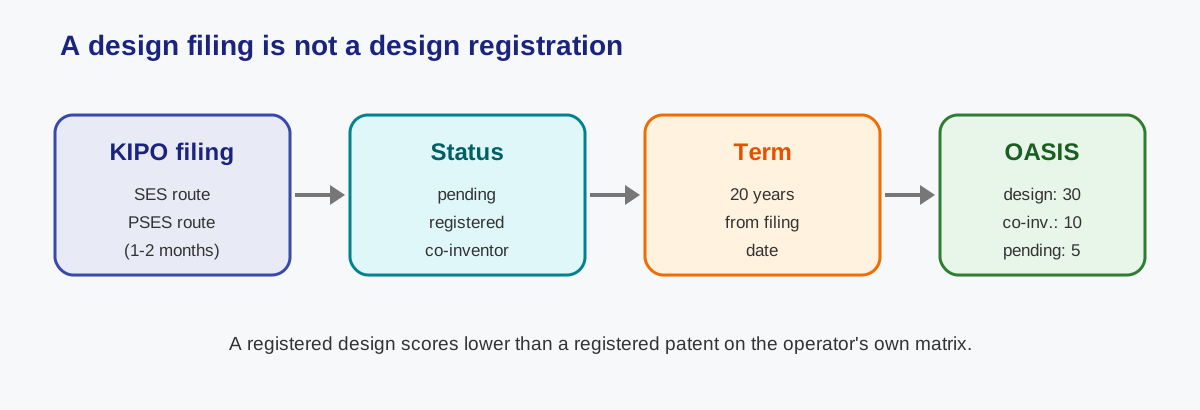
OASIS treats a design the same as a utility model, and less than a patent
The OASIS operator publishes its own D-8-4 point matrix. A registered design sits in the same bracket as a registered utility model there. The operator's page lists 30 points for a holder, 10 for a co-inventor, and up to 5 for a pending applicant.
A registered patent scores higher on that same table. The operator lists 60, 30 and 10 points for the same three roles. Design status is real for OASIS purposes, but it is not the top tier.
The operator's page also caps how these points combine. It states overlapping IP points across several rights are capped at 60 points in total. Pending applications, regardless of type or count, are capped separately at 10 points combined.
This post does not repeat the full cap mechanics or the patent side of that table. The KIPO patent and utility model filing guide already covers both in detail.
Filing is not the finish line either way, SES or PSES. KIPO's own late-fee and term rules keep applying long after the initial application goes in. Treat design registration as an ongoing record, not a single form.
Confirm the current design system rules directly with KIPO, or with a Korean-licensed design or patent attorney, before filing. Use the OASIS guide to see how a registered design fits the wider D-8-4 route.
Frequently asked questions
- What does a Korean design right protect?
- KIPO's own design overview describes it as protecting the appearance (shape, pattern or color) of an article that can be independently made and sold, not the underlying idea or a brand.
- What is the difference between SES and PSES?
- KIPO's pages describe SES as full substantive examination and PSES as a formality-only route for trend-sensitive goods, which KIPO states can register in one to two months, though both have identical legal effect once granted.
- How long does a Korean design right last?
- KIPO's page states 20 years from the filing date of the design registration application, except that a related design's term ends with its basic design's term.
- Can part of a product be registered as a design?
- Yes. KIPO's page states that since July 1, 2001, a part of an article, such as a bottle neck or a sock heel, can be registered as a design when the filing names the whole article.
- How many OASIS points is a registered design worth?
- The OASIS operator's matrix lists 30 points for a holder of a registered design, 10 for a co-inventor, and up to 5 for a pending applicant, inside the operator's overall 60-point IP cap.
- Does a fast PSES registration mean the design was checked for novelty?
- No. KIPO's page states PSES applications are examined only for formality, industrial applicability and other unregistrable grounds, not novelty or creativity, though the resulting right has the same legal effect as an SES right.
Sources
- KIPO/MOIP - Korean IP System, Designs (design definition, application system, term, related and partial design) — read 2026-09-24
- KIPO/MOIP - Application Procedure, Designs (SES/PSES overview) — read 2026-09-24
- Global Startup Immigration Center - OASIS D-8-4 requirements and IP point matrix — read 2026-09-24
Everything above is the rule as published. See how it applies to your case.