Entering Korea from a PCT application: the national phase
한국 PCT 국내단계 진입
A PCT application does not become a Korean patent by itself. WIPO's own time-limit table and the Korea national chapter of the PCT Applicant's Guide, both published under MOIP's authority as the designated office, set a 31-month deadline, a Korean-translation requirement, national fees and a mandatory local agent for non-resident applicants.

On this page
- Korea's deadline is 31 months, not the PCT default of 30
- Translation and national fees share the same deadline
- A non-resident applicant must appoint a Korean agent
- Early entry has its own procedure
- Filing through Korea as the receiving office has its own fees
- Color drawings and priority documents move through DAS
- Utility models run the same route, at lower fees
- A discount exists for a natural person who is also the inventor
- A resident applicant needs clearance before filing abroad first
The Patent Cooperation Treaty buys time and a single international filing. It does not grant a Korean patent. Entry into Korea's national phase is a separate step.
That step runs on Korea's own deadline, translation and fee terms. MOIP administers it, as Korea's designated and elected office under the treaty.
Korea's deadline is 31 months, not the PCT default of 30
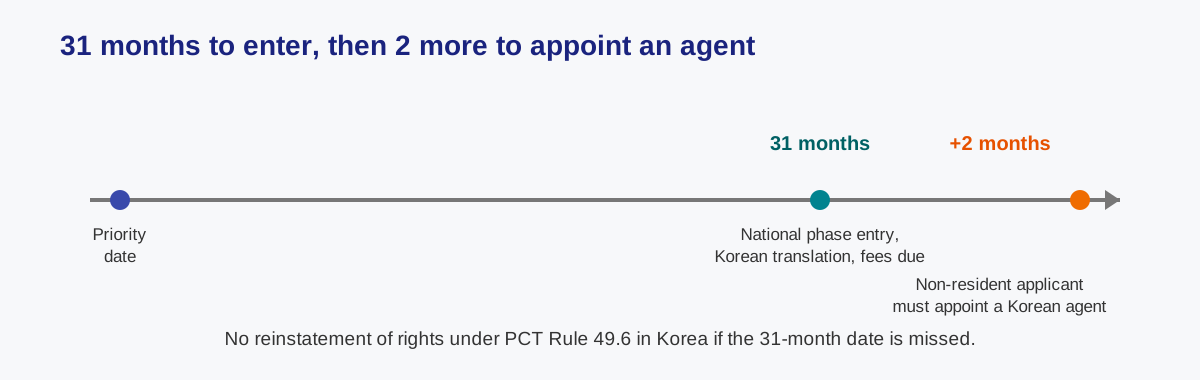
WIPO's own time-limit table lists Korea at 31 months from the priority date. That figure applies to entry under both PCT Article 22(3) and Article 39(1)(b).
Many other designated offices still use the treaty's general 30-month default. Korea's own figure runs one month past that. The KR national chapter of the PCT Applicant's Guide confirms the same number directly, for both PCT tracks.
That same chapter closes off one common escape route. Korea does not permit reinstatement of rights under PCT Rule 49.6. A missed 31-month deadline has no recovery path through that specific rule.
Translation and national fees share the same deadline
The KR chapter sets one clock for the translation, too. A Korean translation must be furnished, or paid for, within that same 31-month limit. It is not a separate, later date.
The exact content required shifts slightly by track. Under Article 22, it covers the request, description, claims, drawing text and abstract. Under Article 39(1), amendments from international preliminary examination get included as well.
National fees run on the same schedule. The guide prints a patent filing fee: 46,000 KRW filed electronically, or 66,000 KRW on paper. Sheets beyond 20, across description, drawings and abstract, add 1,000 KRW each.
A request for examination costs more, and runs separately. The guide lists 166,000 KRW, plus 51,000 KRW per claim, for that request.
| National phase requirement | Deadline | Amount, where fixed |
|---|---|---|
| National phase entry | 31 months from priority date | — |
| Korean translation | Within the same 31-month limit | — |
| Patent filing fee (electronic) | Within the same 31-month limit | 46,000 KRW |
| Patent filing fee (paper) | Within the same 31-month limit | 66,000 KRW, plus 1,000 KRW per sheet over 20 |
| Request for examination | Separate request required | 166,000 KRW plus 51,000 KRW per claim |
A non-resident applicant must appoint a Korean agent
The KR chapter is direct on this point. Agent appointment is required whenever the applicant is not resident in the Republic of Korea. The window for that appointment is two months, counted from the expiration of the 31-month deadline.
Any registered patent attorney can fill that role. So can a legal representative more broadly, per the same guide. Korea does not name a narrower category for this specific purpose.
KIPO's own general patent overview backs this up from the other direction. An application filed by someone with no Korean address, and no Korean agent, can come back to the applicant. KIPO treats it as though it had never been filed at all.
Early entry has its own procedure
An applicant can enter the national phase before international publication. The KR chapter dates this option to 20 May 2019. It comes with one paperwork shortcut attached.
Normally, the applicant supplies a copy of the international application. For early entry, MOIP retrieves that copy directly from the International Bureau instead. The applicant does not have to submit it separately.
That shortcut saves one step, nothing more. Translation, national fees and, for a non-resident applicant, the agent appointment, all still run against the same 31-month figure. Early entry moves the door, not the clock behind it.
Filing through Korea as the receiving office has its own fees
Some readers will file the original PCT application through MOIP itself, as the receiving office, rather than filing abroad first. That step is separate from national phase entry, and it carries its own fee schedule.
The KR chapter lists a transmittal fee of 45,000 KRW for this filing. On top of that, the standard PCT international filing fee applies, currently 1,330 Swiss francs, plus 15 Swiss francs per sheet beyond 30.
Electronic filing brings its own discount. The guide lists a 100 Swiss franc reduction where the request is filed electronically but not fully character-coded, and 300 francs where the request, description, claims and abstract are all in character-coded form.
A priority document costs nothing extra at this stage. The KR chapter lists the fee for a priority document, under PCT Rule 17.1(b), as none.
Color drawings and priority documents move through DAS
MOIP accepts color drawings under Korea's national law, per the KR chapter. That removes one common formatting worry for an applicant used to jurisdictions that restrict filings to black and white.
Korea also participates in WIPO's Digital Access Service, or DAS, for priority documents. The KR chapter confirms MOIP is prepared to make national applications available to DAS on request.
That service has a practical payoff. A later filing can pull a certified priority document electronically. Nobody has to mail a paper copy between offices.
The KR chapter also flags where MOIP will and will not accept documents by fax. Most document types can go by facsimile, per the guide. The one exception is the translation required under PCT Article 22 or 39, which the guide excludes from that channel.
Utility models run the same route, at lower fees
A PCT applicant can also enter Korea's national phase as a utility model, not only as a patent. The KR chapter prints its own fee table for that route.
Filing runs 20,000 KRW electronically, or 30,000 KRW on paper. A request for examination adds 71,000 KRW, plus 19,000 KRW per claim. Both figures sit well under the equivalent patent fees.
Annual fees differ too. The guide lists 12,000 KRW per year for a utility model's first three years, against 13,000 KRW for a patent over the same period. The gap is small on paper, but it compounds across a portfolio.
A discount exists for a natural person who is also the inventor
The KR chapter lists a fee reduction most foreign applicants will not use, but should know about. Filing fees, the examination fee, and the first three years of annual fees drop by 70 percent. That applies where the applicant is a natural person, and also the invention's own inventor.
That reduction shrinks if the applicant files often. Past 20 applications in a year, the guide caps the reduction at 30 percent instead of 70. A corporate applicant, the more common case for a founded company, does not draw on this discount at all.
A separate, larger reduction applies to the examination-request fee itself. The KR chapter puts it at 70 percent. It applies where MOIP itself, acting as the International Searching Authority or International Preliminary Examining Authority, already produced the search or examination report.
Check which authority actually ran your PCT search before assuming this discount applies. A report from a different authority does not qualify under the KR chapter's own wording.
A resident applicant needs clearance before filing abroad first
One more rule runs in the opposite direction from national phase entry, and it matters for a company that later becomes Korean-resident. The KR chapter states that Korea's Patent Act restricts international filings by residents under Article 41, on national-defense grounds.
That restriction targets where an application is first filed, not where it later enters national phase. A Korean resident filing internationally through a foreign office first can run into it. The correct Korean channel matters here, not just the destination office.
Confirm this rule directly with MOIP in one case especially. If your company or an inventor becomes Korean-resident before a first filing, check it before that filing happens, not after. A cleared first filing avoids a defect that surfaces only later, once national phase entry is already underway.
None of these figures are guaranteed to hold past the guide's own stated version date. Fees and deadlines in a WIPO national chapter are updated as MOIP notifies changes to the International Bureau. Check the current version before treating any number here as final.
Confirm the current fee schedule, and any procedural updates, directly with MOIP or a Korean-licensed patent attorney before the 31-month window closes. See the KIPO patent and utility model filing guide for how a resulting Korean patent status is treated separately by the OASIS operator.
Frequently asked questions
- How long do I have to enter Korea's national phase under the PCT?
- WIPO's time-limit table and the KR national chapter of the PCT Applicant's Guide both give 31 months from the priority date, under both PCT Article 22(3) and Article 39(1)(b), one month past the PCT's general 30-month default.
- Is the Korean translation due on a separate deadline from national phase entry?
- No. The KR chapter states the translation must be furnished or paid within the same time limit applicable under PCT Article 22 or 39(1), which is the 31-month figure.
- Do I need a Korean patent attorney to enter the national phase?
- If you are not resident in the Republic of Korea, yes. The KR chapter requires appointment of an agent, any registered patent attorney or legal representative, within two months after the 31-month deadline expires.
- Can I recover a missed 31-month deadline through reinstatement of rights?
- The KR chapter states the Office does not permit reinstatement of rights under PCT Rule 49.6, so that specific route is not available in Korea.
- What does entering the national phase cost?
- The KR chapter lists a patent filing fee of 46,000 KRW filed electronically or 66,000 KRW on paper, plus per-sheet and per-claim charges and a separate examination-request fee, all as printed on the guide fetched for this post.
- Can I enter the national phase before international publication?
- Yes. Since 20 May 2019 the KR chapter states MOIP retrieves the international application and associated documents directly from the International Bureau for early entry, without the applicant submitting a separate copy.
Sources
- WIPO - PCT time limits for entering the national/regional phase (KR row: 31 months) — read 2026-09-23
- WIPO PCT Applicant's Guide - National Chapter, Republic of Korea (KR), current version — read 2026-09-23
- KIPO/MOIP - Overview of the Patent System in Korea (formality examination, agent requirement) — read 2026-09-24
Everything above is the rule as published. See how it applies to your case.
Read next
- FounderCraftHometax for foreign founders: VAT, filings and the certificates you will be asked for
- FounderCraftGetting a K-Startup portal account as a foreigner: identity, ARC and certificates
- FounderCraftThe four major insurances when you make your first hire
- FounderCraftThe business address: what a tax office and the visa file accept