Reading a Korean programme notice: 입주기업 모집공고 vocabulary, from 참가기업 to 하반기
모집공고 용어: 입주기업, 참가기업, 차수, 하반기
A Korean programme notice (모집공고) is short on prose and heavy on fixed words. This glossary reads 입주기업, 참가기업, 차수, 하반기, 자부담, 업력 and 대표자 from the notices themselves and from the startup support act, with the Dobong tenant call as the worked case.

On this page
- What does 입주기업 모집공고 mean?
- How do 참가기업, 선정기업 and 졸업기업 differ?
- What do 차수 and 회차 mean?
- What do 상반기 and 하반기 mean in a notice?
- Who are the 주관기관, 전담기관 and 사업운영기관?
- Which words describe who you are?
- Which words describe money and points?
- Do these words decide eligibility for a foreign founder?
- Which word decides it?
- Which documents decide it?
A founder who types 입주기업 모집공고 into a search box meets the same dozen words in every notice. If you know them, you can triage a notice in a minute.
This glossary reads each word as the fetched notices and the law use it, not from general dictionary knowledge. It uses the Dobong tenant call as the worked case.
What does 입주기업 모집공고 mean?
A 모집공고 is a recruitment notice. It opens one call and fixes who may apply.
Our guide to how a 모집공고 is structured covers the header fields. This guide covers the words inside them.
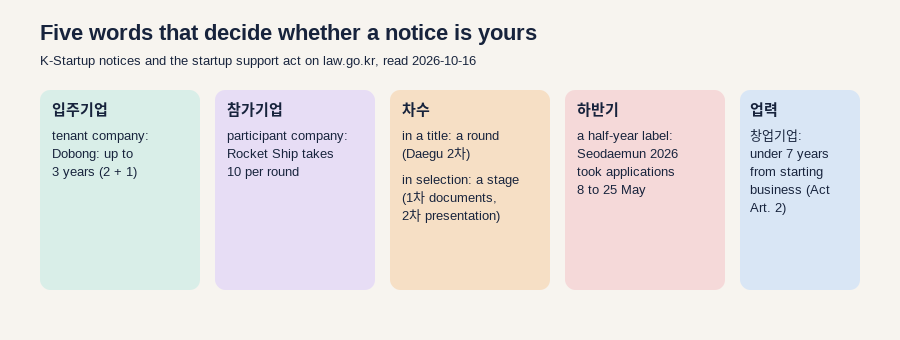
입주기업 means a tenant company: a company that rents space in an incubation centre. For example, the Dobong-gu district office recruited new tenants for six rooms across two centres in August 2026.
According to the Dobong notice (2026), the lease terms are as follows.
| Item | What the Dobong notice prints |
|---|---|
| Tenancy | Up to 3 years: 2 initially, 1 extension once |
| Rent, first centre room 505 (64.9 m2) | 5,023,040 won a year, deposit 4,190,000 won |
| Rent, second centre rooms | 451,280 to 481,420 won a year, deposits 1,500,000 to 1,700,000 won |
| Applicants | First centre: registered, under 7 years. Second centre: pre-founders or under 7 years |
| Screening | Documents, then a 5-minute presentation. A pass mark of 70 average points |
In the selection process, the notice sets a 2배수 rule. If applicants exceed twice the number of rooms, outside experts score the documents first. Only the top scorers, up to twice the room count, reach the face-to-face round.
How do 참가기업, 선정기업 and 졸업기업 differ?
참가기업 means a participant company. A call for 참가기업 recruits companies for a programme or an event, not for space. CNTTech's Rocket Ship contest, for example, recruits 참가기업 for an investor pitch contest, and each round took 10.
선정기업 literally means a selected company, and 졸업기업 a graduated one. However, the notices do not define them. The Rocket Ship notice uses both for companies from the 2023 to 2026 Early Startup Package.
협약 is the grant agreement. The notice asks for the 협약 certificate as proof.
The PDF says to issue a selection confirmation from your K-Startup account page. If your host does not confirm the agreement, you may be out of the call. See our Early Startup Package guide for the programme itself.
What do 차수 and 회차 mean?
Both words count things, but the notice decides what. In a title, 차수 means a round of the call, and a 2차 모집 is the second recruitment.
In the Daegu women's call, for example, the title reads 사업화지원사업(2차). 회차 does the same job: Rocket Ship runs 1회차 to 4회차, each with a theme.
In the selection section, 차 means a stage. The G-Space marketing call used 1차 서류평가 and then 2차 발표평가. Seodaemun's tenant call used a 1차 document check and a 2차 face-to-face round.
So 2차 can mean either "you are late for the second round" or "you passed the first stage". In practice, check which section it sits in.
What do 상반기 and 하반기 mean in a notice?
상반기 is the first half of the year and 하반기 the second half. A notice uses them as a label for the period the tenancy or programme covers, not for the date you apply.
Seodaemun's 2026 하반기 call took applications from 8 to 25 May, with results planned for 8 June. The Hansung University centre posted its 하반기 call on 22 July. Its contract starts on 1 September 2026.
Treat 하반기 as a clue about when you will move in. Read 접수기간 for when you must apply.
Who are the 주관기관, 전담기관 and 사업운영기관?
주관기관 is the administering body that runs a call, and the header field 주관기관명 names it. In the Dobong notice it is the district office. In the CNTTech notices it is CNTTech.
전담기관 means a dedicated body. The LIPS notice, for example, names an association as its 전담기관. Article 52 of the startup support act lets the MSS Minister designate a 지역창업전담기관 in each region: a public institution, an association or a 창조경제혁신센터.
사업운영기관 is the operating body. K-Startup states that the information you give in an application stays with that body, and that questions about returned documents go to it.
Which words describe who you are?
These words fix whether a call is yours. The Act defines four of them, and we confirmed each against its Article 2.
| Word | Literal meaning | Where it comes from |
|---|---|---|
| 예비창업자 | Person planning to start a business | Act, Art. 2: an individual who intends to found a company |
| 창업기업 | Startup company | Act, Art. 2: under 7 years from starting business |
| 초기창업기업 | Early-stage startup | Act, Art. 2: under 3 years from starting business |
| 청년창업기업 | Youth startup | Act, Art. 2: representative aged 39 or younger |
| 업력 | Business age | The notice header field 창업업력, such as 7년미만, counted as the Act counts a 창업기업 |
| 대표자 | Representative | The person the notice scores and tests |
The Seodaemun notice cites the Act's definitions by number for its youth rule. For example, 청년창업기업 in that notice means a company whose 대표자 is 39 or younger.
대표자 does real work in notices. The Daegu call required the 대표자 to give the pitch in person. It could also cancel the agreement if the 대표자 changed.
Which words describe money and points?
자부담 means self-funded share, and it has two uses in the notices read. The Daegu call added a 10% self-funded share on top of its 3,000,000 won grant.
The NextRunners camp used 자부담 for a 400,000 won tuition share that the participant pays.
가점 means bonus points. The Daegu call gave up to 3, only in the document stage.
제외 업종 means excluded sectors. Article 4 of the decree lists entertainment bars and casino operation among them. See grant, matching and voucher for how these shares work.
Do these words decide eligibility for a foreign founder?
Which word decides it?
Not the word 외국인 (foreigner): none of the notices read here use it. The documents decide instead.
Which documents decide it?
Hansung asks sole proprietors for a 인감증명서 and an ID copy. Daegu asks for a 주민등록등본.
Dobong requires a 사업자등록증 for the first centre. Hansung excludes companies that cannot move their business address into the centre within three months of move-in.
For where nationality does bite, read where the Korean nationality restriction bites.
For notices to practise on, browse the EastStartup programme catalogue.
Frequently asked questions
- What does 입주기업 모집공고 mean?
- It is a recruitment notice for tenant companies of an incubation centre or office. 입주기업 means a company that moves in and rents space, as in the Dobong-gu centre notice with a tenancy of up to three years.
- What is the difference between 입주기업 and 참가기업?
- 입주기업 rents space. 참가기업 takes part in a programme or event, such as the Rocket Ship IR contest, and gets no space.
- Does 2차 mean second round or second stage?
- Both appear. In a title such as the Daegu women's call, (2차) is the second recruitment round. In an evaluation section, 1차 and 2차 are stages, such as document review then presentation.
- Does 하반기 mean applications open in the second half?
- No. Seodaemun's 2026 하반기 tenant call took applications from 8 to 25 May. The label covers the period, so read 접수기간 for the application dates.
- How does Korean law count 업력 for a startup?
- Article 2 of the startup support act defines a 창업기업 as a company that has not yet passed 7 years since starting business, and an 초기창업기업 as one under 3 years.
- What does 자부담 mean?
- Self-funded share. The Daegu women's call asked a 10% share on top of a 3,000,000 won grant, and the NextRunners camp used it for a 400,000 won tuition share.
Sources
- K-Startup notice: Dobong-gu small business startup incubation centre, new tenant companies (Dobong-gu Office) — read 2026-10-16
- K-Startup notice: Hansung University venture startup support centre, second-half 2026 tenants — read 2026-10-16
- K-Startup notice: Seodaemun youth startup centre, second-half 2026 tenants (Seodaemun-gu Office, notice 2026-764) — read 2026-10-16
- K-Startup notice: 2026 women's startup commercialisation support, 2nd round (Dalgubeol Women's Workforce Development Center, notice 2026-242) — read 2026-10-16
- K-Startup notice: 2026 Rocket Ship IR competition, round 1 (CNTTech, notice 2026-022, PDF attachment read) — read 2026-10-16
- K-Startup notice: 2026 G-Space startup digital marketing support (Gyeongnam Center for Creative Economy and Innovation, notice 2026-66) — read 2026-10-16
- K-Startup notice: AI solo founder camp, 7th cohort (NextRunners) — read 2026-10-16
- National Law Information Center: Small and Medium Enterprise Startup Support Act (중소기업창업 지원법), Articles 2 and 52 — read 2026-10-16
- National Law Information Center: Enforcement Decree of the Small and Medium Enterprise Startup Support Act, Article 4 — read 2026-10-16
Everything above is the rule as published. See how it applies to your case.
Read next
- FounderCraftSEO training in Korea for startups: the public courses and what they cover
- FounderCraftHometax for foreign founders: VAT, filings and the certificates you will be asked for
- FounderCraftGetting a K-Startup portal account as a foreigner: identity, ARC and certificates
- FounderCraftThe four major insurances when you make your first hire