Demo days and IR events: which ones take a foreign-founded company?
데모데이와 IR 행사에 외국인 창업기업이 참여하는 법
A demo day, an investor-matching day and a startup festival can all appear under Korea's event and network support line, but they do not share one eligibility rule. Foreign-founded companies should read the event notice for applicant, location, language and pitch requirements.
On this page
“Demo day” is a format, not a national eligibility category. One event may be a local company showcase. Another may be an investor meeting. A third may be a contest with a separate application, judging process and award. The title tells you what to investigate, not whether your company can enter.
K-Startup's official event and network page groups different offerings together. The fetched list includes startup festivals, startup contests, investor-facing events and regional networking programmes. The descriptions explain purposes such as connecting founders with investors, finding promising early companies or creating a place for ecosystem exchange.
Those purposes are useful for choosing an event. They do not replace each event's current announcement. A foreign founder should treat the event page, attached form and operator instructions as separate evidence.
Identify the event's actual format
Start by asking what the organiser wants from a participant. A public seminar may accept attendees but not pitches. A networking event may accept companies without selecting a stage slot. An IR day may request a deck, screening call or financial information. A contest may ask for an application and judge the business under its own criteria.
| Format | Likely participant action | Question to verify in the notice |
|---|---|---|
| Demo day | Pitch or demonstrate a product | Who selects the presenting companies? |
| Investor-matching day | Submit a company for meetings | Which investors and stages are in scope? |
| Startup festival | Attend, exhibit or join a programme track | Is the company applying for a booth, pitch or attendance? |
| Startup contest | Submit an entry for judging | Who may enter and what documents are required? |
| Open lecture or networking event | Register for a session or meeting | Is participation open, screened or limited by region? |
K-Startup's event page itself distinguishes these kinds of purposes. It describes investor-facing activities as opportunities for investment and networking, while contest listings describe discovery, selection or follow-on support. Preserve that distinction in your application notes.
The event's support line also matters. K-Startup places the examples on an event and network page, but a company may find related recruitment under commercialisation, global support or mentoring. Search across the portal when the event has more than one participation route.
Check foreign-founded eligibility field by field
There is no safe shortcut from “foreign founder” to “eligible.” Read the applicant definition first. Does it name a Korean corporation, a business with a registered address, a team, an individual founder, or a company selected by a partner institution? Does it require a local office, a local business number, a particular business age or a regional connection?
Next check the participation role. A foreign-founded company may be able to attend an open event but not receive a selected pitch slot. It may be able to apply for an international track but not a local-company track. It may need a Korean-speaking representative for the presentation even when the application permits English.
Then check the documents. The notice may ask for a company profile, registration certificate, financial records, pitch deck, proof of location, consent form or a representative's identification. Do not promise that an English translation will be accepted unless the notice or operator says so.
The K-Startup page also contains regional events. A regional event may have a local-company condition even when the event welcomes outside visitors. “Open to the ecosystem” and “open to applications from every company” are different statements.
Prepare an investor-facing record
An IR event application is usually shorter than a full programme application, but it still needs traceable claims. Prepare a one-page company record with the legal entity or founder name used in the notice, the product, customer, present evidence and next financing or partnership question.
Separate three kinds of statement. A fact says what the company has done. A metric says how it was measured and when. A proposal says what the company wants to do next. Do not present a target as traction or a conversation as investment interest.
Keep the company story compatible with the event's purpose. If the listing describes meetings with investors, explain the round or partnership question you want answered. If it describes a contest, explain the problem and execution evidence the judges can evaluate. If it describes a festival, explain what a visitor or partner can see at the event.
For a foreign-founded company, add the operating context that a Korean organiser may need: where the company is incorporated, where the team works, which market the product serves and which representative will attend. Include only facts supported by company documents or the application record.
An event is not a substitute for due diligence. Investors may ask follow-up questions about ownership, revenue, customers, rights, data or immigration status. The notice may not ask for all of those items, but the founder should know which claims are public, which are confidential and which still need verification.
Read the selection and follow-up terms
If the event selects companies, read how selection happens. A notice may name a screening stage, a pitch format, a deadline for materials or a restriction on changing the presenter. A contest may add judging categories or follow-on terms. An investor-matching event may make no promise that a meeting produces an investment.
The K-Startup event list is a directory of programmes and purposes. It does not make a general promise of capital, partnership, admission or selection. Keep that distinction in the article, the deck and the internal CRM note.
Record dates in a calendar using the event's official time zone and format.
Do not call a company “selected” until the operator publishes or sends that decision. Do not call a meeting “investment” until an investment document exists. A pitch is an opportunity to test a story, not proof that the story has been accepted.
Choose the right route
Use K-Startup's event and network listings to discover events, then open the operator's current notice. Compare the event's applicant field with your company documents. If the fields match, prepare the requested materials. If they do not, ask the operator whether another participation route exists rather than applying under a different category.
When the company is foreign-founded, ask a precise question: “Can a company incorporated outside Korea, with [the stated operating condition], apply for the selected pitch track?” Include the event title and the applicant facts that matter. Keep the answer with the notice.
This process is slower than choosing by title, but it prevents a costly mismatch. It also gives the organiser a clean record of why the company believes it fits. The strongest pitch is not the one with the broadest claim. It is the one that answers the event's actual purpose with evidence the organiser can check.
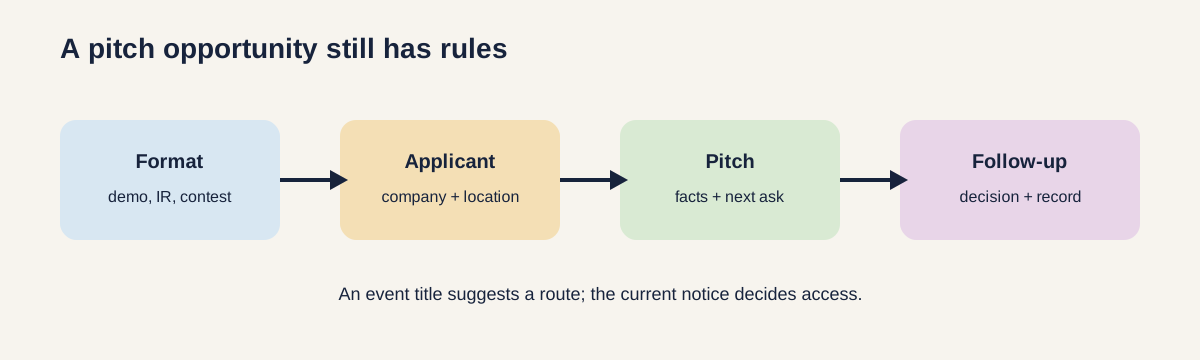
Start with the programmes directory, open the event's current notice, and keep the operator's answer with your company record. The event title is a clue; the notice is the rule.
Frequently asked questions
- Can a foreign-founded company join a Korean demo day?
- Possibly, but there is no universal rule. Check that event's applicant, location, language, document and selection requirements.
- Is every IR event an investment programme?
- No. An IR or investor-matching event may create meetings or pitching opportunities without promising an investment.
- What documents should a foreign-founded company prepare?
- Prepare the documents named by the notice, such as a company profile, registration record, deck or proof of the required location. Do not assume an English translation is accepted.
- What is the difference between a demo day and a startup contest?
- A demo day usually centres on presenting a product or company, while a contest adds an application and judging process. The current notice defines the format.
- Where can I find Korean startup events?
- Use K-Startup's event and network listings, then open the operator's current announcement for the actual application route and conditions.
Sources
- K-Startup - 행사ㆍ네트워크 programme listings — read 2026-09-21
- K-Startup - 모집중 사업공고 — read 2026-09-21
- MSS English site - startup policy and newsroom — read 2026-09-21
Everything above is the rule as published. See how it applies to your case.
Read next
- ProgramsIP support programmes for startups: where IP-R&D fits
- ProgramsGovTech and public-sector competitions in Korea: read the line before the prize
- ProgramsThe Korean startup 공고 season: why January to March feels heaviest
- ProgramsCorporate open innovation calls: what BOUNCE shows a startup should prepare