IP support programmes for startups: where IP-R&D fits
스타트업 IP 지원사업과 IP-R&D의 위치
Korean startup support includes public IP search, consulting and commercialisation programmes, but each notice sets its own applicant and delivery rules. This guide separates the IP work a founder can do now from the programme support that must be matched to a current notice.

On this page
IP support is not one product. A founder may need to find earlier rights, define an invention, decide whether a product problem has an IP angle, or plan how an existing right supports commercialisation. Those are different jobs and should not be collapsed into one phrase such as “IP-R&D.”
The public sources make that separation visible. KIPRIS is a search service for Korean and overseas intellectual-property information. K-Startup is a portal that lists support programmes and places IP Narae and IP Didimdol among mentoring, consulting and education offerings. MOIP is the government ministry site linked from the IP information service.
Begin with the question behind the IP request
Write the question before selecting a programme. Are you checking whether a similar right exists? Are you trying to turn an early idea into a protectable claim? Are you solving a product problem with a right you already hold? Or are you trying to connect an IP asset to a business plan?
Each question produces a different record. A search record contains keywords, classifications, dates and results. A consulting brief describes the technical or product issue. A business plan explains the customer, the proposed work and the expected use of the result. Keeping them separate prevents a search result from being described as legal clearance.
KIPRIS exposes separate search areas for patents and utility models, designs, trademarks, trials and other documents. That menu is useful because a startup name, product shape and technical mechanism may belong to different search tasks. A single keyword search is rarely a complete review.
The KIPRIS site also provides search help and technical-search tools. Its own notice says the technical-search insight feature is a reference service and that information may differ from the actual technology and has no legal effect. That qualification belongs in a founder's notes whenever the tool is used to frame a business decision.
What IP-R&D can mean in an application
In startup support, IP-R&D can describe research and development informed by intellectual-property information. The phrase does not, by itself, identify a fixed benefit, eligibility test or award amount. The current notice must say what the programme supports and who may enter it.
Use the phrase narrowly in a plan. Explain the technical question, the relevant search or consulting output, and the decision that the work will inform. A good plan can say that the founder will compare prior disclosures, refine a design, or test a route to commercialisation. It should not say that a search proves freedom to operate unless a qualified source actually provides that conclusion.
| IP work | Useful output for a startup file | Boundary to state |
|---|---|---|
| Landscape or prior-art search | Search terms, classifications, records and questions | A search is not a legal opinion |
| Idea-stage consulting | A defined technical issue and possible protection route | A programme may limit eligible applicants |
| Product or service problem solving | A documented change connected to an IP asset | A programme does not guarantee market success |
| Commercialisation planning | A link between the asset, customer and execution plan | The notice controls eligible costs and outputs |
| Monitoring and renewal work | Dates, owners and next actions | A public listing is not a personal deadline |
The table is a drafting tool, not a universal programme map. K-Startup's listing describes IP Didimdol as support from the early idea stage through patent consulting and rights acquisition. The same listing describes IP Narae as professional IP consulting intended to strengthen a startup's IP capability and market competitiveness. Those descriptions tell you the broad purpose, not every condition in a specific recruitment notice.
Search first, then read the notice
KIPRIS can help you form an evidence file before applying. Record the search date, the exact query, the search type, any classification used and the records that changed your next question. Save the page or identifier that lets another person repeat the search.
Do not hide an unhelpful result. A crowded field may change the product design. A similar trademark may change the name. A technical document may suggest a different experiment. The application becomes more credible when it explains the decision rather than claiming that every search confirmed the original idea.
After the search, return to K-Startup. Its official programme pages separate support lines and list many notices. The IP listings appear in the mentoring, consulting and education area, while other IP-related work can appear under commercialisation or regional support. Search by the work you need, then open the current notice.
Check the notice's applicant definition, location or business-stage conditions, required documents, delivery period, selection method and submission route. If the page you fetched only gives a programme summary, do not invent the missing fields. Write “confirm against the current 공고.”
Make the IP record useful to a reviewer
A reviewer needs to see why the IP work belongs in this application. Start with the business problem. Name the product or service element involved. State what you searched or tested. Explain what the result changed. Then connect the next activity to the notice's stated support purpose.
Avoid three common shortcuts. “We have a patent” is incomplete without identifying what right or application the sentence refers to. “We have no competitors” is not a conclusion supplied by a search. “The programme will protect our idea” confuses a support activity with a guaranteed legal outcome.
For a foreign-founded company, keep the jurisdiction explicit. A search in Korean records answers a narrower question than a global search. A Korean trademark question is not answered by a foreign registry. If a notice requires a Korean applicant or a local condition, quote that field from the notice rather than translating a general programme description into eligibility.
Use KIPRIS identifiers and dates in the working file. Use the official notice URL in the application ledger. Keep a separate list of questions for a patent attorney or other qualified adviser. That division protects the application from overstating what a public search can establish.
Turn support into a work plan
The work plan should have a beginning, a decision point and an output. For example, the first activity may define the search question and collect relevant records. The next may compare the findings with the product design. The final activity may produce a revised design brief, an application decision or a commercialisation experiment, depending on what the notice supports.
Do not assign a result that the source does not promise. A public listing can say that a programme offers consulting or supports IP capability. It cannot prove that every participant will receive a patent, investment, customer or selection result.
The same evidence chain works for a support application and a founder's internal plan. Record what was known before the work, what the support is intended to examine, and what will count as a useful output. That makes the IP section readable even when the current notice changes.
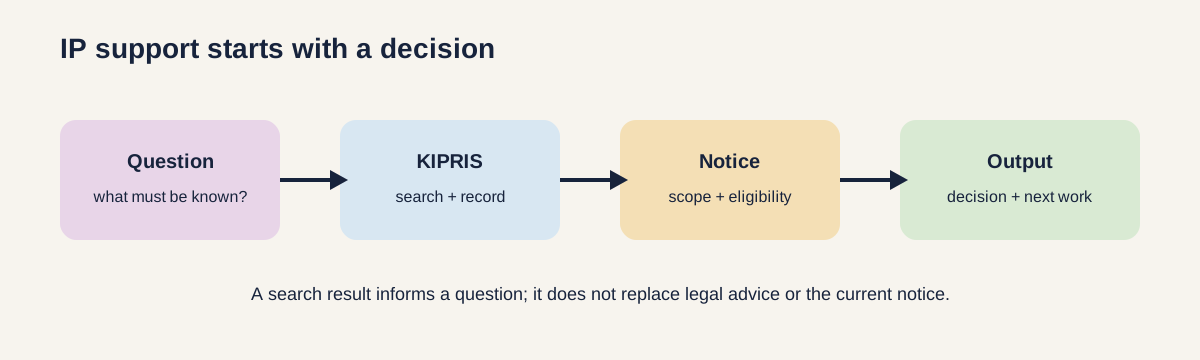
For the next step, use the programmes directory to locate a current notice. Keep KIPRIS as the search record and the notice as the eligibility record; neither replaces the other.
Frequently asked questions
- What is KIPRIS used for?
- KIPRIS provides searches for patents, utility models, designs, trademarks, trials and other intellectual-property information.
- What are IP Narae and IP Didimdol?
- K-Startup lists them among mentoring, consulting and education offerings, with descriptions covering IP consulting and early idea-stage patent support.
- Does a KIPRIS search prove freedom to operate?
- No. A search is a research record and may generate questions for qualified advice. It is not automatically a legal opinion.
- What should an IP-R&D application explain?
- State the technical or product question, the search or consulting work, the decision it will inform and the output that matches the current notice.
- Where do I find eligibility and deadlines?
- Open the current K-Startup recruitment notice and its attachments. A programme summary does not replace those documents.
Sources
- K-Startup - mentoring, consulting and education programme listings — read 2026-09-21
- KIPRIS intellectual-property search service — read 2026-09-21
- Ministry of Intellectual Property — read 2026-09-21
Everything above is the rule as published. See how it applies to your case.
Read next
- ProgramsGovTech and public-sector competitions in Korea: read the line before the prize
- ProgramsThe Korean startup 공고 season: why January to March feels heaviest
- ProgramsCorporate open innovation calls: what BOUNCE shows a startup should prepare
- ProgramsTokyo PMF and GTM programmes: how to read an overseas expansion line